

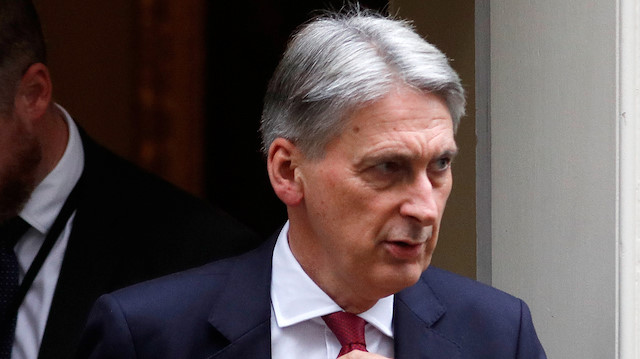
British Finance Minister Philip Hammond
British finance minister Philip Hammond said an end to his spending squeeze depended on the country getting a Brexit deal and he warned he would have to drop plans to boost public services without one.
Hammond, who is due to announce an annual budget plan on Monday, said the government would be able to show voters that "their hard work has paid off" if Britain achieves a smooth exit from the European Union in five months' time.
Hammond has angered many Conservative Party lawmakers by arguing Britain should remain close to the EU.
The British pound laboured near seven-week lows against the dollar on Friday and three-week lows versus the euro, as doubt grows about whether the UK and the European Union can clinch a Brexit deal.Bloomberg, citing people familiar with the matter, reported on Friday that Brexit talks were on hold because Prime Minister Theresa May's cabinet was not close enough to agreement on how to proceed for the negotiations to restart.The report sent sterling to a day's low of $1.2805 before the pound recovered to trade flat at $1.2820. That leaves the pound close to seven-week lows hit on Thursday of $1.2795.The British currency was largely unchanged versus the euro, at 88.76 pence per euro, after earlier weakening to a three-week low.Asian stocks hit 20-month lows, S&P futures slide as investors flee risk"GBP remains in its usual state of flummox as the Brexit impasse continues, with politics at home the biggest stumbling block. Until this is resolved, we expect GBP/USD to trade below $1.30," said Viraj Patel, a currencies analyst at ING.With Brexit dominating the news agenda, Britain's economic fortunes have taken a backseat.Next week, the Bank of England is expected to leave interest rates unchanged and stress that while there are some signs of rising wage and price pressures, it will not be ready to tighten policy until there is clarity on Brexit."Fears of a no-deal Brexit and the wider risk-off market move have seen the (UK interest rate) curve flatten. Next week's BoE policy statement is likely to restate the need for higher rates and we see scope for a steeper front end to money markets," Societe Generale analysts said in a note to clients. 
Sterling stuck at seven-week lows as Brexit uncertainty mounts
Asian shares skidded to 20-month lows, S&P futures fell sharply and China's yuan weakened at the end of a turbulent week for financial markets on Friday, as anxiety over corporate profits added to lingering fears about global trade and economic growth.The gloom enveloping Asia was at odds with a bounce on Wall Street overnight, highlighting fragile investor confidence, as shares of tech titans Amazon.com Inc and Alphabet Inc fell sharply after the closing bell on disappointing earnings.In Friday's Asian session, S&P E-mini futures slumped 0.88 percent, setting up a potentially rough session for U.S. markets which had crumbled on Wednesday on concerns about earnings and sent global equities into a tailspin.MSCI's broadest index of Asia-Pacific shares outside Japan dropped 1.04 percent, erasing tiny gains made in the opening hour and hitting its lowest level since February 2017. Not helping was a slide in the Chinese yuan past a key level, refocusing market attention on slowing growth in the world's second-biggest economy.Shares in Europe are seen following Asia down, with London's FTSE expected to open 0.9 percent lower, Germany's DAX off 1 percent and France's CAC 40 down 1.2 percent, according to David Madden, market analyst at CMC Markets UK."There's no question that the weight of sentiment has been building," said James McGlew, executive director of corporate stockbroking at Argonaut in Brisbane, highlighting in particular rising geopolitical tensions including Brexit, and "internal financial tension" in China."All of these things added up to the volatility hitting a boiling point... and I don't' think at the moment people should be trying to catch the falling knife," he said.The MSCI Asia index has been bruised by a heavy sell-off in the past several days, and is on course for its fifth weekly loss - its longest such streak since 2015. It has fallen more than 4 percent this week.Chinese shares were pulled lower amid the generally dismal mood, and as the yuan fell past the psychologically important 6.96 level to the dollar, touching its lowest levels against the greenback since December 2016.The blue-chip index was down 0.9 percent and the Shanghai Composite was 0.51 percent lower in afternoon trade.Chinese shares have been hit by volatility this week amid a string of official announcements and measures aimed at supporting the markets following a recent plunge. The heavy sell-off has raised concerns about risks posed by about $620 billion worth of shares pledged for loans.In Hong Kong, the Hang Seng index was 1.05 percent lower, with tech shares dropping 2.94 percent.Tech firms also fell in South Korea, where the broader market slid 1.8 percent. The Kospi had earlier touched its lowest level since December 2016.In Australia, shares ended flat at the end of a see-saw day. Japan's Nikkei stock index closed 0.4 percent lower after a volatile session, ending the week down 5.98 percent.Financial markets have been whipsawed in recent sessions on concerns over global growth as investors fretted over Sino-U.S. trade frictions, a mixed bag of U.S. corporate earnings, Federal Reserve rate hikes and Italian budget woes.A slowdown in China has been particularly worrying for policy makers and investors, hitting asset markets from stocks to currencies and commodities. Friday's fresh 22-month low for the yuan adds to the myriad of negative factors roiling investors.Analysts at Capital Economics sounded a cautious note, suggesting that the bounce in the S&P 500 index on Thursday was only temporary as investors worries about the economic outlook worsen."The first, and most important (worry) is that Fed tightening and fading fiscal stimulus will cause the US economy to take a turn for the worse ... The second is that China's economy will continue to struggle," the analysts said in a note to clients."As we have been arguing for a while now, these worries are likely to get worse over the next twelve months or so."Investors will get a chance to check the U.S. economic pulse later Friday when the government releases third-quarter GDP data.ANZ analysts highlighted weak U.S. core durable goods data as suggesting that "investment is not taking off, even with the apparent tailwind from tax cuts and USD repatriation.""This indicates that the boost to GDP growth from the fiscal stimulus could be fairly transitory," the analysts said.Draghi comments hit euroIn currency markets, the euro fell, extending weakness after European Central Bank President Mario Draghi said the bank's 2.6 trillion euro ($2.96 trillion) asset purchase program will end this year and interest rates could rise after next summer, despite fears about the monetary union's economic and political future.The single currency was 0.1 percent lower at $1.1363.The dollar was off 0.2 percent against the yen at 112.18 . The dollar index, which tracks the greenback against a basket of six major rivals, was 0.05 percent lower at 96.633.U.S. Treasury yields fell as equity markets plunged. The 10-year yield fell to 3.1018 percent compared with its U.S. close of 3.136 percent on Thursday.Oil prices gave up ground, heading for their third weekly loss after earlier rising on signals from Saudi Arabia's energy minister that there could be a need for intervention to reduce oil stockpiles.U.S. crude dipped 1.07 percent to $66.61 a barrel. Brent crude fell 0.83 percent to $76.25 per barrel.Spot gold ticked up 0.07 percent to $1,232.44 per ounce. ($1 = 0.8794 euros)
Asian stocks hit 20-month lows, S&P futures slide as investors flee risk
"If we don't get a deal ... we would need to take a different approach to the future of Britain's economy," Hammond said in an interview with Sky News broadcast on Sunday.
"We would need to look at a different strategy and frankly we'd need to have a new budget that set out a different strategy for the future."
Britain has cut its budget deficit sharply since the financial crisis 10 years ago but its debt levels remain high.
Most economists say Britain would suffer an economic shock if it leaves the EU with no deal.
Hammond said he was very confident that Britain would negotiate a Brexit deal that would minimise trade friction with the bloc but the government, and the Bank of England, would have to look at the situation and take action if there is no deal.
Britain’s budget announcement on Monday and a “Super Thursday” at the Bank of England would normally be key moments for the world’s fifth-biggest economy, but this time they are likely to be overshadowed by the drama of Brexit.Finance minister Philip Hammond and Bank of England Governor Mark Carney have little option but to sit on the fence as they wait to see whether a no-deal exit from the European Union, which they warn would harm the economy, can be averted.Both men have other business they want to get on with.Technical Brexit talks are ongoing, says UK PM's spokeswomanHammond is under pressure from Prime Minister Theresa May to end a decade of austerity to see off a rise in popularity of the opposition Labour Party.At the BoE — where an interest rate decision and economic forecasts are due to be announced on Thursday — Carney and his fellow policymakers want to progress with their plan to raise borrowing costs gradually over the coming years.That would allow the British central bank to follow the lead of other central banks, especially in the United States and Canada, which are dismantling 10 years of massive stimulus.Sterling stuck at seven-week lows as Brexit uncertainty mountsExpectations of another rate hike by the U.S. Federal Reserve in December are likely to grow if the monthly payrolls report on Nov. 2 shows further jobs growth and rising pay.In the euro zone, data on economic growth and inflation on Tuesday and Wednesday will show whether the recovery in the single currency area has kept pace.But in Britain, with Brexit just five months away, things are much less clear cut.BREXIT FOGThere is no sign of a Brexit breakthrough with Brussels, in large part because May's Conservative Party is riven over how close Britain should remain to the European Union after it leaves the bloc."The budget is likely to be something of a holding exercise until the Brexit fog clears and the MPC is likely to remain in a state of inertia until there is a bit more clarity on the state of the Brexit negotiations," Ruth Gregory, an economist with Capital Economics, a research firm, said.When he stands up in parliament on Monday afternoon, Hammond is expected to use his high-profile budget speech to try to cool the Conservative rebels by dangling the prospect of higher spending in the future, as long as a Brexit deal is done.Britain's economy has slowed since the 2016 referendum decision to leave the EU. But it has not suffered as badly as many forecasters expected, giving Hammond some fiscal wiggle room to fund higher health spending already promised by May.Hammond might get further help if Britain's budget forecasters scale back their estimates of future deficits, as they have suggested they will.But his ability to ramp up spending in other areas depends most on avoiding a new shock to the economy.A no-deal Brexit would slash economic growth to just 0.3 percent a year in 2019 and 2020 compared with 1.9 and 1.6 percent if there is a deal, the National Institute of Economic and Social Research estimated on Friday.Britain's budget deficit would stop falling and would rise under a no-deal scenario, according to its forecasts.Looking further ahead, Hammond has suggested he will need to raise taxes to help fund higher public spending.SIGNS OF PAY "NEW DAWN"But the prospect of getting controversial measures passed in parliament, where the Conservatives have no outright majority, is probably too daunting at a time of heightened Brexit tensions.For the BoE, the Brexit stakes are high too.It has begun raising interest rates from their crisis-era levels and its chief economist has said he sees signs of a "new dawn" for British workers' pay, long the missing link in the country's recovery from the financial crisis.But most economists think it will wait until May to raise rates again, assuming Britain leaves the EU with a deal."In any other situation, we suspect the Bank of England would be looking to increase interest rates pretty soon," ING economists said in a note to clients on Friday."But inevitably, Brexit remains policymakers' number one consideration, and given that there may still be some time before we know for sure whether a deal will be in place before the UK formally leaves the EU, there is a risk growth slows as businesses and consumers grow more cautious." 
UK budget and Bank of England take back seat to Brexit drama
The European Union is proposing to give the European Central Bank sweeping powers over foreign clearing houses in times of market stress, an EU document showed, as the bloc shows little sign of heeding U.S. calls to water down the plans.The bloc has proposed changing the ECB’s statute to give it a broad role in the oversight of EU and foreign clearing houses that handle large amounts of euro-denominated securities. That would include those in London, which will lie outside the EU in five months’ time.Now the current EU president Austria has proposed fleshing out the role with detailed powers, such as being able to force foreign clearing houses to “submit information, cooperate in the assessment of their resilience to adverse market conditions, and open overnight deposit accounts”, the document said.The EU wants the changes approved in time for Britain’s departure from the bloc next March. LCH, a unit of the London Stock Exchange (LSE.L), dominates clearing of euro-denominated interest rate swaps and will be outside the EU.Austria calls on EU to halt arms sales to Saudi ArabiaIn exceptional situations, the ECB could force a foreign clearing house to comply with temporary requirements on how much margin customers should post to back trades, the level of collateral, and how frequent intraday margins should be collected, tasks normally supervised by the home regulator.Financial lawyers say this would, for example, give the ECB power to stop a foreign clearing house raising margins on euro-denominated positions in times of market stress.The ECB has long been concerned that so much euro-denominated trade is already conducted outside the euro zone in London, and appears keen to bring this under its supervision after Brexit.Some policymakers had wanted to stop a clearing house from increasing margins during the euro zone debt crisis, saying this amplified stress in markets.The United States is unhappy about the EU plans.Christopher Giancarlo, chairman of the U.S. Commodity Futures Trading Commission which regulates the American derivatives market, has threatened retaliation against EU financial firms if the bloc does not water down what he sees as overly intrusive proposals affecting U.S. clearers such as CME and ICE. The European Commission has dismissed this as “blackmail” and a working group of EU member state representatives could give the proposals the green light next Tuesday. Member states would then thrash out a final text with the European Parliament, which has already backed similar proposals.
EU shows no sign of heeding US threat over derivatives clearing
Technical talks on Britain's departure from the European Union are ongoing and Brexit minister Dominic Raab will head to Brussels as soon as is necessary, Prime Minister Theresa May's spokeswoman said on Friday."Technical talks have carried on between officials this week as has been the case all the way through negotiations, but I don't have a specific time or framework date as to when the minister will return, but as soon as is necessary," she told reporters. Sterling stuck at seven-week lows as Brexit uncertainty mountsUK Labour presses PM May to deliver 'end of austerity' claim
Technical Brexit talks are ongoing, says UK PM's spokeswoman