

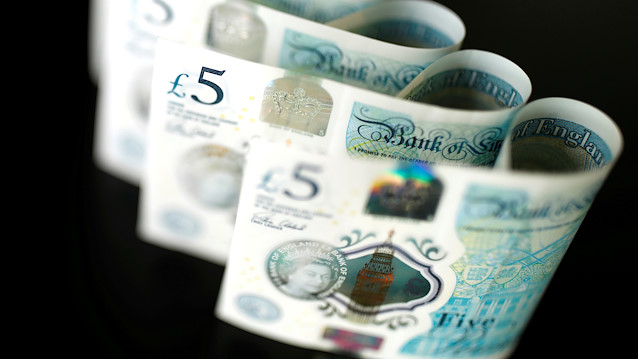
File photo
The British pound laboured near seven-week lows against the dollar on Friday and three-week lows versus the euro, as doubt grows about whether the UK and the European Union can clinch a Brexit deal.
Bloomberg, citing people familiar with the matter, reported on Friday that Brexit talks were on hold because Prime Minister Theresa May's cabinet was not close enough to agreement on how to proceed for the negotiations to restart.
The report sent sterling to a day's low of $1.2805 before the pound recovered to trade flat at $1.2820. That leaves the pound close to seven-week lows hit on Thursday of $1.2795.
The British currency was largely unchanged versus the euro, at 88.76 pence per euro, after earlier weakening to a three-week low.
Asian shares skidded to 20-month lows, S&P futures fell sharply and China's yuan weakened at the end of a turbulent week for financial markets on Friday, as anxiety over corporate profits added to lingering fears about global trade and economic growth.The gloom enveloping Asia was at odds with a bounce on Wall Street overnight, highlighting fragile investor confidence, as shares of tech titans Amazon.com Inc and Alphabet Inc fell sharply after the closing bell on disappointing earnings.In Friday's Asian session, S&P E-mini futures slumped 0.88 percent, setting up a potentially rough session for U.S. markets which had crumbled on Wednesday on concerns about earnings and sent global equities into a tailspin.MSCI's broadest index of Asia-Pacific shares outside Japan dropped 1.04 percent, erasing tiny gains made in the opening hour and hitting its lowest level since February 2017. Not helping was a slide in the Chinese yuan past a key level, refocusing market attention on slowing growth in the world's second-biggest economy.Shares in Europe are seen following Asia down, with London's FTSE expected to open 0.9 percent lower, Germany's DAX off 1 percent and France's CAC 40 down 1.2 percent, according to David Madden, market analyst at CMC Markets UK."There's no question that the weight of sentiment has been building," said James McGlew, executive director of corporate stockbroking at Argonaut in Brisbane, highlighting in particular rising geopolitical tensions including Brexit, and "internal financial tension" in China."All of these things added up to the volatility hitting a boiling point... and I don't' think at the moment people should be trying to catch the falling knife," he said.The MSCI Asia index has been bruised by a heavy sell-off in the past several days, and is on course for its fifth weekly loss - its longest such streak since 2015. It has fallen more than 4 percent this week.Chinese shares were pulled lower amid the generally dismal mood, and as the yuan fell past the psychologically important 6.96 level to the dollar, touching its lowest levels against the greenback since December 2016.The blue-chip index was down 0.9 percent and the Shanghai Composite was 0.51 percent lower in afternoon trade.Chinese shares have been hit by volatility this week amid a string of official announcements and measures aimed at supporting the markets following a recent plunge. The heavy sell-off has raised concerns about risks posed by about $620 billion worth of shares pledged for loans.In Hong Kong, the Hang Seng index was 1.05 percent lower, with tech shares dropping 2.94 percent.Tech firms also fell in South Korea, where the broader market slid 1.8 percent. The Kospi had earlier touched its lowest level since December 2016.In Australia, shares ended flat at the end of a see-saw day. Japan's Nikkei stock index closed 0.4 percent lower after a volatile session, ending the week down 5.98 percent.Financial markets have been whipsawed in recent sessions on concerns over global growth as investors fretted over Sino-U.S. trade frictions, a mixed bag of U.S. corporate earnings, Federal Reserve rate hikes and Italian budget woes.A slowdown in China has been particularly worrying for policy makers and investors, hitting asset markets from stocks to currencies and commodities. Friday's fresh 22-month low for the yuan adds to the myriad of negative factors roiling investors.Analysts at Capital Economics sounded a cautious note, suggesting that the bounce in the S&P 500 index on Thursday was only temporary as investors worries about the economic outlook worsen."The first, and most important (worry) is that Fed tightening and fading fiscal stimulus will cause the US economy to take a turn for the worse ... The second is that China's economy will continue to struggle," the analysts said in a note to clients."As we have been arguing for a while now, these worries are likely to get worse over the next twelve months or so."Investors will get a chance to check the U.S. economic pulse later Friday when the government releases third-quarter GDP data.ANZ analysts highlighted weak U.S. core durable goods data as suggesting that "investment is not taking off, even with the apparent tailwind from tax cuts and USD repatriation.""This indicates that the boost to GDP growth from the fiscal stimulus could be fairly transitory," the analysts said.Draghi comments hit euroIn currency markets, the euro fell, extending weakness after European Central Bank President Mario Draghi said the bank's 2.6 trillion euro ($2.96 trillion) asset purchase program will end this year and interest rates could rise after next summer, despite fears about the monetary union's economic and political future.The single currency was 0.1 percent lower at $1.1363.The dollar was off 0.2 percent against the yen at 112.18 . The dollar index, which tracks the greenback against a basket of six major rivals, was 0.05 percent lower at 96.633.U.S. Treasury yields fell as equity markets plunged. The 10-year yield fell to 3.1018 percent compared with its U.S. close of 3.136 percent on Thursday.Oil prices gave up ground, heading for their third weekly loss after earlier rising on signals from Saudi Arabia's energy minister that there could be a need for intervention to reduce oil stockpiles.U.S. crude dipped 1.07 percent to $66.61 a barrel. Brent crude fell 0.83 percent to $76.25 per barrel.Spot gold ticked up 0.07 percent to $1,232.44 per ounce. ($1 = 0.8794 euros)
Asian stocks hit 20-month lows, S&P futures slide as investors flee risk
"GBP remains in its usual state of flummox as the Brexit impasse continues, with politics at home the biggest stumbling block. Until this is resolved, we expect GBP/USD to trade below $1.30," said Viraj Patel, a currencies analyst at ING.
With Brexit dominating the news agenda, Britain's economic fortunes have taken a backseat.
Next week, the Bank of England is expected to leave interest rates unchanged and stress that while there are some signs of rising wage and price pressures, it will not be ready to tighten policy until there is clarity on Brexit.
"Fears of a no-deal Brexit and the wider risk-off market move have seen the (UK interest rate) curve flatten. Next week's BoE policy statement is likely to restate the need for higher rates and we see scope for a steeper front end to money markets," Societe Generale analysts said in a note to clients.