

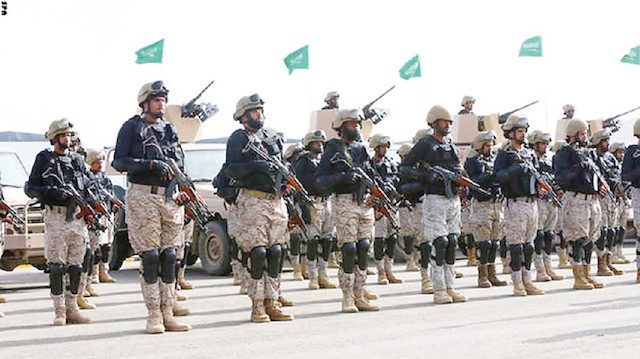
File photo
The United Arab Emirates (UAE) and Saudi Arabia allegedly dispatched troops to Syria’s northeast, which is occupied by the PKK/YPG terror group. The soldiers are purportedly stationed with the U.S.-led coalition.
Although there is no estimate of how many troops were posted from the two Gulf countries, the claim comes at a time when Turkey could launch an operation targeting the east of the Euphrates at any given moment.
President Recep Tayyip Erdoğan said in late October that Turkey had completed preparations for operations on the eastern side of Euphrates River.
“We will trample on terror groups with more effective operations. We have finished all our preparations and plans regarding the issue," Erdoğan said.
Saudi King Salman bin Abdulaziz on Monday reiterated support for reaching political solutions to the conflicts in Yemen and Syria.In a speech to the Shura Council, a top advisory body, the monarch said the oil-rich kingdom would continue its efforts to resolve regional crises.“Our stand with Yemen was not an option but a duty to support the Yemeni people against the Iran-backed putschist militias,” he said.Yemen has remained wracked by violence since 2014, when Shia Houthi rebels overran much of the country, including capital Sanaa.The conflict escalated in 2015 when Saudi Arabia and its Sunni-Arab allies -- who accuse the Houthis of serving as proxies for Shia Iran -- launched a massive air campaign in Yemen aimed at rolling back Houthi gains.The Saudi king also called for reaching a political solution that help “cruise Syria out of its crisis, push away terrorist groups and allow the repatriation of Syrian refugees.”The king’s speech was his first public comments since the murder of Saudi journalist Jamal Khashoggi last month.Khashoggi, a frequent contributor to The Washington Post, was killed shortly after he entered the Saudi Consulate in Istanbul Oct. 2.Saudi Arabia had offered shifting explanations for Khashoggi's disappearance before suggesting he was killed during a botched rendition operation by rogue agents.So far, 21 people, including security officers, have been arrested in Saudi Arabia in connection with the murder.Top security official shot dead in Yemen’s AdenTurkey says Khashoggi killers may have taken body parts out of countrySaudi Arabia defies US pressure to end Qatar row after Khashoggi killingSaudi account of Khashoggi killing 'unsatisfying'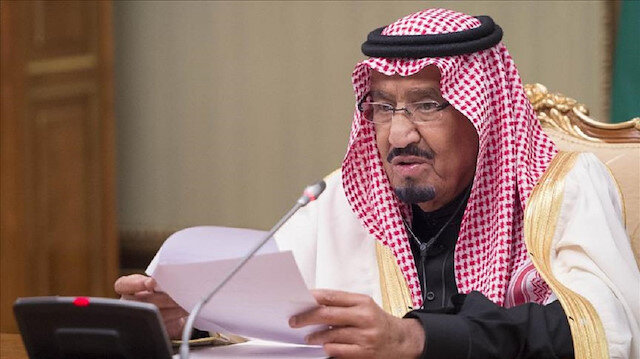
Saudi king backs political solutions in Yemen, Syria
Saudi FM confirms Arab force
Saudi Foreign Minister Adel al-Jubeir confirmed in April a report published in the Wall Street Journal saying that U.S. troops in Syria could be replaced by an Arab force. Jubeir said Riyadh was in talks with Washington about such a force.
“We are in discussion with the U.S. and have been since the beginning of the Syrian crisis about sending forces into Syria,” Jubeir said on Apr. 17.
“There are discussions regarding ... what kind of force needs to remain in eastern Syria and where that force would come from, and those discussions are ongoing,” he added.
In August, Riyadh pledged $100 million to northeastern Syria, which is occupied by the Kurdistan workers’ Party (PKK) to rebuild and stabilize the area.
The Turkish Armed Forces (TAF) and opposition members from the Syrian National Army imposed a curfew on Sunday to conduct a “peace operation” in order to capture suspects who are in cooperation with Kurdistan Workers' Party (PKK) terrorists and the Assad regime in Syria's northwestern Afrin.The operation was carried out by three armed divisions of the National Army and a total of 2,000 Free Syrian Army (FSA) members, targeting the headquarters of the groups and terrorists who harass civilians and seek to harm peace in the region.It started early in the morning in Afrin’s city center, Jindares and Shaykh al-Hadid, and particularly targeted the Ahrar al-Sharqiya and Shuhadaa Hasakah groups.Ahrar al-Sharqiya consists of members mostly from Syria’s Deir ez-Zor Governorate, and Shuhadaa Hasakah is comprised of people from the capital city of al-Hasakah Governorate, located in the far northeast of Syria.Syria regime, Iran-backed groups propagating Shia faithA great deal of weapons and ammunitions were seized and hundreds arrested during the operation.Colonel Haitham Afisi, head of the National Army, divulged the details of the peace operation to Yeni Şafak daily, and said that preparations started three days ago, aiming to capture those who backed the PKK’s terror activities and tried to provide intelligence to the Assad regime to undermine and tarnish Turkey’s Operation Olive Branch.On Jan. 20, Turkey launched Operation Olive Branch in coordination with FSA troops to clear PKK/YPG and Daesh terrorists from Afrin amid growing threats from the region.The PKK is listed as a terrorist organization by Turkey, the European Union and the United States. The PKK has been conducting armed violence in the southeastern part of Turkey since 1984. More than 40,000 people, mostly civilians, have been killed in the three-decade long conflict.Video: Members of criminal gang surrender to TAF, FSA in Syria’s Afrin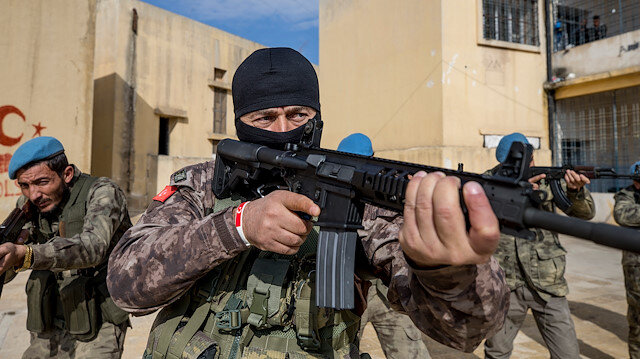
Turkey and Syrian opposition conduct ‘peace op’ in Afrin
Cooperation with Assad
Recent developments indicate that Saudi Arabia and the UAE are leaning toward cooperating with the regime of Syrian President Bashar al-Assad, who has massacred millions of his own citizens.
Last week, the UAE said it was negotiating the reopening of its embassy in Damascus and restoring ties with Syria.
Pro-Syrian regime news outlet al-Masdar recently reported that Saudi Arabia and Syria were working through back channels with the UAE’s help to reach political conciliation.
The Kurdistan Workers’ Party (PKK) terror group has moved its drug cultivation and trafficking operation to Syria’s Manbij under U.S. protection, following the disruption of its illicit drug activities in northwestern Afrin after Turkey’s Operation Olive Branch cleared the area of PKK presence.The drug trade supplies PKK terrorists with $1.5 billion, making up its most important source of income, as the terror group is said to control 80 percent of Europe’s drug trafficking.Special protection for factoriesThe drugs are being cultivated and processed in fields and factories in PKK-controlled regions south of Manbij. The factories are said to enjoy a high level of protection from the terror group as the Manbij-cultivated drugs are smuggled worldwide through the southeastern route. An upcoming operation by Turkey in Manbij is expected to take out these factories as the PKK will be deprived of yet another drug smuggling route. Report lifts veil on Manbij drug tradeAs the U.S. continues to conduct joint patrols with the PKK, the terror group carries on committing crimes against humanity as it takes part in global drug smuggling activities. A special team that has been working for months on a report is set to shed light on the Manbij drug trade after closely monitoring terrorists involved in the city’s drug hierarchy. The report, which is set to be shared with intelligence services, will include the names and aliases of PKK terrorists involved in the drug trade, in addition to coordinators and photos of factories and drug shipments. It is expected to deal a great blow to the Manbij drug operations.Turkey’s mini drone neutralizes 18 PKK terroristsRussia, Turkey, Iran to hold Syria talks Nov. 28-29Cannabis was planted in PYD-occupied areas that included thousands of acres of land that provided the bulk of agriculture in pre-war in Syria.The PKK/YPG controls an area of about 53,000 square kilometers with a percentage of 28.6 of Syrian territory.Turkey’s Olive Branch deals blow to PKK’s drug activities in AfrinAfter seizing close to 120 hectares of arable lands between 2012- 2017, the PKK turned Afrin into the Middle East’s biggest drug cultivation and trading region, according to a previous report by Yeni Şafak daily.A report for earlier this year shed light on drug cultivation in PKK-occupied Raqqa. “After Operation Olive Branch, a number of drug traffickers fled to Tal Abyad and Hasakah, but the majority resettled in Raqqa. Dozens of businesses in the city’s industrial zone were turned into drug factories. Raqqa became the new center of drug cultivation and trafficking to Syria, Iraq, Lebanon, Iran, Turkey, and Gulf and European countries,” according to eyewitness accounts.The Turkish military cleared a 2,500 square-mile (4,000 square-kilometer) area from Daesh and YPG/PKK terrorists as part of the Euphrates Shield and Olive Branch operations in Syria.The PKK is listed as a terrorist organization by Turkey, the European Union and the United States. The PKK has been conducting armed violence in the southeastern part of Turkey since 1984. More than 40,000 people, mostly civilians, have been killed in the three-decade long conflict.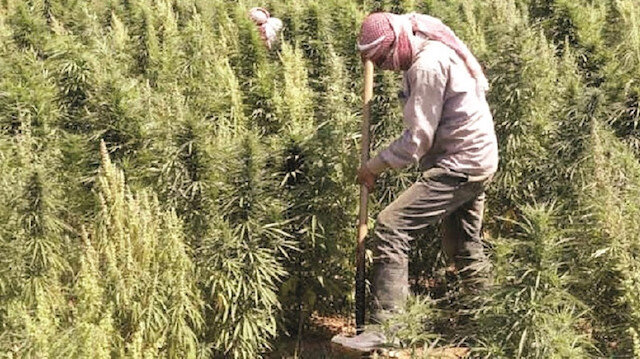
US-backed PKK moves drug cultivation industry to Syria’s Manbij
Furthermore, there are claims that the UAE seeks to include the Syrian regime in the Arab force.
Syria has been locked in a vicious civil war since early 2011 when the Assad regime cracked down on pro-democracy protests with unexpected ferocity.
Since then, hundreds of thousands of people have been killed and more than 10 million others were displaced, according to UN officials.
The next round of Syria peace talks in the Astana format will take place in the Kazakh capital on Nov. 28-29, Kazakhstan's foreign minister announced on Monday.Speaking to reporters, Kayrat Abdrahmanov said the guarantor countries Turkey, Russia, and Iran have agreed on the date of the 11th meeting on Syria in the Astana format.Rouhani says Iran to continue oil exports and resist US economic warIran remains hopeful that Europe can salvage nuclear dealAbdrahmanov said the meeting is planned to be attended by the guarantor countries, the Bashar al-Assad regime, and Syrian military opposition.He added that the UN and Jordan were also invited to the meeting as observers.The first meeting in the Astana format for reaching a cease-fire in Syria was held in January 2017.Nine meetings were held in Astana, while the 10th meeting was held in Sochi, Russia this July.FSA ready to fight PKK/YPG alongside Turkey in east of EuphratesRussian ambassador to Finland summoned over GPS disruptionFour PKK/KCK suspects arrested across Turkey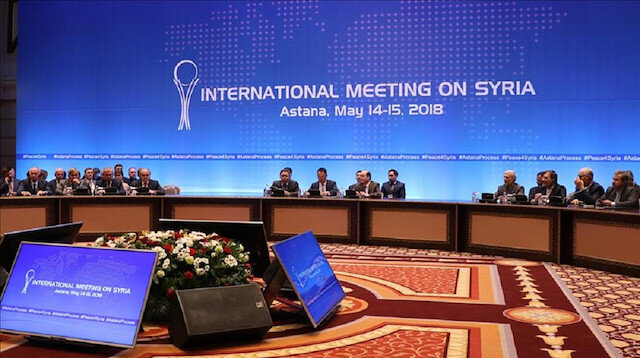
Eleventh Astana talks for Syria to be held on Nov. 28-29
Eighteen Kurdistan Workers’ Party (PKK) terrorists, including three senior operatives, responsible for the death of 103 Turkish troops were neutralized in a Turkish Armed Forces (TAF) operation conducted by a miniature drone that lasted 504 hours (21 days).The operation dubbed “Dagger 2” that was launched on Oct. 11 in southeast Turkey utilized the “wasp” drone.The digital material captured from terrorists neutralized in Gabar was deciphered, as well as the coded messages sent using radios.The PKK terrorists’ location was found using photographs published in an interview they gave, and their coordinates were found.Turkey neutralizes 73 wanted PKK terrorists in 2018Following this, the silent “wasp” drone was dispatched, and on Nov. 2, the terrorists were killed in groups.The wasp drone was also used during Turkey's Operation Olive Branch in Syria's Afrin to monitor PKK terrorists. The PKK is listed as a terrorist organization by Turkey, the European Union and the United States. The PKK has been conducting armed violence in the southeastern part of Turkey since 1984. More than 40,000 people, mostly civilians, have been killed in the three-decade long conflict.Video: TAF uses ‘wasp’ drone to monitor PKK terrorists in Afrin op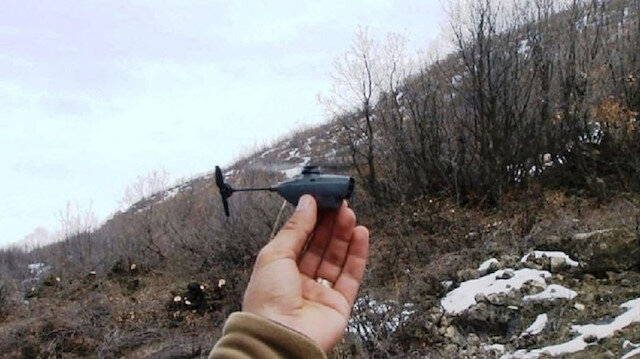
Turkey’s mini drone neutralizes 18 PKK terrorists