

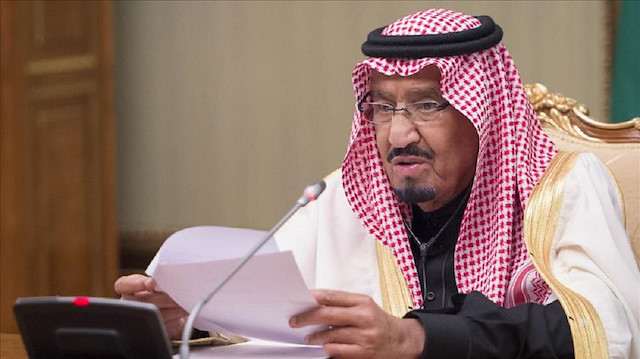
Saudi King Salman bin Abdulaziz
Saudi King Salman bin Abdulaziz on Monday reiterated support for reaching political solutions to the conflicts in Yemen and Syria.
In a speech to the Shura Council, a top advisory body, the monarch said the oil-rich kingdom would continue its efforts to resolve regional crises.
“Our stand with Yemen was not an option but a duty to support the Yemeni people against the Iran-backed putschist militias,” he said.
Yemen has remained wracked by violence since 2014, when Shia Houthi rebels overran much of the country, including capital Sanaa.
The conflict escalated in 2015 when Saudi Arabia and its Sunni-Arab allies -- who accuse the Houthis of serving as proxies for Shia Iran -- launched a massive air campaign in Yemen aimed at rolling back Houthi gains.
The Saudi king also called for reaching a political solution that help “cruise Syria out of its crisis, push away terrorist groups and allow the repatriation of Syrian refugees.”
The king’s speech was his first public comments since the murder of Saudi journalist Jamal Khashoggi last month.
Khashoggi, a frequent contributor to The Washington Post, was killed shortly after he entered the Saudi Consulate in Istanbul Oct. 2.
Saudi Arabia had offered shifting explanations for Khashoggi's disappearance before suggesting he was killed during a botched rendition operation by rogue agents.
So far, 21 people, including security officers, have been arrested in Saudi Arabia in connection with the murder.
A senior security official was killed in a drive-by shooting in Yemen’s southern city of Aden on Sunday, according to a local resident.Three gunmen opened fire on Brigadier-General Fahd Gharama as he left his home in the city, killing him on the spot, the resident said on condition of anonymity due to restrictions on speaking to media.Seven people, including six female students, were injured in the attack.No group has yet claimed responsibility for the attack.Gharama is the deputy commander of the UAE-backed Security Belt forces in Aden.Aden serves as the temporary capital of the Yemeni government, which fled Yemen in 2015 after Shia Houthi rebels overran much of the country, including capital Sanaa a year earlier.Since mid-2015, Aden has seen bombings and assassination incidents targeting security and government headquarters, preachers, mosque imams, along with army and security officers.Yemen gov’t says to swap prisoners with Houthi rebelsUN: Yemeni parties to attend peace talks in SwedenUS senators seek clampdown on Saudis over Yemen, Khashoggi murderClashes stop in Yemeni port citySaudi-led coalition orders halt in assault on Yemen's Hodeidah
Top security official shot dead in Yemen’s Aden
The body of slain Saudi journalist Jamal Khashoggi may have been smuggled out in suitcases, said Turkey’s Defense Minister Hulusi Akar on Sunday.Khashoggi, a frequent contributor to The Washington Post, was killed Oct. 2 inside the Saudi consulate in Istanbul.Speaking during the International Security Forum in Canada, Hulusi outlined the possible scenarios for culprits to smuggle the body after the gruesome murder in Istanbul.“You can talk about possibilities regarding this subject. One is that they left Turkey three to four hours after the murder. They may have smuggled Khashoggi’s dismembered body out in suitcases without any problems due to their diplomatic immunity,” said Akar in Halifax.Khashoggi’s body injected with clotting agent to ‘leave no blood trace’CIA believes Saudi crown prince ordered journalist's killingAccording to reports, Turkish investigators found traces of "hydrofluoric acid and other chemicals" inside a well at the Saudi consul general's home in Istanbul, suggesting Khashoggi’s body was dissolved in acid and other chemicals.After weeks of denying any involvement in the crime, Saudi Arabia later admitted that Khashoggi had been killed inside the consulate but claimed the Saudi royal family had no prior knowledge of any plot to murder the journalist.On Thursday, Saudi Arabia’s chief prosecutor’s office announced it had charged 11 out of 21 suspects in relation to the murder, seeking the death penalty for five of the suspects.The CIA believes Saudi Crown Prince Mohammed bin Salman ordered the killing of journalist Jamal Khashoggi, sources familiar with the matter said on Friday, complicating President Donald Trump's efforts to preserve ties with a key U.S. ally.The sources said the CIA had briefed other parts of the U.S. government, including Congress, on its assessment, which contradicts Saudi government assertions that Prince Mohammed was not involved.
Turkey says Khashoggi killers may have taken body parts out of country
Saudi Arabia is defying U.S. calls to mend ties with Qatar despite signs that pressure to end another regional crisis, the Yemen war, has had an impact on Riyadh since the killing of a prominent journalist.Jamal Khashoggi's murder at the Saudi consulate in Istanbul on Oct. 2 caused a global outcry, opened Saudi Arabia to the possibility of sanctions and damaged the image of Crown Prince Mohammed bin Salman.Washington believes it has more influence over Riyadh as its ally tries to repair the damage to the kingdom's standing, and wants to use this leverage to end the Yemen war and rebuild Gulf unity against Iran, four sources familiar with the matter said.On one front, there is movement.In an apparent response to U.S. and British pressure for a ceasefire in Yemen by the end of this month, the Saudi-led coalition fighting Iran-aligned Houthi rebels halted an offensive on the main port city of Hodeidah on Thursday.Maintaining pressure on Riyadh, Washington imposed sanctions on 17 Saudi officials for their role in Khashoggi's killing later on Thursday, and U.S. senators introduced draft legislation which, if it became law, would suspend arms sales to Saudi Arabia over the journalist's death and the Yemen war.Saudi authorities did not respond to requests for comment. A U.S. State Department spokeswoman said Washington had been calling for a resolution throughout the Qatar and Yemen crises."We continue to engage on both of these issues with our partners in the region, including Saudi Arabia," the spokeswoman, Heather Nauert, said."Gulf unity is essential to our common interests of confronting Iran’s malign influence, countering terrorism, and ensuring a prosperous future for all of our Gulf partners."Qatar Rift Runs DeepThe United States sees Saudi Arabia as a crucial player in the efforts to build unity in the Gulf to contain Iran's influence in the Middle East, and Secretary of State Mike Pompeo visited Riyadh soon after Khashoggi's killing.But Washington sees the Yemen war as a destabilising factor in the region and wants an end to the conflict, which has killed more than 10,000 people and pushed Yemen to the brink of famine.Saudi Arabia and its ally, the United Arab Emirates, also now have reasons to exit the war as it has proved costly and reached stalemate.Since the death of Khashoggi, a Saudi national and U.S. resident who was critical of the Crown Prince, U.S. officials have also sought to sway Riyadh over its row with Qatar.Gulf unity, which Washington considers a bulwark against Iran, was shattered when Saudi Arabia, the UAE, Bahrain and Egypt severed trade and transport ties in June 2017, accusing Doha of supporting terrorism and Iran -- charges Doha denies."They are seizing the opportunity to try to end the Qatar dispute," a source with knowledge of U.S. policy said.Washington had wanted Gulf unity restored, to help contain Iran's influence in the region, before new sanctions went into force against Tehran over its nuclear programme on Nov. 4, two of the sources said.Western hopes that Riyadh might mend ties with Doha had been raised by a comment Prince Mohammed made on the strength of Qatar's economy at an investment forum on Oct. 25.Yemen gov’t says to swap prisoners with Houthi rebelsUN: Yemeni parties to attend peace talks in SwedenUS senators seek clampdown on Saudis over Yemen, Khashoggi murderClashes stop in Yemeni port cityBut diplomats and Gulf sources say they have seen no new ideas or concrete moves by Riyadh or its allies to end the row with tiny but wealthy Qatar."I don't see any change on Qatar. The crown prince's message was interpreted wrongly. He was sending a message to America ... 'Don't get worried about Qatar because you still have a strong economy in Qatar'," one Arab diplomat told Reuters.Each of the boycotting countries is an ally of Riyadh and has longstanding political and security differences with Qatar.A Gulf source said Prince Mohammed, known as MbS, would avoid any move that could be interpreted as weakness as he tries to recover from the diplomatic fallout over Khashoggi.Riyadh offered contradictory explanations for Khashoggi's disappearance before saying he was killed in a rogue operation. King Salman, who stepped in to defuse the crisis, has stood by his chosen heir, in whose hands he has concentrated power.Containing The CrisisKuwait said this month there was a "positive view to contain the Gulf crisis," and a source familiar with U.S. policy said diplomats were putting forward a plan on Qatar.But neither side seems ready to cede ground.Qatar's foreign ministry spokeswoman said last month that Khashoggi's death should serve as a "wake-up call". Qatar Airways Chief Executive Akbar al-Baker said on Tuesday he did not expect a thaw soon."I am very pessimistic about this. With the current (Saudi and UAE) leadership I don't see that there is any way that things may be loosened up," he told reporters. "The only face-saving way for them to get out is to apologise."Abu Dhabi says the dispute is not a priority, according to three diplomats and other sources familiar with Gulf policy."The Qataris are raising the price for resolving the crisis," said one Western diplomat. "The Emiratis are happy to keep the Qataris isolated."Qatar and UAE authorities did not respond to requests for comment.Riyadh and Abu Dhabi continue to reassure Washington that the dispute will not deter the formation of a proposed Middle East security alliance, which would include Doha, diplomats said.They said the UAE still strongly supports MbS against Iran and on his economic and social reforms, seen by Abu Dhabi as essential to replicating the UAE model of a business-friendly, tolerant Muslim society to combat extremism."The Emiratis see Saudi Arabia as the only choice to lead the region. They haven't blinked in their belief that Riyadh's reform plans are the best and only option," said Elizabeth Dickinson, Senior Analyst for the Arabian Peninsula at the International Crisis Group.Saudi account of Khashoggi killing 'unsatisfying'New York Times posts video on slain Saudi journalistUS not considering extradition of FETÖ leader: TrumpTrump says US to issue Khashoggi report early next week
Saudi Arabia defies US pressure to end Qatar row after Khashoggi killing
Remarks by the Saudi Chief Prosecutor’s Office on last month’s killing of journalist Jamal Khashoggi present an unbelievable scenario and leave some questions unanswered, an analysis of the statement shows.The Saudi office’s announcement on Thursday that it had charged 11 out of 21 suspects in relation to the Oct. 2 killing of Khashoggi at the Saudi Consulate in Istanbul was deficient and satisfied neither Turkey nor the international community.Turkey is "unsatisfied" by the prosecutors’ statements, said Turkish Foreign Minister Mevlut Cavusoglu.After Khashoggi disappeared, camera footage and other evidence revealed that a 15-member hit squad came from Saudi Arabia to Turkey on the same day as the killing.Now Saudi prosecutors have indicted 11 people over the killing, including five for whom it has recommended the death penalty for ordering and committing the killing.According to the Saudi account, a team of negotiators at the consulate was unable to persuade Khashoggi to return to the kingdom, so they used a poisonous injection to kill him, and then dismembered the body.Under this account, while the intelligence officers waited on the sidelines, the negotiators did the actual killing, which requires professional skills and tools, one of the points that makes it unbelievable.Apparently the Saudis are pushing this unlikely scenario in order to clear the name of Ahmed al-Assiri, a former Saudi deputy head of intelligence. If they succeed, it will strengthen the claim that the incident took place independently of Saudi Crown Prince Mohammed bin Salman.The fact that Khashoggi was killed within minutes after he entered the consulate is more proof that the hit squad did not take part in any negotiations.All this suggest that the members of the 15-member hit squad the Saudi prosecutors paint as negotiators were actually executioners.- Forensics expert on 15-member Saudi teamShaalan al-Shaalan, the Saudi deputy public prosecutor, said an operation was ordered to either persuade or force Khashoggi to return to Saudi Arabia.Al-Assiri, a former deputy head of intelligence, issued an order for Khashoggi’s return on Sept. 29, a day after the journalist first visited the consulate building to do paperwork for his marriage.It was al-Assiri who put together the 15-member team, according to the prosecutor. He contacted a forensics expert to join it for the purpose of removing evidence from the scene should force have to be used.The Saudi prosecutors are trying to present the killing as "a unilateral improvised decision" that was taken at the last minute, but bringing in this forensics expert from Riyadh indicates that the decision to kill Khashoggi was not taken in Istanbul but rather planned in Saudi Arabia.- Local collaboratorThe Saudi Prosecutors' Office said the 15-member team asked an unnamed local collaborator in Istanbul to find "a safe place" where they could keep Khashoggi if they had to take him to Saudi Arabia by force.The Saudi team, however, did not check on or try to explore this safe place.Moreover, the Saudi authorities failed to produce a sketch of the collaborator -- which they said they would share with the Turkey -- whom they even trusted to arrange a safe place if needed and to handle the remains of Khashoggi, which proves that the collaboration with Saudi authorities was not a sound one.- Trial in TurkeyTurkey does not believe that involvement by the Turkish side in any Saudi trial process will help, as the suspects are not likely to give free and truthful testimony before a Saudi security and intelligence team.Thus, Turkey wants the suspects to be tried in Turkey, where they committed the crime.The Saudi chief prosecutor wants to come to Turkey again to give a sketch of the collaborator and request the evidence that Turkey has.The names and duties of the 11 people accused by the Saudi side are not yet known.If the Saudi chief prosecutor visits Turkey again, the Saudi side is expected to tell Turkey about these 11 people.Khashoggi, a frequent contributor to The Washington Post, was killed on Oct. 2 inside the Saudi consulate in Istanbul.After weeks of denying any involvement in the crime, Saudi Arabia admitted that Khashoggi had been killed inside the consulate but claimed the Saudi royal family had no prior knowledge of any plot to murder the journalist.
Saudi account of Khashoggi killing 'unsatisfying'