

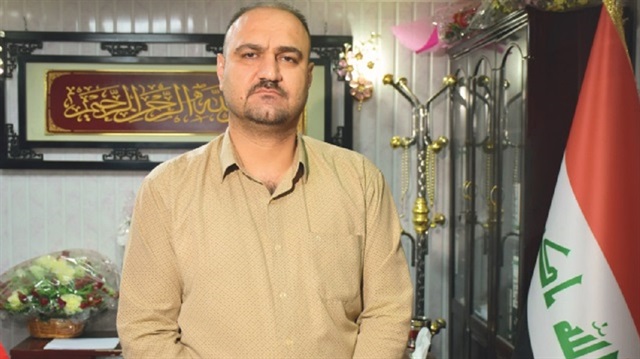
ITF Kirkuk Province Directorate Organization Officer Muhammet Saman
Iraqi Turkmens are worried about a possible Kurdistan Workers’ Party (PKK) attack in Iraq’s oil-rich Kirkuk as terrorists have started to return to the city and harass civilians.
Speaking exclusively to Yeni Şafak daily, Kirkuk Province Directorate Organization Officer Muhammet Saman of the Iraqi Turkmen Front (ITF) expressed his concern over the latest deployment of terrorists to the region and said, “PKK terrorists have begun to settle in some districts of Kirkuk once again. We are worried about PKK conducting a massacre against civilians.”

Terrorists rent houses near ITF buildings
Saman stressed that PKK terrorists were especially deployed near Turkmen regions where ITF Front buildings are located.
“PKK terrorists have begun to settle in the city by renting houses near buildings of the ITF,” he said.
He also underlined that PKK terrorists disguise themselves as Peshmerga members or security forces, who withdrew from the city about a year ago, to return to Kirkuk. They have also started harassing civilians in the region, according to reports.
A military initiative launched by Baghdad following the illegitimate Sept. 25 independence referendum enabled the swift recapture of the oil-rich city of Kirkuk from the Peshmerga as well as several other parts of Iraq that were disputed between Baghdad and the Kurdistan Regional Government (KRG).
Stressing the importance of purging all the terrorists in the country, “We don’t want to see any terror organization that threatens Iraq and its neighbors,” he added.
The U.S., taking advantage of the rising tensions in Syria’s Idlib and Iraq’s struggle to form a government, is now in preparation for a Kirkuk-centered bloody scenario in the region in alliance with the Peshmerga and Kurdistan Workers' Party (PKK) terrorists.With the aim of delivering Turkmen towns to the Peshmerga, PKK terrorists are being deployed to the region.Speaking exclusively to Yeni Şafak daily, Iraqi Turkmen Front (ITF) officer Mehmet Seman Ağaoğlu divulged details about the Washington administration’s recent occupational plans in cooperation with the Peshmerga in Iraq, while conflicts remain after the May 12 elections and wide-spread protests that have resulted in death and violence.“Barzani and Talabani are planning a bloody return to Kirkuk from which they were forced to withdraw on October 16,” he said.A military initiative launched by Baghdad following the illegitimate Sept. 25 independence referendum enabled the swift recapture of the oil-rich city of Kirkuk as well as several other parts of Iraq that were disputed between Baghdad and the Kurdistan Regional Government (KRG).The KRG obtained half of the oil they exported from the Bai Hassan and Havana oil fields northwest of Kirkuk.Iraqi forces took control of these oilfields northwest, after Kurdish Peshmerga fighters had retreated.The Barzani and Talabani administrations dispatched PKK terrorists to Kirkuk, Mosul, Hanakin and surrounding towns.Since July 9, Iraq’s Shia-majority central and southern provinces -- especially Basra -- have been rocked by protests to demand better public services, more job opportunities and an end of government corruption.Iraqi parliament elects second deputy speakerIraq parliament elects Sunni lawmaker Al-Halbousi as speaker, breaking deadlockTurkmen centers surrounded by terroristsPKK terrorists were especially deployed near to the Turkmen regions where the Turkmen Party and association centers are located.“PKK terrorists are being sent to the regions, notably to the Iraq Turkmen Front’s buildings, that are near to the headquarters of Turkmeneli TV and Turkmen Party. “We have identified more than 20 houses and work offices that are used by PKK terrorists as observations posts,” he said.“A ferocious massacre similar to the one conducted on July 14, 1959 is currently being prepared and the PKK will play active role in this process,” he added.At least 30 Turkmens were killed, and over 100 injured, in what is today known as the three-day long "Kirkuk Massacre," after a rally to celebrate the first anniversary of the 1958 revolution deteriorated.Iraqi parliament holds second session to elect Speaker
US seeks to deliver Kirkuk to Peshmerga in cooperation with PKK terrorists
“We don’t want to re-live those days”
Saman also stated that concerns had risen over Kurdish political parties asserting that Peshmerga forces had to return to Kirkuk for them to join the government being established in Baghdad.
“Among the Peshmerga and security forces, there will also be PKK terror elements. We are worried that the PKK might conduct a massacre against Turkmens.”
The PKK is listed as a terrorist organization by Turkey, the European Union and the United States. The PKK has been conducting armed violence in the southeastern part of Turkey since 1984. More than 40,000 people, mostly civilians, have been killed in the three-decade long conflict.
Reiterating that Turkmen leaders were killed in the last 15 years, especially in Kirkuk and Tuzhurmatu, “We don’t want to re-live those days. We want security in Kirkuk to be provided by the central Baghdad government alone,” Saman concluded.
Six Daesh terrorists were killed Monday in an airstrike carried out by Iraqi warplanes in the eastern Diyala province, according to a local police source.Police Captain Habib al-Shimmar told Anadolu Agency that the strikes were “based on intelligence information regarding the location of several Daesh militants -- including a group leader -- near Diyala’s northern city of Khanaqin”.According to al-Shimmar, Monday’s airstrike “completely destroyed” its target.Recent months have seen frequent attacks by Daesh terrorists on security personnel stationed in Iraq’s northern and eastern provinces.Last year, Iraqi officials declared that Daesh's military presence in the country had been all but destroyed following a three-year conflict with the army.Nevertheless, the group appears to have maintained a limited presence in certain parts of the country, against which Iraqi security forces continue to carry out frequent operations.h terrorist nabbed after police hunt in TurkeyDaesh terrorist nabbed after police hunt in Turkey
Six Daesh terrorists killed by airstrike in Iraq's Diyala
The Iraqi Defense Ministry on Saturday announced the start of a wide-ranging military operation aiming to clear desert regions in the provinces of Anbar (west), Saladin and Nineveh (north) of remaining Daesh elements.The operation declared Saturday is the first of its kind carried out in the desert in these three Iraqi provinces since the Iraqi government announced defeating the self-proclaimed Daesh terrorist organization late last year.Units from the Iraqi army-linked Al-Jazeera and the Badia Operations Command (JBOC), as well as the pro-government Shia Al-Hashd al-Shaabi forces began combing the desert area, Brig. Gen. Yahya Rasool, Iraqi military spokesman said in a statement Saturday.The operation, according to Rasool, has been launched from seven directions and is backed by both the Iraqi Air Force and the U.S.-led International Aliance’s fighter jets.Last December, officials in Baghdad declared that Daesh's military presence in Iraq had been all but dismantled following operations backed by the U.S.-led International Alliance.However, from time to time, Iraqi officials announce operations against Daesh-affiliated "sleeper cells" in certain parts of the country.Turkish police discover link between PKK, Daesh terror groups
First military op in Iraqi desert launched
The U.S. has accelerated efforts to gather informants in Syria’s north and east. Ahmad Jaber, a former top ranking Syrian intelligence official, spoke exclusively to Yeni Şafak daily, noting that in the past two years, over 3,000 informants were given duties in al-Hasaka, Raqqa, Deir ez-Zor, Manbij, Kobani and Tel Abyad.Jaber said that the U.S. uses aid organizations and churches to conduct these activities, and that CIA officials who travel to the region as health officials, education volunteers, city planners, religious officials and so forth are accompanied by over 70 Mossad agents.Neutralized on the border“Over 10 Western agents who came to the region with the aim of infiltrating Turkey were killed in the Turkish army’s latest bombardment of the Qandil area and border. They attribute importance to Afrin, Idlib, Jarabulus, al-Bab and Azaz. Agents are placed among civilians who flee from the PKK. Furthermore, individuals and families against the opposition are identified by Assad’s intelligence and included in this network. They conduct these activities under the guise of being ‘volunteers’ and ‘reporters.’ All the attacks carried out by the PKK-U.S. in Idlib, Afrin and the Euphrates Shield area are conducted as a result of the information and logistical support provided by these informants,” Jaber said.Approximately 10,000 agents in Syria, Iraq“The U.S. and Israel are leaders in efforts to gather informants in the region. France, Denmark, Britain, Canada and the Netherlands are also active. Many of the Western foreign fighters brought to the region to allegedly fight against Daesh were actually intelligence members of foreign countries. They formed certain connections on the field and many still have not cut these ties. Among these informants, over 200 are Westerners who have wed local women. Regardless of various periodical changes, there are approximately 10,000 agents in Syria and Iraq,” Jaber added.Churches and aid institutions used as intelligence centersOsama Muslim, a Kobani local who spoke to Yeni Şafak, said PKK controlled areas al-Hasaka, Tel Abyad, Rasool Ayn, Qamishli and Manbij were brimming with foreign agents. Muslim said those employed by Western education institutions and churches in these areas were all intelligence officials. Truckloads of US weapons continue to arm PKK terrorists in SyriaUS bolsters support to PKK terror group in SyriaTurkey to continue anti-terror activities in Syria
Iraq, Syria swarming with approximately 10,000 foreign agents