

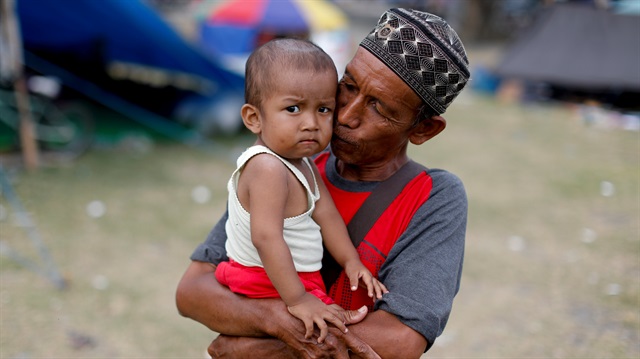
Forjan carries his grandson Rafa outside his tent at a camp for displaced victims of the earthquake and tsunami in Palu, Central Sulawesi, Indonesia, October 9, 2018.
The charity group of Turkey's top religious authority was the first to deliver aid to the disaster-hit people of Lompio, a small region in Indonesia.
Abdullah Ucak, a humanitarian aid expert at Turkiye Diyanet Foundation (TDV), told Anadolu Agency that the foundation was the first to reach the area located in the Donggala Regency.
Ucak said a month's worth of aid supplies consisting of basic needs, including food and personal care items, was distributed to some 1,040 families.
He recalled that he reached Lompio together with Selahattin Karabostan, another expert, on the fourth day of the earthquake -- which struck Indonesia’s Sulawesi Island on Sept. 28 -- and carried out a needs analysis.
Turkey sent two aircrafts loaded with humanitarian aid supplies to the disaster-hit region in Indonesia on Tuesday.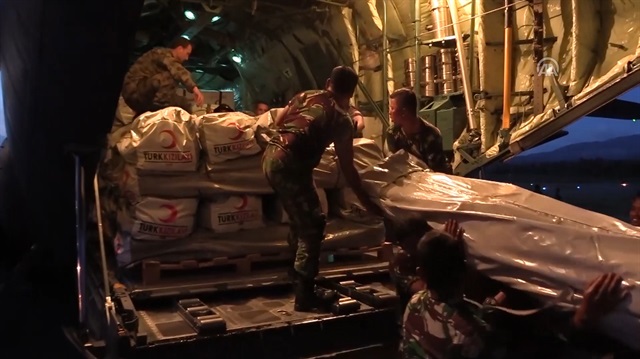
Turkey sends humanitarian aid to quake-hit Indonesia
After the analysis we immediately initiated aid efforts, Ucak added.
He also said help was underway in an extensive area in the quake-hit region for those who face difficulties in meeting their basic needs, particularly in rural areas.
On Sept. 28, a 7.4-magnitude earthquake struck Sulawesi Island, which triggered a tsunami in Donggala and Palu cities that towered up to 10 feet (3 meters) high.
The disaster has caused over 2,000 deaths, according to military authorities in the region on Tuesday.
The death toll is feared to rise as at least 5,000 people were still missing, according to Sutopo Purwo Nugroho, the spokesman of the National Disaster Management Agency (BNPB).
Ahmed Latama, one of the survivors of last month's Indonesian earthquake and tsunami, is searching for his relatives, though he fears they have unfortunately perished. Officials of the Southeast Asian nation announced on Tuesday that the disaster’s death toll had topped 2,000, but many survivors have not forsaken their loved ones.Many Indonesians have been looking for their lost relatives for over 10 days now.After surviving the disaster with his wife and children, Latama, 72, is continuing to search for find his brother and brother-in-law despite his advanced age.Turkish humanitarian aid arrives in quake-hit IndonesiaOn Sept. 28, the day disaster struck, Latama was sitting with his family and before he realized there had been an earthquake he heard people screaming "tsunami" and ran, he told Anadolu Agency. "My wife was inside, I was waiting for her to come out,” he related.“Before she came out, the tsunami reached us. I saw my wife, children and grandchildren, and brother and brother-in-law taken by the water. “I started shouting ‘Allahu Akbar’ [God is great] and ran from the water.Health fears turn from injury to disease as Indonesia quake toll rises above 2,000"Later I found my children besides me, and asked them where their mother was. They told me she also survived and was taken to a safe area." Latama, who fled to high ground to save his life, explained that he started looking for his lost brother and brother-in-law after making sure his wife and children were safe."I’m trying to find my lost brother and brother-in-law, but I still didn't find them,” he said.“I heard that they’re dead. It's my youngest brother that I love dearly. I was wounded in many places but what pains me the most is losing my brother."Indonesia tells independent foreign aid workers to leave quake zone‘We need food’ According to Latama, the most urgent need for the survivors is food."First of all, we need to eat. All the houses on the coast are destroyed. I don't give importance to properties or fancy stuff, all I need is my family to be safe and not hungry. This is the greatest treasure for me." Official search and rescue operations in the region are expected to end on Thursday.Over 1,000 victims have been buried in three different mass graves, and families and relatives have claimed the bodies of 934 people who lost their lives in the disaster.The number of injured is estimated to stand at around 4,000, and more than 67,000 houses have been damaged in the affected areas of Palu, Donggala, and Siri.
Search for survivors continues in Indonesia
Turkey has sent two aircrafts loaded with humanitarian aid supplies to the disaster-hit region in Indonesia on Tuesday.The Turkish Armed Forces sent two C-130 transport aircrafts which transferred aid by the country's charity groups in order to meet the needs of the people affected by the earthquake and tsunami.The aid, which included 1,000 sleeping bags and 250 tents, were transported to the affected regions after the aircraft landed in Palu.Three Turkish Red Crescent and two Turkish Disaster and Emergency Management Authority (AFAD) personnel were also on board.Health fears turn from injury to disease as Indonesia quake toll rises above 2,000A total of nine personnel from Turkey are currently active in the region.On Sept. 28, a 7.4-magnitude earthquake struck Sulawesi Island, which triggered a tsunami that towered up to 10 feet (3 meters) high.The disaster has caused over 2,000 deaths, according military authorities in the region on Tuesday.The death toll is feared to rise as at least 5,000 people were still missing, according to Sutopo Purwo Nugroho, the spokesman of the National Disaster Management Agency (BNPB).Indonesia tells independent foreign aid workers to leave quake zone
Turkish humanitarian aid arrives in quake-hit Indonesia
Health workers in Indonesia are struggling to care for tens of thousands of people displaced by an earthquake and tsunami, with a lack of shelter and clean water among major problems as the focus turns from injury to disease.The official death toll from a 7.5 magnitude earthquake and tsunami on Sept. 28 has risen to 2,010, with most of the fatalities in Palu, a small coastal city that bore the brunt of the disaster. More than 10,000 people were injured.About 70,000 people have been displaced and many are living in crude shelters made out of salvaged wood and plastic in Palu and its surrounding hills."Frankly, we don’t have the capacity to organise and focus our efforts right now," Dr Jumriani, chief of health services at the provincial health department, told Reuters in a tent set up outside her quake-damaged office.Indonesia tells independent foreign aid workers to leave quake zone"The evacuation camps are scattered everywhere and so are our volunteers,” she said.White boards set up in her tent were crammed with figures on various medical cases in different areas.“Initially, we were dealing mainly with injuries. Now our main concerns are diarrhoea, flu, skin disease, mostly because of a lack of clean water and exposure,” she said.A plan to relocate the displaced into more organised communities is being drawn up and the national disaster mitigation agency is seeking 10,000 tents.For now, the displaced huddle in tarpaulin camps along roads, most with no proper latrines, amid piles of flyblown garbage. Where a temporary toilet is available, scores of people depend on it.Video: Turkish charity aids 7,400 Indonesia quake victims"We're getting enough supplies now, there's food and water, but many kids have started to get sick with diarrhoea and flu,” said Megawati, 31, as she rocked her baby in a sarong hanging from wooden beams holding up a plastic sheet.With the rainy season due next month, it was essential to improve conditions as fast as possible, said Samuel Carpenter, humanitarian adviser at the British government’s Department for International Development."The immediate concern is over shelter and water-borne and vector-borne diseases," Carpenter told Reuters in Palu."We need to be prepared for outbreaks."Indonesia has traditionally been reluctant to accept international aid but has approved overseas help with this disaster, including water purification systems. But it has declined foreign medical aid, saying it is capable of handling that itself.'CASE BY CASE'The earthquake destroyed much of Palu's water system, which will take many months to repair, said city official TM Nazar.Much of the city is relying on trucks to deliver water."Sanitation remains a major concern," Nazar said.A volunteer doctor, one of many who have come from across Indonesia to help, estimated that up to 40 percent of displaced people were suffering from diarrhoea, most of them children under the age of six.Medicines and equipment was being brought in from provincial offices and medical posts were being set but services were haphazard, said the doctor, Fauzan Abdul Hadi."At the moment, we're handling things on a case by case basis. I haven’t heard anything from the government yet about systematic medical relief,” he said.A navy hospital ship with more than 30 doctors and five operating theatres has docked in Palu and has provided life-saving services, especially for injured people pulled from the ruins of collapsed buildings.Many have been brought in with infected wounds, said Heru Setianto, an anaesthesiologist on board the KRI Dr. Soeharso."Many patients were not found quickly so their infections had become so bad so they needed to be operated on immediately," he said.One woman trapped under the mud for more than a day next to her dead grandmother spoke from her bed on the hospital ship."It would be difficult without this because the health clinics are full," said Nur Amalia, 23, who suffered injuries and infections to her legs and an eye. 
Health fears turn from injury to disease as Indonesia quake toll rises above 2,000