

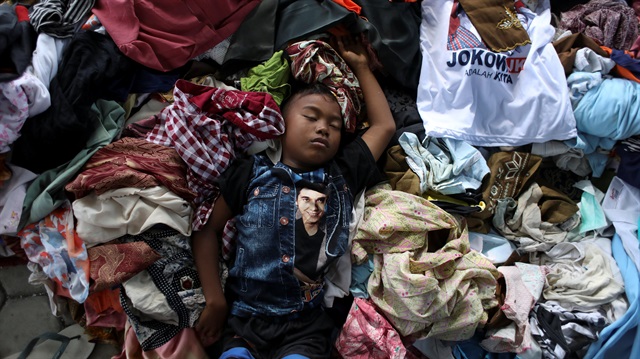
A boy sleeps over a pile of recycled clothes at a camp for displaced victims of the earthquake and tsunami in Palu, Central Sulawesi, Indonesia, October 9, 2018.
Health workers in Indonesia are struggling to care for tens of thousands of people displaced by an earthquake and tsunami, with a lack of shelter and clean water among major problems as the focus turns from injury to disease.
The official death toll from a 7.5 magnitude earthquake and tsunami on Sept. 28 has risen to 2,010, with most of the fatalities in Palu, a small coastal city that bore the brunt of the disaster. More than 10,000 people were injured.
About 70,000 people have been displaced and many are living in crude shelters made out of salvaged wood and plastic in Palu and its surrounding hills.
"Frankly, we don’t have the capacity to organise and focus our efforts right now," Dr Jumriani, chief of health services at the provincial health department, told Reuters in a tent set up outside her quake-damaged office.
Indonesia on Tuesday ordered independent foreign aid workers to leave the quake zone and said foreign groups with staff in the disaster area on Sulawesi island should pull them out.Indonesia has traditionally been reluctant to be seen as relying on outside help to cope with disasters, and the government shunned foreign aid this year when earthquakes struck the island of Lombok.But it has accepted help from abroad to cope with the aftermath of a 7.5 quake and tsunami that hit the west coast of Sulawesi on Sept. 28, killing at least 1,948 people.Despite that, some foreign groups say they have faced difficulties getting entry permits to bring in staff and equipment, and there has been confusion about the rules.Indonesia quake, tsunami death toll climbs to 1,944There have long been restrictions on the activity of foreign aid workers, and the national disaster agency, in a notice posted on Twitter, set the rules out for foreign non-governmental organisations (NGOs).Foreign groups are not allowed to "go directly to the field" but must conduct all activities "in partnership with local partners", it said."Foreign citizens who are working with foreign NGOs are not allowed to conduct any activity on the sites affected," it said.After Indonesia quake, empowering coastal communities will save lives: UN"Foreign NGOs who have deployed its foreign personnel are advised to retrieve their personnel immediately," the agency said in its English-language notice.The official death toll in Sulawesi stood at 1,948 on Tuesday, with most of the fatalities in Palu, a small city that bore the brunt of the disaster.No one knows how many people are missing, especially in areas of southern Palu devastated by soil liquefaction, but it could be as high as 5,000, the national disaster agency said.About 70,000 people have been displaced.Video: Turkish charity aids 7,400 Indonesia quake victimsA few foreign aid workers have been in the disaster zone, including some searching for survivors in the ruins of collapsed buildings in Palu, 1,500 km (930 miles) northeast of the capital, Jakarta. A German group brought in a water-purification system.As well as being concerned to show it can manage disasters on its own, Indonesian governments are wary of being too open to outside help because they could face criticism from political opponents.There is particular resistance to the presence of foreign military personnel as it could be seen as an infringement of sovereignty."There are political sensitivities, especially with an election coming up, and sovereignty is another issue,” said Keith Loveard, senior analyst with advisory and risk firm Concord Consulting, referring to polls due in Muslim-majority Indonesia next year.Many countries regulate the activity of foreign aid groups but restrictions are sometimes set aside after major disasters.Many of the displaced in Sulawesi are living in basic shelters in Palu and surrounding hills. A plan to relocate communities is being drawn up, the agency said.The government has allocated 560 billion rupiah ($37 million) for quake relief and has said some 20 countries have offered help.Sulawesi is one of Indonesia's five main islands. The archipelago sees frequent earthquakes and occasional tsunami.In 2004, a quake off Sumatra island triggered a tsunami across the Indian Ocean that killed 226,000 people in 13 countries, including more than 120,000 in Indonesia.Foreign governments and aid groups played a big role in the emergency response and recovery efforts in 2004.
Indonesia tells independent foreign aid workers to leave quake zone
"The evacuation camps are scattered everywhere and so are our volunteers,” she said.
White boards set up in her tent were crammed with figures on various medical cases in different areas.
“Initially, we were dealing mainly with injuries. Now our main concerns are diarrhoea, flu, skin disease, mostly because of a lack of clean water and exposure,” she said.
A plan to relocate the displaced into more organised communities is being drawn up and the national disaster mitigation agency is seeking 10,000 tents.
For now, the displaced huddle in tarpaulin camps along roads, most with no proper latrines, amid piles of flyblown garbage. Where a temporary toilet is available, scores of people depend on it.
Members of the Humanitarian Relief Foundation (IHH), an Istanbul-based aid agency, humanitarian aid supplies in the quake-hit Palu city, Central Sulawesi province of Indonesia on October 04, 2018. The Turkish aid group on Thursday dispatched aid for 7,400 victims in disaster-hit Indonesia's Palu, Donggala and Makassar cities.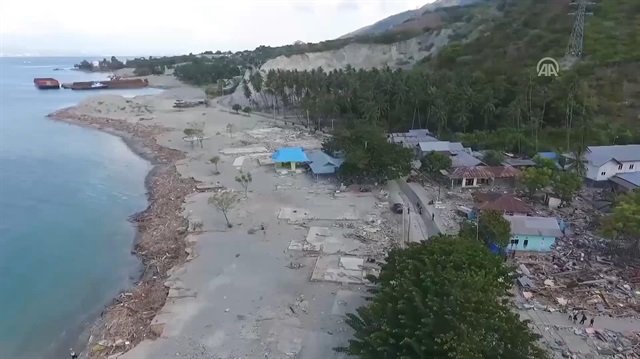
Turkish charity aids 7,400 Indonesia quake victims
With the rainy season due next month, it was essential to improve conditions as fast as possible, said Samuel Carpenter, humanitarian adviser at the British government’s Department for International Development.
"The immediate concern is over shelter and water-borne and vector-borne diseases," Carpenter told Reuters in Palu.
"We need to be prepared for outbreaks."
Indonesia has traditionally been reluctant to accept international aid but has approved overseas help with this disaster, including water purification systems. But it has declined foreign medical aid, saying it is capable of handling that itself.
'CASE BY CASE'
The earthquake destroyed much of Palu's water system, which will take many months to repair, said city official TM Nazar.
Much of the city is relying on trucks to deliver water.
"Sanitation remains a major concern," Nazar said.
A volunteer doctor, one of many who have come from across Indonesia to help, estimated that up to 40 percent of displaced people were suffering from diarrhoea, most of them children under the age of six.
Medicines and equipment was being brought in from provincial offices and medical posts were being set but services were haphazard, said the doctor, Fauzan Abdul Hadi.
"At the moment, we're handling things on a case by case basis. I haven’t heard anything from the government yet about systematic medical relief,” he said.
A navy hospital ship with more than 30 doctors and five operating theatres has docked in Palu and has provided life-saving services, especially for injured people pulled from the ruins of collapsed buildings.
Many have been brought in with infected wounds, said Heru Setianto, an anaesthesiologist on board the KRI Dr. Soeharso.
"Many patients were not found quickly so their infections had become so bad so they needed to be operated on immediately," he said.
One woman trapped under the mud for more than a day next to her dead grandmother spoke from her bed on the hospital ship.
"It would be difficult without this because the health clinics are full," said Nur Amalia, 23, who suffered injuries and infections to her legs and an eye.