

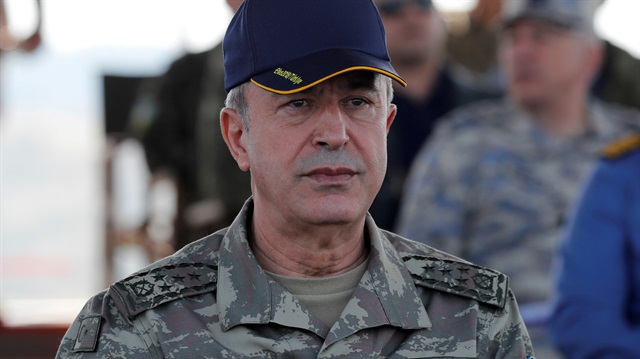
Turkey's Chief of the General Staff Hulusi Akar
Turkey's Defense Minister Hulusi Akar said Monday the country's most important aim in Idlib, Syria is to stop land and air attacks and establish a cease-fire and stability.
Answering questions from reporters in the capital, Ankara, during Afghanistan's National Day reception, Akar said Turkey "wants the absolute cease-fire to be maintained" which was planned within the scope of the Astana peace process brokered by Turkey, Russia and Iran.
"If the cease-fire is not maintained, then civilians, children and elderly people would suffer the most in case of an attack," Akar said.
"Our most important aim is to maintain cease-fire and stability in the region," he said.
At least 17 people were wounded Monday by airstrikes carried out by the Assad regime and Russian warplanes on Idlib and Hama provinces in northern Syria.
Since the beginning of the month, at least 29 civilians have been killed and dozens injured in airstrikes and attacks by regime forces and Russian warplanes in Idlib and Hama, according to the White Helmets, a local civil defense agency.
The Syrian regime has recently announced plans to launch a major military offensive in Idlib, which has long been controlled by various armed opposition groups.
The UN warned last week that such an offensive would lead to the "worst humanitarian catastrophe in the 21st century".
Located near the Turkish border, Idlib is home to more than 3 million Syrians, many of whom fled from other cities following attacks by regime forces.
On Friday, Turkish President Recep Tayyip Erdogan called for a cease-fire in Idlib during a tripartite summit in Tehran with Iran's President Hassan Rouhani and Russia's President Vladimir Putin.
- Akar's comments on returned Turkish soldiers
Asked to comment on Greece returning two Turkish soldiers Sunday after they crossed to the Greek side of the border by mistake, Akar said "positive and constructive attitude by the two countries gave out a good example of the neighbor relations."
"There is an effort going on to prevent illegal crossing between two countries. During those efforts, an incident happened. After our phone conversations with Greece Defense Minister Mr. [Panos] Kammenos, our two soldiers were returned to us," Akar said, thanking those who contributed.
Greece allowed two Turkish soldiers to return after they were held, when they crossed to the Greek side of the border, the Chief of General Staff said in a statement.
The statement said the soldiers were chasing irregular migrants when they crossed the border by mistake.
The soldiers were held by Greek patrol units at 11 a.m. (GMT0800), the statement said.
It added the soldiers were returned to Turkey at around 6.30 p.m. (GMT1530) after the Turkish side held talks with Greek authorities.
The EU warned on Monday that airstrikes carried out by the Bashar al-Assad regime and Russia would lead to "catastrophic human and humanitarian consequences" in Idlib and Hama provinces in northern Syria.Answering a question on casualties caused by regime and Russian airstrikes in Syria's Idlib, EU foreign affairs spokeswoman Maja Kocijancic said: "There are a lot of suffering and the military offensive in Idlib is not to go ahead.""We continue to stand and talk to various interlocutors in this issue," Kocijancic added. At least 17 people were wounded on Monday by airstrikes carried out by regime and Russian warplanes in Idlib and Hama provinces in northern Syria. Since the beginning of this month, at least 29 civilians have been killed and dozens injured in airstrikes and attacks by regime forces and Russian warplanes in Idlib and Hama , according to the White Helmets.UK lawmakers: Preventing atrocities in Idlib 'urgent'Turkish agency launches aid campaign for Syria’s IdlibUN voices concern over military operations in IdlibAn Assad regime helicopter on Saturday dropped a barrel bomb on a hospital in Has village in Idlib rendering it useless.The Syrian regime has recently announced plans to launch a major military offensive in the area, which has long been controlled by various armed opposition groups.The UN warned last week that such an offensive would lead to the "worst humanitarian catastrophe in the 21st century".A trilateral summit of the presidents of Turkey, Russia and Iran on Friday underlined that “there could be no military solution to the Syrian conflict" and called for advancing the political process to reach a negotiated solution.
EU warns against military offensive in Syria
More than 30,000 people have been displaced within opposition-held northwest Syria by bombardment by Syrian government and allied forces which began last week, a United Nations official told Reuters on Monday.Civilians fled the towns of Morek, al-Lataminah, Morek and Sahl al-Ghab amid heavy aerial bombardment by the Assad regime and Russia that killed and injured scores of people over the past nine days.Schools and hospitals are among the targets of the ferocious aeril campaign in the northwestern provinces of Idlib and Hama."As of 9 Sept. 30,542 people have been displaced from northwest Syria, moving to different areas across Idlib," David Swanson, spokesman for the U.N. Office for the Coordination of Humanitarian Affairs (UNOCHA) said.Turkish agency launches aid campaign for Syria’s IdlibUN voices concern over military operations in IdlibSyrian opposition forces on red alert as Idlib offensive looms
More than 30,000 displaced in Syria's Idlib in latest offensive
The action "to prevent mass atrocities" in Syria’s Idlib is an urgent matter as the situation is "reaching crisis point", British parliament’s Foreign Relations Committee Chairman Tom Tugendhat said Monday.Tugendhat said the U.K. government must do more to "protect civilians as part of its responsibility to protect".Tugendhat’s comments came with the release of the committee’s report "Global Britain: The Responsibility to Protect and Humanitarian Intervention", which was published on Monday following its inquiry into the legal basis for military interventions under these concepts and their effectiveness in protecting civilians, with a focus on Syria."The consequences of inaction can be devastating. The people of Syria show clearly that choosing not to act, standing aside, can have consequences every bit as real and horrific as the decision to act," he said.UK govt refuses to say if it has taken legal advice on second Brexit referendumThe report by the cross-party committee said a "proportionate and necessary force" should be used "to alleviate extreme human distress", in conflicts where there is human suffering.The report said, "the absence of humanitarian intervention as a final recourse can result in grave consequences for civilian populations.""During this inquiry, we heard from those who have the first-hand experience of what life is like in Syria right now and the impact the conflict there has had on people," Tugendhat said."The Government must do more to protect civilians as part of its responsibility to protect. British PM May hopes parliament will support her Brexit plan"With the situation in Idlib reaching crisis point, action to prevent mass atrocities is ever more urgent."The committee chairman said prevention is always better than a later response. "As the situation in Syria has shown us, waiting to respond can have devastating consequences," he said.Tugendhat said the atrocity prevention must be prioritized in political and diplomatic conversations."Now, more than ever, the Government needs to produce a comprehensive atrocity prevention strategy and implementation plan," he urged."The cost of inaction has been unacceptably high," he added.The committee’s report said the U.K. "must bear its share of the responsibility" for the atrocity crimes committed in Syria and "examine the repercussions of its decisions not to do more on its own or collectively".It also urged for an "independent inquiry" into the decision-making processes so lessons should be learned "to prevent similar humanitarian crises happening in the future and offer a more effective response".
UK lawmakers: Preventing atrocities in Idlib 'urgent'
A 20-truck convoy carrying humanitarian aid for Syria’s northwestern province of Idlib set off from Istanbul on Monday, president of a Turkish aid agency said. This is the first part of 1,000 truck-load of humanitarian aid for Idlib, Bülent Yıldırım, the president of the Istanbul-based Humanitarian Relief Foundation (IHH) told reporters during the event."A tragedy that will occur in a possible [military] operation in Idlib is not only Turkey’s problem but Europe’s as well," Yıldırım said.The Syrian regime has recently announced plans to launch a major military offensive in the area, which has long been controlled by various armed opposition groups.The UN warned last week that such an offensive would lead to the "worst humanitarian catastrophe in the 21st century".Turkey currently hosts nearly 3.5 million Syrian refugees, more than any other country in the world."Our goal is to send 1,000 trucks to Idlib," Yıldırım said, adding the agency was working across Turkey for this aid campaign."Today, we have started with 20 trucks," he added."Idlib hit by barrel bombs as well. These bombs hit even civil defense teams. Russia hits too," he added.On Sunday, a footage showing Russian and regime jets targeting teams of the White Helmets while rescuing civilians in Syria’s northwestern Idlib province was revealed.The video showed a team of the White Helmets, a local civil defense agency, while extinguishing a fire that broke out after an airstrike in Khan Sheykhun.Anas Diab, a civil defense member, was injured while capturing the video and pleaded for help from others around him when another strike hit the area near him.Syria has only just begun to emerge from a devastating civil war that began in 2011. Since then, hundreds of thousands of people have been killed in the conflict and millions more displaced, according to the UN.UN voices concern over military operations in IdlibTurkish Red Crescent sends aid to Syria's Idlib, LatakiaTurkey's first lady to get humanitarian service award
Turkish agency launches aid campaign for Syria’s Idlib
The UN's Human Right Council on Monday expressed concerns over "the ongoing military operations" and their impact on millions of civilians in Syria’s northwestern Idlib province.In the keynote speech at the 39th session of the Human Rights Council in Geneva, UN High Commissioner for Human Rights Michelle Bachelet said: "We remind all parties to the conflict that they must adhere strictly to all relevant principles of international humanitarian law in the conduct of operations."The impact of the conflicts on civilians should be minimized, humanitarian aid should be provided, and humanitarian corridors should be opened to ensure that the civilians safely leave conflict-affected areas, Bachelet added.Syrian opposition forces on red alert as Idlib offensive looms"Accountability must be a corner-stone of the country's future," she said.The Syrian regime has recently announced plans to launch a major military offensive in the area, which has long been controlled by various armed opposition groups.The UN warned last week that such an offensive would lead to the "worst humanitarian catastrophe in the 21st century".Located near the Turkish border, Idlib is home to more than 3 million Syrians, many of whom fled from other cities following attacks by regime forces.Turkish Red Crescent sends aid to Syria's Idlib,LatakiaCall to establish independent mechanism to probe MyanmarBachelet also commented on a recent UN report on Myanmar’s human rights violations and abuses.She said, "This Council session will be apprised of the deeply shocking findings of the Independent International Fact-Finding Mission on Myanmar."She referred to the report where the UN documented mass gang rapes, killings -- including of infants and children -- brutal beatings, and disappearances committed by Myanmar state forces.Turkey welcomes half of the world’s Syrian refugeesIn the report issued by the UN Independent International Fact-Finding Mission on Myanmar, UN investigators said the violations may have constituted crimes against humanity.Bachelet called on member states at the council to establish an "independent international mechanism" for Myanmar to collect, consolidate, preserve, and analyze evidence of the most serious international crimes in order to expedite fair and independent trials in national and international courts.The commissioner added: "This mechanism would also complement and support the preliminary examination of the ICC [International Criminal Court] Prosecutor."Last week, ICC ruled it could investigate Myanmar for the alleged deportation of Rohingya to Bangladesh as a possible crime against humanity.The unprecedented decision could expose the country’s politicians and army generals to charges.The 39th Human Rights Council is held between Sept. 10-28 at the UN headquarters in Geneva.The council will discuss human rights violations in Syria, Yemen, the occupied Palestinian territory, South Sudan, Somalia, Libya, as well as in the Democratic Republic of Congo.The three-week session will be carried out with the participation of 25 independent human rights experts, groups and mechanisms.
UN voices concern over military operations in Idlib
Turkey will not be responsible for a migration wave in case of possible attacks on Syria's Idlib, Turkish interior minister said on Sunday.Süleyman Soylu was speaking to reporters in Yayladagi district of Turkey's southern province of Hatay bordering Syria.The Syrian regime has recently announced plans to launch a major military offensive in the area, which has long been controlled by various armed opposition groups.The UN warned earlier this week that such an offensive would lead to the "worst humanitarian catastrophe in the 21st century".Assad regime, Russia resume Idlib air strikesRussia mistaken in backing Assad: Ex-Syria PM"255,300 Syrians have returned to their homes over the past 2 years, 160,000 of them returned to Euphrates Shield region after Turkey brought peace there", Soylu said.Euphrates Shield cut off the PKK/PYD/YPG terror groups' access to the Mediterranean Sea and eliminated threats posed by the terrorist group along the Turkish-Syrian border.Operation Euphrates Shield, which began on Aug. 24, 2016 and ended in March 2017, was aimed at eliminating the terrorist threat along the border in the northern Syrian regions of Jarabulus, Al-Rai, Al-Bab, and Azaz with the use of the Free Syrian Army, backed by Turkish artillery and air cover.Slamming so-called big countries about their approach on the Syrian crisis, the interior minister said there is a major contradiction in what those countries say and do regarding the issue.Meanwhile, Soylu also noted an average of 6,800 irregular migrants used to enter Greece from western Turkey daily in 2015 and now it has been reduced to 79.Turkey has been a main route for irregular migrants trying to cross into Europe, especially since 2011 when the Syrian civil war began.
Turkish minister warns of mass migration from Idlib