

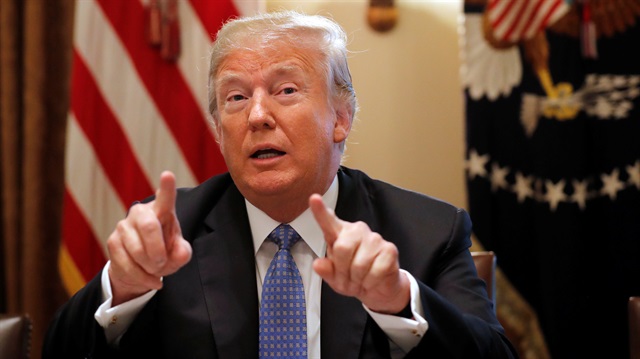
U.S. President Donald Trump
When the U.S. Secretary of State flies into Southeast Asia this week with a new investment pitch for the region, the response could be: thanks a million, but please stop threatening a trade war with China that will make us lose billions of dollars.
Analysts say the $113 million of technology, energy and infrastructure initiatives trumpeted by Mike Pompeo earlier this week - the first concrete details of U.S. President Donald Trump's vague 'Indo-Pacific' policy - may be hard to sell to countries that form an integral part of Chinese exporters' supply chains.
It may even further inflame tensions with Beijing, which has been spreading money and influence across the region via its Belt and Road Initiative development scheme.
"The Southeast Asian capitals are more worried about any blowback effects for them of U.S.-China trade tension than they are about how much they can benefit from this $113 million initiative," said Malcolm Cook, senior fellow at the Institute of Southeast Asian Studies in Singapore.
U.S. President Donald Trump said he looked forward to meeting Kim Jong Un soon and thanked the North Korean leader for sending the suspected remains of U.S. soldiers killed in the 1950-1953 Korean War back to the United States."Thank you to Chairman Kim Jong Un for keeping your word & starting the process of sending home the remains of our great and beloved missing fallen! I am not at all surprised that you took this kind action," Trump wrote in a Twitter message."Also, thank you for your nice letter - I look forward to seeing you soon!", Trump said, without elaborating.
Trump thanks Kim Jong Un for sending war remains, hopes to see him 'soon'
"Pompeo has a hard selling job. There is still no real positive trade story for Asia coming out of the United States."
Hot on the heels of Washington's new economic plan for emerging Asia came reports the United States could more than double planned tariffs on $200 billion of imported Chinese goods from dog food to building materials. China called it "blackmail" and vowed retaliation.
After a brief meeting with new Malaysian Prime Minister Mahathir Mohamad in Kuala Lumpur, Pompeo will fly to Singapore - a global trading hub that could be one of the hardest-hit in the region by a trade war - for a sit-down with the 10-member Association of Southeast Asian Nations (ASEAN) on Friday.
The escalating trade conflict between the United States and China is hitting German companies doing business in both countries, a survey by the DIHK Chambers of Industry and Commerce showed on Thursday.China has warned the United States it would hit back if the Trump administration takes further steps hindering trade as Washington considers slapping a 25 percent tariff on $200 billion worth of Chinese goods.The proposal would increase the potential tariff rate from 10 percent the U.S. administration had initially put forward on July 10 for that wave of duties in a bid to pressure Beijing into making trade concessions, a source familiar with the plan said on Tuesday.The U.S. tariffs target thousands of Chinese imports, including food products, chemicals, steel and aluminium and consumer goods ranging from dog food, furniture and carpets to car tires, bicycles, and baseball gloves and beauty products.The DIHK said a survey among its members doing business in China showed that 41 percent were already affected by the higher tariffs when exporting to the United States while 46 percent reported higher costs when importing from the United States.Among the German companies doing business in the United States, 57 percent said they already faced negative effects when exporting to China while 75 percent reported disadvantages such as higher costs when importing from China."The dangerous trade dispute between the U.S. and China is also hitting German companies doing business in the two countries," said Volker Treier, foreign trade chief at the DIHK."The impact is huge: nearly half of the imports from German companies are directly or indirectly affected by the new tariffs, for example because they source raw materials or components from the other country," Treier said.To avoid the higher costs caused by the tit-for-tat tariffs, many German firms doing business in the United States are considering the closure of production sites and relocation to other countries, the DIHK said.The DIHK survey showed that German companies producing at home were also hit by the U.S.-Chinese trade conflict due to their international network of suppliers and broad customer relationships around the globe."A further escalation of the dispute would be a threat to world trade as a whole," Treier said.The United States is Germany's biggest single export destination while China is the most important business partner in overall trade volumes for German companies.German companies have invested 400 billion euros ($466.60 billion) in the United States and 80 billion euros in China. They employ more than 850,000 people in the United States and some 700,000 in China, according to DIHK.Trump says attorney general should stop Mueller probe 'right now'China vows retaliation if Trump slaps 25 pct tariff on $200 bln of Chinese importsFacebook says it identifies campaign to meddle in 2018 US elections
US-China trade dispute hitting German companies
Singapore's biggest bank, DBS, estimates that a full-scale trade war - defined as 15-25 percent tariffs on all products traded between the U.S. and China - could more than halve Singapore's growth rate next year from a forecast 2.7 percent to 1.2 percent. Malaysia's growth rate in 2019 could fall from an estimated 5 percent to 3.7 percent.
"We are all acutely aware of the storm clouds of trade war," Singapore's Foreign Minister Vivian Balakrishnan said at the opening of an ASEAN foreign ministers meeting on Thursday that precedes meetings with the United States and other nations.
Singapore's Prime Minister Lee Hsien Loong said earlier this year that a trade war would have a "big, negative impact" on the country.
Ratings agency Moody's said this week that an escalation of trade tensions in 2018 had become its "baseline expectation", and that Asia was "especially vulnerable" given the integration of regional supply chains.
SANCTIONS ON NORTH KOREA
As well as trade, Friday's meeting will also cover security issues such as South China Sea disputes and North Korea's nuclear disarmament. The United States will press Southeast Asian leaders to maintain sanctions on Pyongyang following reports of renewed activity at the North Korean factory that produced the country's first intercontinental ballistic missiles capable of reaching the United States.
Pompeo will also travel to Indonesia during his trip - Southeast Asia's biggest economy which under Trump faces losing some of the trade preferences given by Washington for poor and developing countries.
Few officials around the region offered comment on the Indo-Pacific strategy when contacted by Reuters for this story. One said that the ASEAN meeting in Singapore would be an opportunity "to have clarity and a more unified position" on the vision.
One reason for caution is that the region has been wrong-footed by U.S. advances before.
Former U.S. President Barack Obama's "pivot" to Asia went on the backburner after Trump won the 2016 election promising to put "America First". One of his early acts in office was to pull out of the Trans-Pacific Partnership (TPP) trade agreement, which involved four Southeast Asian states.
The result was that across Asia, more and more countries were pulled into China's orbit: softening their stance on territorial disputes in the South China Sea and borrowing billions of dollars from Beijing to develop infrastructure.
The Philippines is one example of a country which has taken a more conciliatory approach to China despite a bitter history of disputes over maritime sovereignty.
Its President Rodrigo Duterte frequently praises Chinese counterpart Xi Jinping and in February caused a stir when he jokingly offered the Philippines to Beijing as a province of China.
Thailand, one of Washington's oldest allies, is another major regional power perceived to have moved closer to China after U.S. relations came under strain because of concerns about freedoms under its military-dominated government.
Thai foreign ministry spokesperson Busadee Santipitaks told Reuters the country was proceeding with "a balanced approach" towards the United States and China.
U.S. officials said the Indo-Pacific strategy does not aim to compete directly with China's Belt and Road Initiative. Yet, in an apparent reference to China, Pompeo said Washington will "oppose" any country that seeks dominance in the region.
While Chinese officials have not criticised the U.S. approach, its influential state-run tabloid the Global Times said in an editorial on Tuesday: "Belt and Road is destined to continue to flourish. This has nothing to do with certain forces that are selfish and engage in petty practices and make jibes."