

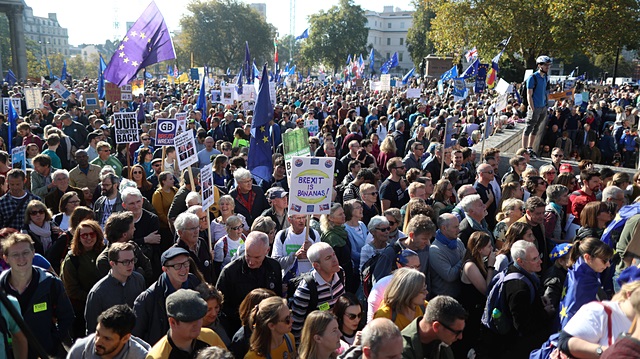
Protesters participating in an anti-Brexit demonstration, march through central London
Tens of thousands of supporters of the European Union began marching through London on Saturday as part of what organisers say will be the largest ever demonstration to demand that the British government holds a public vote on the terms of Brexit.
The protesters waved the blue and gold flag of the EU and held up "Bollocks to Brexit" banners under sunny skies to call for another referendum on the eventual deal on how Britain will leave the world's biggest trading bloc.
The march comes as pressure builds on Prime Minister Theresa May over her negotiating strategy with just over five months until Britain is due to leave. There is, so far, no divorce deal and some rebels in May's Conservative Party have threatened to vote down a deal if she clinches one.
James McGrory, one of the organisers of the march, said the public should have the chance to change their minds because the decision will impact their lives for generations.
Tens of thousands of supporters of the European Union began marching through London on Saturday as part of what organizers say will be the largest ever demonstration to demand that the British government holds a public vote on the terms of Brexit.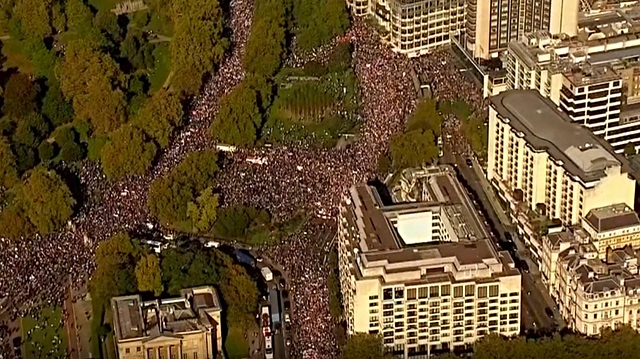
London protesters call for vote on final Brexit deal
At the march, demonstrators carried placards saying "Brexit is pants" and "time for an EU turn." Members of parliament from all the main political parties are set to join the demonstration.
Organisers estimate that more than 100,000 people will take part. Crowds will gather near Hyde Park and pass Downing Street and finish outside of parliament.
The 2016 referendum saw 52 percent vote in favour of leaving the European Union. But the past two years have been politically fraught as the government has struggled to agree on a plan and there are fears that Britain leave the bloc without a deal.
Irish Prime Minister Leo Varadkar said on Friday that a possible extension of Britain's post-Brexit transition period would not diminish Ireland's need for a "backstop" to avoid a hard border with Northern Ireland.He also told reporters on the third day of EU summit meetings in Brussels that it would be up to British Prime Minister Theresa May to decide whether she had to defy opposition from her unionist Northern Irish allies and agree to the EU's proposed backstop, which would potentially create trade barriers between Northern Ireland and the British mainland.He said it was a "judgment call" May would have to make but said that without an Irish backstop, any withdrawal treaty might not be ratified by the European Parliament. EU's Barnier says Brexit deal 90 pct done, but Ireland issue could derail it
Ireland insists on Brexit 'backstop'
Some opinion polls have shown a slight shift in favour of remaining in the European Union, but there has yet to be a decisive change in attitudes and many in Britain say they have become increasingly bored by Brexit.
The prime minister has repeatedly ruled out holding a second referendum. The opposition Labour party said last month they open to a second referendum with the option of staying in the bloc in certain circumstances.
Brexit supporters say a second referendum would trigger a major constitutional crisis.
German Finance Minister Olaf Scholz is working with international counterparts on a global minimum corporate tax, a ministry spokesman said on Friday, as governments look to prevent companies from shopping around for tax havens.A crackdown by the European Commission on deals between individual EU governments and multinationals has resulted in Apple, Starbucks and Fiat paying billions of euros in back taxes."The goal is to prevent unfair tax competition," the spokesman said. "The German government is convinced that big, digital and border-crossing companies must do their part to finance the common good."Europe, Asia show commitment to free trade: MerkelConceptual work on the proposal is still under way and consultations are still at an early stage, the spokesman said.Germany is working closely with France on the plan, German newspaper Handelsblatt reported, adding that Scholz has asked the Organisation for Economic Co-operation & Development (OECD) to consider the proposal.The proposal would be an extension of BEPS, a set of OECD policies to tackle tax avoidance strategies that allow multinational companies to shift profits artificially to low or no-tax locations.Handelsblatt quoted an OECD official as saying the proposal had been well received but that talks remained at an early stage. "In the context of the BEPS discussion, France and Germany have proposed discussing a minimum tax and making it the standard," OECD tax lead Pascal Saint-Amans was quoted as saying.The goal is not to force countries to potentially raise their tax levels, but to give them a way to ensure that companies did not skip paying taxes at all. Extension of Brexit transition would not solve the problems: German minister
Germany looking to coordinate global minimum corporate tax
"We had a vote, we voted to leave, the idea to have a second referendum would be incredibly damaging," said Richard Tice, Vice-Chairman of Leave Means Leave, which wants a clean break with the EU.
"People need to be under no illusions as to how people feel about what is a significant potential for a total betrayal of democracy in this country."