

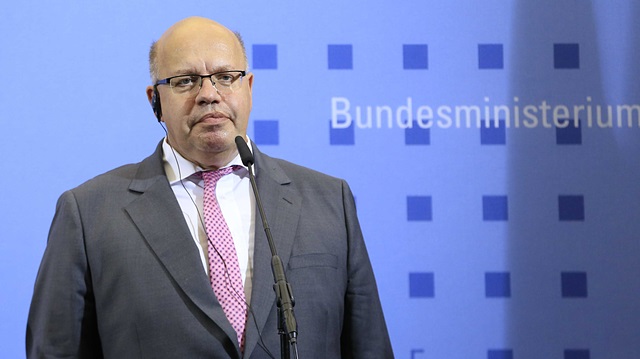
Olaf Scholz
German Finance Minister Olaf Scholz is working with international counterparts on a global minimum corporate tax, a ministry spokesman said on Friday, as governments look to prevent companies from shopping around for tax havens.
A crackdown by the European Commission on deals between individual EU governments and multinationals has resulted in Apple, Starbucks and Fiat paying billions of euros in back taxes.
"The goal is to prevent unfair tax competition," the spokesman said. "The German government is convinced that big, digital and border-crossing companies must do their part to finance the common good."
German Chancellor Angela Merkel said on Friday that an Asia-Europe summit in Brussels showed that some two-thirds of the world was committed to multilateralism and recognised the benefits of free trade."The summit shows that countries have gathered from Europe and Asia who want a rules-based trading and have pledged themselves to multilateralism," she said, adding it was an important signal given that Europe and Asia represented almost two-thirds of world GDP, trade and population."Our theme is about creating connections, for example through free trade agreement... We can show that it's about creating win-win situations, making it clear that when one profits, the other also profits." Extension of Brexit transition would not solve the problems: German minister
Europe, Asia show commitment to free trade: Merkel
Conceptual work on the proposal is still under way and consultations are still at an early stage, the spokesman said.
Germany is working closely with France on the plan, German newspaper Handelsblatt reported, adding that Scholz has asked the Organisation for Economic Co-operation & Development (OECD) to consider the proposal.
The proposal would be an extension of BEPS, a set of OECD policies to tackle tax avoidance strategies that allow multinational companies to shift profits artificially to low or no-tax locations.
Handelsblatt quoted an OECD official as saying the proposal had been well received but that talks remained at an early stage. "In the context of the BEPS discussion, France and Germany have proposed discussing a minimum tax and making it the standard," OECD tax lead Pascal Saint-Amans was quoted as saying.
The goal is not to force countries to potentially raise their tax levels, but to give them a way to ensure that companies did not skip paying taxes at all.
The European Union and Germany's government will not block an extension of the post-Brexit transition period, but an extension alone will not solve the problems on hand, European Affairs Minister Michael Roth said on Friday."If that solves problems and if a few more months are needed to negotiate the details of future relations, then it will certainly not fail because of the EU-27 and because of us in Berlin," Roth told German broadcaster WDR."But an extension alone does not solve the problems," he added." "There is no reasonable solution yet over a hard border between Ireland and Northern Ireland."UK is considering other ideas to break Brexit deadlock: PM May's spokeswomanToo early to know cost of Brexit transition extensionBrexit impasse continues due to lack of progress
Extension of Brexit transition would not solve the problems: German minister