

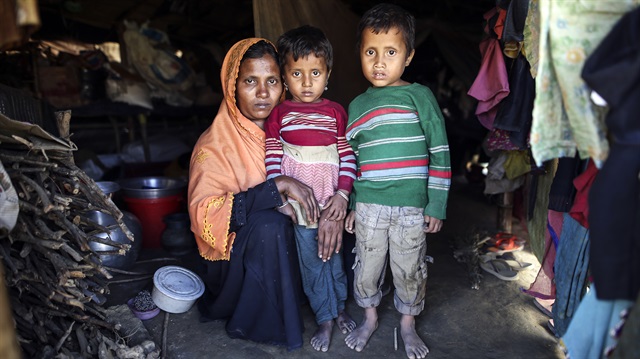
Women victims of the military crackdown in Myanmar
M ohib Bullah is not your typical human rights investigator. He chews betel and he lives in a rickety hut made of plastic and bamboo. Sometimes, he can be found standing in a line for rations at the Rohingya refugee camp where he lives in Bangladesh.
Yet Mohib Bullah is among a group of refugees who have achieved something that aid groups, foreign governments and journalists have not. They have painstakingly pieced together, name-by-name, the only record of Rohingya Muslims who were allegedly killed in a brutal crackdown by Myanmar's military.
The bloody assault in the western state of Rakhine drove more than 700,000 of the minority Rohingya people across the border into Bangladesh, and left thousands of dead behind.
Aid agency Médecins Sans Frontières, working in Cox's Bazar at the southern tip of Bangladesh, estimated in the first month of violence, beginning at the end of August 2017, that at least 6,700 Rohingya were killed. But the survey, in what is now the largest refugee camp in the world, was limited to the one month and didn't identify individuals.
The Rohingya list makers pressed on and their final tally put the number killed at more than 10,000. Their lists, which include the toll from a previous bout of violence in October 2016, catalogue victims by name, age, father's name, address in Myanmar, and how they were killed.
"When I became a refugee I felt I had to do something," says Mohib Bullah, 43, who believes that the lists will be historical evidence of atrocities that could otherwise be forgotten.
Myanmar government officials did not answer phone calls seeking comment on the Rohingya lists. Late last year, Myanmar's military said that 13 members of the security forces had been killed. It also said it recovered the bodies of 376 Rohingya militants between Aug. 25 and Sept. 5, which is the day the army says its offensive against the militants officially ended.
Rohingya regard themselves as native to Rakhine State. But a 1982 law restricts citizenship for the Rohingya and other minorities not considered members of one of Myanmar's "national races". Rohingya were excluded from Myanmar's last nationwide census in 2014, and many have had their identity documents stripped from them or nullified, blocking them from voting in the landmark 2015 elections. The government refuses even to use the word "Rohingya," instead calling them "Bengali" or "Muslim."
Now in Bangladesh and able to organise without being closely monitored by Myanmar's security forces, the Rohingya have armed themselves with lists of the dead and pictures and video of atrocities recorded on their mobile phones, in a struggle against attempts to erase their history in Myanmar.
The Rohingya accuse the Myanmar army of rapes and killings across northern Rakhine, where scores of villages were burnt to the ground and bulldozed after attacks on security forces by Rohingya insurgents. The United Nations has said Myanmar's military may have committed genocide.
Myanmar says what it calls a "clearance operation" in the state was a legitimate response to terrorist attacks.
"NAME BY NAME"
Clad in longyis, traditional Burmese wrap-arounds tied at the waist, and calling themselves the Arakan Rohingya Society for Peace & Human Rights, the list makers say they are all too aware of accusations by the Myanmar authorities and some foreigners that Rohingya refugees invent stories of tragedy to win global support.
But they insist that when listing the dead they err on the side of under-estimation.
Mohib Bullah, who was previously an aid worker, gives as an example the riverside village of Tula Toli in Maungdaw district, where - according to Rohingya who fled - more than 1,000 were killed. "We could only get 750 names, so we went with 750," he said.
"We went family by family, name by name," he added. "Most information came from the affected family, a few dozen cases came from a neighbour, and a few came from people from other villages when we couldn't find the relatives."
In their former lives, the Rohingya list makers were aid workers, teachers and religious scholars. Now after escaping to become refugees, they say they are best placed to chronicle the events that took place in northern Rakhine, which is out-of-bounds for foreign media, except on government-organised trips.
"Our people are uneducated and some people may be confused during the interviews and investigations," said Mohammed Rafee, a former administrator in the village of Kyauk Pan Du who has worked on the lists. But taken as a whole, he said, the information collected was "very reliable and credible."
SPRAWLING PROJECT
Getting the full picture is difficult in the teeming dirt lanes of the refugee camps. Crowds of people gather to listen - and add their comments - amid booming calls to prayer from makeshift mosques and deafening downpours of rain. Even something as simple as a date can prompt an argument.
What began tentatively in the courtyard of a mosque after Friday prayers one day last November became a sprawling project that drew in dozens of people and lasted months.
The project has its flaws. The handwritten lists were compiled by volunteers, photocopied, and passed from person to person. The list makers asked questions in Rohingya about villages whose official names were Burmese, and then recorded the information in English. The result was a jumble of names: for example, there were about 30 different spellings for the village of Tula Toli.
Wrapped in newspaper pages and stored on a shelf in the backroom of a clinic, the lists that Reuters reviewed were labeled as beginning in October 2016, the date of a previous exodus of Rohingya from Rakhine. There were also a handful of entries dated 2015 and 2012. And while most of the dates were European-style, with the day first and then the month, some were American-style, the other way around. So it wasn't possible to be sure if an entry was, say, May 9 or September 5.
It is also unclear how many versions of the lists there are. During interviews with Reuters, Rohingya refugees sometimes produced crumpled, handwritten or photocopied papers from shirt pockets or folds of their longyis.
The list makers say they have given summaries of their findings, along with repatriation demands, to most foreign delegations, including those from the United Nations Fact-Finding Mission, who have visited the refugee camps.
A LEGACY FOR SURVIVORS
The list makers became more organised as weeks of labour rolled into months. They took over three huts and held meetings, bringing in a table, plastic chairs, a laptop and a large banner carrying the group's name.
The MSF survey was carried out to determine how many people might need medical care, so the number of people killed and injured mattered, and the identity of those killed was not the focus. It is nothing like the mini-genealogy with many individual details that was produced by the Rohingya.
Mohib Bullah and some of his friends say they drew up the lists as evidence of crimes against humanity they hope will eventually be used by the International Criminal Court, but others simply hope that the endeavour will return them to the homes they lost in Myanmar.
"If I stay here a long time my children will wear jeans. I want them to wear longyi. I do not want to lose my traditions. I do not want to lose my culture," said Mohammed Zubair, one of the list makers. "We made the documents to give to the U.N. We want justice so we can go back to Myanmar."
Matt Wells, a senior crisis advisor for Amnesty International, said he has seen refugees in some conflict-ridden African countries make similar lists of the dead and arrested but the Rohingya undertaking was more systematic. "I think that's explained by the fact that basically the entire displaced population is in one confined location," he said.
Wells said he believes the lists will have value for investigators into possible crimes against humanity.
"In villages where we've documented military attacks in detail, the lists we've seen line up with witness testimonies and other information," he said.
Spokespeople at the ICC's registry and prosecutors' offices, which are closed for summer recess, did not immediately provide comment in response to phone calls and emails from Reuters.
The U.S. State Department also documented alleged atrocities against Rohingya in an investigation that could be used to prosecute Myanmar's military for crimes against humanity, U.S. officials have told Reuters. For that and the MSF survey only a small number of the refugees were interviewed, according to a person who worked on the State Department survey and based on published MSF methodology.
MSF did not respond to requests for comment on the Rohingya lists. The U.S. State Department declined to share details of its survey and said it wouldn't speculate on how findings from any organization might be used.
For Mohammed Suleman, a shopkeeper from Tula Toli, the Rohingya lists are a legacy for his five-year-old daughter. He collapsed, sobbing, as he described how she cries every day for her mother, who was killed along with four other daughters.
"One day she will grow up. She may be educated and want to know what happened and when. At that time I may also have died," he said. "If it is written in a document, and kept safely, she will know what happened to her family."
Facebook has been “too slow” to address hate speech in Myanmar and is acting to remedy the problem by hiring more Burmese speakers and investing in technology to identify problematic content, the company said in a statement on Thursday.The acknowledgement came a day after a Reuters investigation showed why the company has failed to stem a wave of vitriolic posts about the minority Rohingya.Some 700,000 Rohingya fled their homes last year after an army crackdown that the United States denounced as ethnic cleansing. The Rohingya now live in teeming refugee camps in Bangladesh."The ethnic violence in Myanmar is horrific and we have been too slow to prevent misinformation and hate speech on Facebook,” Facebook said.The Reuters story revealed the social media giant for years dedicated scant resources to combating hate speech in Myanmar, which is a market it dominates and where there have been repeated eruptions of ethnic violence.In early 2015, for instance, there were only two people at Facebook who could speak Burmese monitoring problematic posts.In Thursday’s statement, posted online, Facebook said it was using tools to automatically detect hate speech and hiring more Burmese-language speakers to review posts, following up on a pledge made by founder Mark Zuckerberg to U.S. senators in April.The company said that it had over 60 “Myanmar language experts” in June and plans to have at least 100 by the end of the year.Reuters found more than 1,000 examples of posts, comments, images and videos denigrating and attacking the Rohingya and other Muslims that were on the social media platform as of last week.Some of the material, which included pornographic anti-Muslim images, has been up on Facebook for as long as six years.There are numerous posts that call the Rohingya and other Muslims dogs and rapists, and urge they be exterminated.Facebook currently doesn’t have a single employee in Myanmar, relying instead on an outsourced, secretive operation in Kuala Lumpur – called Project Honey Badger – to monitor hate speech and other problematic posts, the Reuters investigation showed.Because Facebook’s systems struggle to interpret Burmese script, the company is heavily dependent on users reporting hate speech in Myanmar.Researchers and human rights activists say they have been warning Facebook for years about how its platform was being used to spread hatred against the Rohingya and other Muslims in Myanmar.In its statement on Thursday, Facebook said it had banned a number of Myanmar hate figures and organizations from the platform.Bangladeshi delegation visits Myanmar’s Rakhine stateMyanmar upholds blockade of aid to Rohingya Muslims in RakhineMyanmar to ICC: Rohingya jurisdiction request 'should be dismissed'
Facebook says it was 'too slow' to fight hate speech in Myanmar
Bangladesh Foreign Minister AH Mahmood Ali on Saturday visited Myanmar’s restive Rakhine state, where security forces have been accused of committing crimes against humanity on the minority Rohingya Muslim community.A high-profile delegation led by Bangladesh Foreign Minister AH Mahmood Ali has toured transit camps as well as newly-built houses in the resettlement areas for the returnees, said Win Myat Aye, Myanmar’s minister of social welfare, relief and resettlement.Since Aug. 25, 2017, more than 750,000 refugees, mostly children and women, have fled Myanmar and crossed into Bangladesh after Myanmar forces launched a crackdown on the minority Muslim community, according to Amnesty International.At least 9,400 Rohingya were killed in Rakhine from Aug. 25 to Sept. 24 last year, according to Doctors Without Borders.In a report published recently, the humanitarian group said the deaths of 71.7 percent or 6,700 Rohingya were caused by violence. They include 730 children below the age of 5.“The delegation visited the area as they wanted to see themselves what we had prepared for the returnees,” said the minister, who was accompanying the visiting delegation.The delegation began four-day visit to Myanmar on Thursday to discuss matters on Rohingya repatriation with Myanmar government.According to a press release issued by Bangladesh’s Foreign Ministry, the visiting foreign minister emphasized on the need for accelerating efforts for conductive environment in the Rakhine state and building houses and villages for the returnees.The Rohingya, described by the UN as the world's most persecuted people, have faced heightened fears of attack since dozens were killed in communal violence in 2012.The UN documented mass gang rapes, killings -- including of infants and young children -- brutal beatings, and disappearances committed by security personnel.In a report, UN investigators said such violations may have constituted crimes against humanity.On Friday, the Bangladeshi foreign minister met with Kyaw Tint Swe, minister of Myanmar’s State Counselor Office in Nay Pyi Taw.After the meeting, Myanmar and Bangladeshi officials said in a joint press release that they agreed on several points including establishing reception centers and transit camps in both countries, combating terrorism, drug-trafficking in border areas as well as repatriation of displaced persons residing along the border between the two neighbors.
Bangladeshi delegation visits Myanmar’s Rakhine state
Médecins Sans Frontières (MSF), or more commonly known as Doctors Without Borders, has urged the Myanmar government to allow them to provide healthcare and humanitarian aid to the northern Rakhine State where it previously treated thousands of patients every month.In a press release issued on Friday, MSF has expressed the urgent need of humanitarian access to northern Rakhine saying, “While MSF has repeatedly requested that the Myanmar government grant it the necessary travel and activity authorizations to provide medical care to those in need, administrative red tape has made this impossible.”Myanmar to ICC: Rohingya jurisdiction request 'should be dismissed'“Medical needs must be independently assessed”MSF’s Operations Manager for Myanmar Benoit De Gryse stated, "The medical needs of the remaining Rohingya population in northern Rakhine, as well as those of ethnic Rakhine and other minorities, must be thoroughly and independently assessed.”“The lack of sustained independent assessments in northern Rakhine means that no one has a comprehensive picture of the situation on the ground and the medical and humanitarian needs,” Benoit added.UN urges Myanmar to speed Rohingya returns, grant citizenshipMSF has provided healthcare to all communities in northern Rakhine since 1994. When operations were suspended on August 11, 2017, MSF was operating four primary health care clinics in northern Rakhine—three of which were subsequently burnt down—and was providing over 11,000 primary and reproductive health care consultations per month, as well as emergency transport and assistance for patients requiring hospitalization, according to the MSF website.Bangladesh delegation to visit Rakhine StateAbout 700,000 Rohingya Muslims, according to U.N. estimates, fled from Buddhist-majority Myanmar to Bangladesh after a military crackdown in August 2017 that the United Nations has called ethnic cleansing.Refugees have reported killings, rape and arson on a large scale, but Myanmar has denied nearly all of the accusations, saying it waged a legitimate counter-insurgency operation after coming under attack from Rohingya militants. Relocation of Rohingya from ‘overcrowded’ camp demanded
Myanmar upholds blockade of aid to Rohingya Muslims in Rakhine