

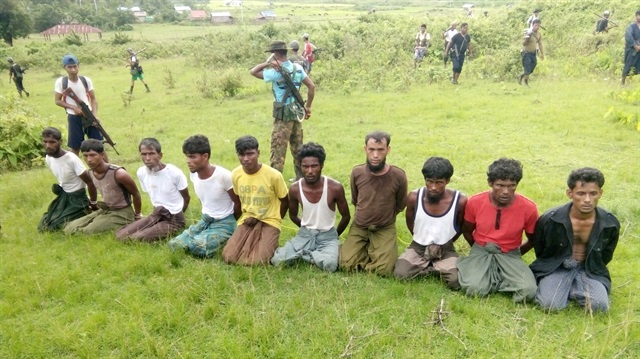
FILE PHOTO: Ten Rohingya Muslim men with their hands bound kneel as members of the Myanmar security forces stand guard in Inn Din village.
Facebook has been “too slow” to address hate speech in Myanmar and is acting to remedy the problem by hiring more Burmese speakers and investing in technology to identify problematic content, the company said in a statement on Thursday.
The acknowledgement came a day after a Reuters investigation showed why the company has failed to stem a wave of vitriolic posts about the minority Rohingya.
Some 700,000 Rohingya fled their homes last year after an army crackdown that the United States denounced as ethnic cleansing. The Rohingya now live in teeming refugee camps in Bangladesh.
"The ethnic violence in Myanmar is horrific and we have been too slow to prevent misinformation and hate speech on Facebook,” Facebook said.
The Reuters story revealed the social media giant for years dedicated scant resources to combating hate speech in Myanmar, which is a market it dominates and where there have been repeated eruptions of ethnic violence.
In early 2015, for instance, there were only two people at Facebook who could speak Burmese monitoring problematic posts.
In Thursday’s statement, posted online, Facebook said it was using tools to automatically detect hate speech and hiring more Burmese-language speakers to review posts, following up on a pledge made by founder Mark Zuckerberg to U.S. senators in April.
The company said that it had over 60 “Myanmar language experts” in June and plans to have at least 100 by the end of the year.
Reuters found more than 1,000 examples of posts, comments, images and videos denigrating and attacking the Rohingya and other Muslims that were on the social media platform as of last week.
Some of the material, which included pornographic anti-Muslim images, has been up on Facebook for as long as six years.
There are numerous posts that call the Rohingya and other Muslims dogs and rapists, and urge they be exterminated.
Facebook currently doesn’t have a single employee in Myanmar, relying instead on an outsourced, secretive operation in Kuala Lumpur – called Project Honey Badger – to monitor hate speech and other problematic posts, the Reuters investigation showed.
Because Facebook’s systems struggle to interpret Burmese script, the company is heavily dependent on users reporting hate speech in Myanmar.
Researchers and human rights activists say they have been warning Facebook for years about how its platform was being used to spread hatred against the Rohingya and other Muslims in Myanmar.
In its statement on Thursday, Facebook said it had banned a number of Myanmar hate figures and organizations from the platform.
Bangladesh Foreign Minister AH Mahmood Ali on Saturday visited Myanmar’s restive Rakhine state, where security forces have been accused of committing crimes against humanity on the minority Rohingya Muslim community.A high-profile delegation led by Bangladesh Foreign Minister AH Mahmood Ali has toured transit camps as well as newly-built houses in the resettlement areas for the returnees, said Win Myat Aye, Myanmar’s minister of social welfare, relief and resettlement.Since Aug. 25, 2017, more than 750,000 refugees, mostly children and women, have fled Myanmar and crossed into Bangladesh after Myanmar forces launched a crackdown on the minority Muslim community, according to Amnesty International.At least 9,400 Rohingya were killed in Rakhine from Aug. 25 to Sept. 24 last year, according to Doctors Without Borders.In a report published recently, the humanitarian group said the deaths of 71.7 percent or 6,700 Rohingya were caused by violence. They include 730 children below the age of 5.“The delegation visited the area as they wanted to see themselves what we had prepared for the returnees,” said the minister, who was accompanying the visiting delegation.The delegation began four-day visit to Myanmar on Thursday to discuss matters on Rohingya repatriation with Myanmar government.According to a press release issued by Bangladesh’s Foreign Ministry, the visiting foreign minister emphasized on the need for accelerating efforts for conductive environment in the Rakhine state and building houses and villages for the returnees.The Rohingya, described by the UN as the world's most persecuted people, have faced heightened fears of attack since dozens were killed in communal violence in 2012.The UN documented mass gang rapes, killings -- including of infants and young children -- brutal beatings, and disappearances committed by security personnel.In a report, UN investigators said such violations may have constituted crimes against humanity.On Friday, the Bangladeshi foreign minister met with Kyaw Tint Swe, minister of Myanmar’s State Counselor Office in Nay Pyi Taw.After the meeting, Myanmar and Bangladeshi officials said in a joint press release that they agreed on several points including establishing reception centers and transit camps in both countries, combating terrorism, drug-trafficking in border areas as well as repatriation of displaced persons residing along the border between the two neighbors.
Bangladeshi delegation visits Myanmar’s Rakhine state
Médecins Sans Frontières (MSF), or more commonly known as Doctors Without Borders, has urged the Myanmar government to allow them to provide healthcare and humanitarian aid to the northern Rakhine State where it previously treated thousands of patients every month.In a press release issued on Friday, MSF has expressed the urgent need of humanitarian access to northern Rakhine saying, “While MSF has repeatedly requested that the Myanmar government grant it the necessary travel and activity authorizations to provide medical care to those in need, administrative red tape has made this impossible.”Myanmar to ICC: Rohingya jurisdiction request 'should be dismissed'“Medical needs must be independently assessed”MSF’s Operations Manager for Myanmar Benoit De Gryse stated, "The medical needs of the remaining Rohingya population in northern Rakhine, as well as those of ethnic Rakhine and other minorities, must be thoroughly and independently assessed.”“The lack of sustained independent assessments in northern Rakhine means that no one has a comprehensive picture of the situation on the ground and the medical and humanitarian needs,” Benoit added.UN urges Myanmar to speed Rohingya returns, grant citizenshipMSF has provided healthcare to all communities in northern Rakhine since 1994. When operations were suspended on August 11, 2017, MSF was operating four primary health care clinics in northern Rakhine—three of which were subsequently burnt down—and was providing over 11,000 primary and reproductive health care consultations per month, as well as emergency transport and assistance for patients requiring hospitalization, according to the MSF website.Bangladesh delegation to visit Rakhine StateAbout 700,000 Rohingya Muslims, according to U.N. estimates, fled from Buddhist-majority Myanmar to Bangladesh after a military crackdown in August 2017 that the United Nations has called ethnic cleansing.Refugees have reported killings, rape and arson on a large scale, but Myanmar has denied nearly all of the accusations, saying it waged a legitimate counter-insurgency operation after coming under attack from Rohingya militants. Relocation of Rohingya from ‘overcrowded’ camp demanded
Myanmar upholds blockade of aid to Rohingya Muslims in Rakhine
Myanmar said on Thursday a request by the International Criminal Court (ICC) prosecutor to seek jurisdiction over suspected deportations of Rohingya Muslims from Myanmar to Bangladesh was "meritless and should be dismissed".Judges at the court had asked Myanmar to respond to the request by July 27. The office of government leader Aung San Suu Kyi outlined reasons why Myanmar has declined to engage with the court on the matter and why it would not submit a response."The request by the prosecutor may be interpreted as an indirect attempt to acquire jurisdiction over Myanmar which is not a State Party to the Rome Statute," the office said in a statement, referring to the ICC's founding treaty.UN urges Myanmar to speed Rohingya returns, grant citizenshipReuters was not able to immediately reach the ICC for comment.The jurisdiction of the world’s first permanent war crimes court is limited to crimes committed on the territory of member states, or in cases referred to it by the U.N. Security Council.But ICC prosecutor Fatou Bensouda has asked the court to look into the Rohingya crisis and the court has sought the views of Bangladesh on the "exercise of territorial jurisdiction over the alleged deportation of members of the Rohingya people from Myanmar into Bangladesh".Bangladesh delegation to visit Rakhine StateSuu Kyi's office said Myanmar was "under no obligation to enter into litigation with the prosecutor" and setting the jurisdiction over the case would "set a dangerous precedent whereby future populistic causes and complaints against non-State Parties ... may be litigated."Myanmar has also alleged procedural irregularities and lack of transparency on the court's part.Relocation of Rohingya from ‘overcrowded’ camp demandedBensouda has said that, given the cross-border nature of the crime of deportation, a ruling in favour of ICC jurisdiction would be in line with established legal principles.However, she acknowledged uncertainty around the definition of the crime of deportation and limits of the court’s jurisdiction.Video: Rohingya sufferings know no end as flooded camps add to miseryAbout 700,000 Rohingya Muslims, according to U.N. estimates, fled from Buddhist-majority Myanmar to Bangladesh after a military crackdown in August 2017 that the United Nations has called ethnic cleansing.Refugees have reported killings, rape and arson on a large scale, but Myanmar has denied nearly all of the accusations, saying it waged a legitimate counter-insurgency operation after coming under attack from Rohingya militants.
Myanmar to ICC: Rohingya jurisdiction request 'should be dismissed'