

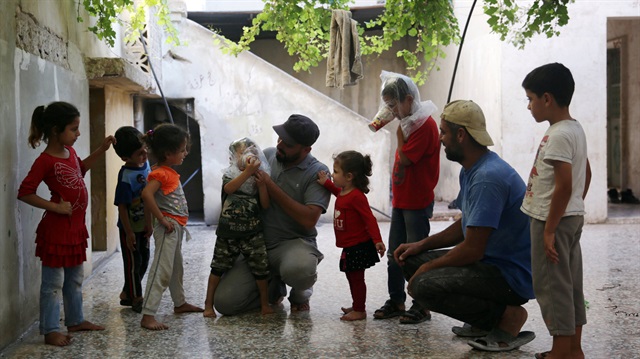
A boy tries an improvised gas mask in Idlib, Syria September 3, 2018.
Millions of residents in Syria's northwestern Idlib province, the final stronghold of Syrian oppositions, are concerned about Bashar al-Assad's possible attack on the city.
The expected ground attack is feared to trigger a mass exodus of refugees fleeing towards the Turkish border and European countries.
The following is a list of frequently asked questions regarding the ongoing calamity in Idlib:
An attack on Syria's Idlib, the last opposition-held stronghold, would be a massacre and the upcoming summit in Tehran, which will be attended by the leaders of Iran, Russia and Turkey, will yield positive results, Turkish President Recep Tayyip Erdoğan told reporters on the plane back from an official visit to Kyrgyzstan.“Turkey is working with Russia and Iran. Turkey has 12 observation posts in Idlib, and our security forces are resolutely carrying out their duties. There are 3.5 million people [in Idlib]. God forbid, if this area is hailed by missiles there would be a grave massacre. In that case, where would those fleeing go to? The majority would come to Turkey. This could give rise to a new issue,” Erdoğan said.“Apart from Idlib, be it regarding Tell Rifaat or Manbij, our efforts are ongoing. The Tehran summit will be held on Sept. 7. We will carry this issue to a positive point with the Tehran summit, which is a continuation of Astana. I hope we will be able to prevent the Syrian government's extremism in this region,” he added.Russia and Turkey, along with Iran are sponsoring the Astana peace talks, which focuses on a cease-fire and ending the seven-year civil war in Syria.UN aid chief fears worst humanitarian crisis in IdlibManbij roadmap not proceeding as plannedErdoğan stated that the road map for the northern Syrian city of Manbij agreed between Ankara and Washington in June is not proceeding as planned.“I can say that we are not at the point discussed by our foreign minister and [his U.S. counterpart] Mike Pompeo regarding Manbij. It is being neglected. We are not at an ideal point. Unfortunately the agreement made is not going forward in the same direction as the initial discussions. I hope that we will enter a new phase with the meetings our Foreign Minister [Mevlüt] Çavuşoğlu and our Defense Minister Hulusi Akar will hold with their counterparts,” Erdoğan said.Under the road map for Manbij agreed by the two NATO allies, Turkish and U.S. forces are now carrying out joint patrols to clear the area of the YPG.In a meeting on Tuesday, Turkish Defense Minister Hulusi Akar and the U.S. special representative for Syria, James Jeffrey, discussed the developments in Syria.Russia says in contact with Turkey regarding northern Syria“Right now, the situation in Idlib is of critical importance for us. A ruthless process has been going on there. God forbid, if disaster strikes, the first place they will be able to flee to is Turkey. Now such a risk is on the agenda at a time Syrians [in Turkey] have started to return,” Erdoğan said.Idlib, located in northwestern Syria on the Turkish border, has faced intense attacks by the Bashar al-Assad regime after a vicious civil war broke out in 2011. Since March 2015, Idlib is no longer under the control of the Assad regime and has been overrun by opposition groups.The Assad regime is currently preparing for an offensive to recapture the region.UN envoy urges Erdoğan, Putin to discuss IdlibTurkey-U.S. tiesThe Turkish president also said that U.S. President Donald Trump had not requested a meeting on the sidelines of this month’s UN general assembly, and that he would not submit a request either.Regarding the case of U.S. pastor Andrew Brunson, which has caused relations between Ankara and Washington to sour, Erdoğan said that Turkey cannot fulfill "unlawful requests.” Erdoğan added that Turkey followed the rule of law and the U.S. would not be able to make progress in the case by using threats.“As another example, we can look at the situation of Halkbank executive Hakan Atilla. He entered the U.S. six times, and they arrested him as he was leaving from his seventh visit. Halkbank doesn’t even have a branch in the U.S. What is the crime of Halkbank or its executive? There is no clear evidence. The law is not important for them [the U.S.]. They say that they are mighty, and therefore right,” Erdoğan said.Turkey expects no fine for Halkbank: FinMinA U.S. law firm hired by Turkey to look into state-owned Halkbank's dealings with Iran found that it did not violate U.S. sanctions. Law firm King and Spalding and data firm Exiger carried out the investigation after a Halkbank executive was charged in New York last year with taking part in a scheme to help Iran evade U.S. sanctions. The executive was found guilty and sentenced in May to 32 months in jail, a decision which Turkey said was politically motivated.Erdoğan hails new U.S. special representative for SyriaErdoğan lauded the new U.S. special representative for Syria, James Jeffrey, who met with Foreign Minister Mevlüt Çavuşoğlu and National Defense Minister Hulusi Akar on Tuesday in Ankara.“I believe Mr. [James] Jeffrey’s appointment is on point. During my visit to the U.S., I had met with him. I believe his appointment is so sagacious it cannot be compared to the previous envoy, who has not been taken off duty and is still active in the region. I hope his appointment will benefit this new process, and that it will enable some steps to be taken quicker,” Erdoğan said.Turkey tells US that YPG/PKK must leave SyriaTurkey-EU relations“Unfortunately, the EU has not responded to the positive steps Turkey has taken. We still have not received reciprocation. Many decisions were always postponed. From free movement to aid promised for refugees, we want to surpass these matters so that we can see ahead,” Erdoğan said.In 2016, Turkey and the EU signed a deal aiming to stem the irregular migration flow through the Aegean Sea by taking stricter measures against human traffickers and improving conditions for nearly 3 million Syrian refugees in Turkey.Turkey has long complained of the EU being slow to deliver the promised funds for refugees and failing to uphold its end of the deal concerning visa-free travel.Erdoğan’s upcoming visit to Germany“The EU, apart from a few exceptions, is not at the point we desire. I will make an official visit to Germany following the invitation of the president [Frank Walter Steinmeier]. The visit will also give me the opportunity to meet with [chancellor] Angela Merkel. There are many matters that must be evaluated regarding Turkey-Germany relations. There are over three million Turks in Germany. I place great importance upon this visit, which will give us the opportunity to discuss many issues face to face. Germany has a very critical position in the EU, and is virtually a leader,” he added.Macron should conduct return visit to Turkey“France seems more positive, but [French President Emmanuel] Macron did not conduct a return visit, and he should. We hold meetings and phone calls in order to make moves, but their approach regarding the developments in Syria are not too good. We cannot say that the approach of the Netherlands or Belgium is too good,” Erdoğan said.The Turkish president had visited France in early 2018.
Erdoğan says Idlib assault would be ‘a grave massacre’
Where is Idlib?
Located near the Turkish border city of Hatay, Syria's northwestern Idlib province is home to more than 3 million Syrians, many of whom fled from other cities following attacks by regime forces.
Idlib shares 130 kilometers (82 miles) borderline with Turkey and is bordered by Syrian province of Aleppo to the east; Aleppo's Afrin district to the northeast; Hama province to the south and Lattakia province to the northwest.
The rebel-controlled town has been under heavy air bombardment since October 2015 when Russia began to actively take part in the civil war.
How many civilians are living in Idlib?
Idlib has been hosting the highest number of refugees, roughly 1.3 million, as it is a city bordering Turkey and is relatively safe since the beginning of the war. Along with 2.4 million permanent residents, administrative records show that Idlib currently houses nearly 4 million civilians within its borders.
After attacks by the Assad regime and the forced migration, the population in the city has increased to nearly 4 million, including 2.4 million residents.
Could a large migration wave occur?
It is feared that a possible military campaign towards Idlib might trigger a wave of migration containing hundreds of thousands of people. Turkey, the EU and United Nations have announced in statements that a possible operation on Idlib might give birth to a fresh rush of migration.
In addition, Stephane Dujarric, the UN Secretary-General's spokesman, Wednesday said: "All parties are responsible for the protection of the civilians, under the international laws. I hope everything will be done to prevent a greater humanitarian plight."
4- Where does the Assad regime prepare?
With the aim of seizing the Idlib region, the regime has been sending military equipment to the frontlines near rural Latakia and northern Hama for more than two months. The Assad regime maintains the preparations, which has paced up recently, in Abu al-Duhur Airport, Skayiybiye of northern Hama, Silimfe regions in Latakia and line extending to Idlib.
5- What does Idlib mean for Syria?
Idlib, addressed as the "deadlock" of the civil war that has been ongoing for more than seven years, has importance in various aspects as a result of its location.
The M5 highway, which goes through the city, connects Turkey, Syria and Jordan. As for the Syria perspective, Idlib is like a door that opens to Mediterranean whilst neighboring Latakia, Hama and Aleppo. Given that it is right next to Latakia, where Russia's Khmeimim Air Base is located and which is regarded as the "fortress" of Assad regime, contributes to Idlib's strategic value.
Roughly 1,500 trucks carrying humanitarian aid per month crosses Bab al-Hawa Border Crossing in Idlib, making the city a key factor for war-weary civilians desperate for help. Besides, some 4,500 commercial trucks pass by the border crossing.
6- Why is Idlib important for Turkey's border security?
Idlib shares a borderline of some 130 kilometers with Turkey. Turkey is most worried that a conflict leads to a new wave of migration. Turkey currently hosts more than 3.5 million Syrians and works for a cease-fire maintenance in Idlib.
On the other hand, the Turkish Armed Forces have established 12 observation points within Idlib's de-escalation zones boundary, adding to the cities' significance. The fact that there are various armed groups in Idlib and they might try to infiltrate into Turkey in case of an operation should be kept in mind.
7- What does Turkey do in Idlib?
Following a consensus reached within the frame of the Astana Agreement, Turkey, in October 2017, entered Idlib to establish the cease-fire observation points within the boundary of the de-escalation zone areas.
As part of the deal, Turkish troops have presence only in the observation points of Idlib.
8- What is the Turkish impact on the solution?
As the civil war has been continuing for more than seven years, Turkey has been one of the most important peace actors. Sharing more than 900 kilometers of borders, Turkish influence on the region increases. Turkey still defends that the issue should be tackled through negotiation, as it said the same before the public demands were repressed violently by the Assad regime.
It has been stated that a solution excluding Turkey, which protects the life and property safety of the civilians and support the legitimate opposition both on field and diplomacy, will lead to a regional disaster.
With its stance on the solution, Turkey plays an effective role in eradicating the terror groups in Syria and represents the democratic and safety rights of the millions of Syrians, who are anticipated to continue living in Syria.
Turkey supports that the opposition and regime find a common political point.
9- Which groups are dominant in Idlib?
Idlib is currently divided between the opposition and Hayat Tahrir al-Sham, an armed anti-regime group. In May, 14 opposition groups fighting against the Assad regime united under the banner of "National Liberation Front". Faylaq al-Sham, Nasr Army, Free Idlib Army, 1st Beach Division, 2nd Beach Division, 1st Firqah, Distinguished Army, Shuda al-Islam Dareyya, Al-Hurriyah Brigade, 23rd Firqah, Syrian Liberation Front, Jaish al-Ahrar and Shukuru Sham have formed the largest military establishment against the regime, containing more than 70 thousand fighters.
Hayat Tahrir al-Sham is the other dominant force in Idlib.
After the Nusra Front, which was on the UN terrorism list, dissolved in early 2017, some 25,000 fighters formed Hayat Tahrir al-Sham. Despite that many of its components left the group, it still controls Bab al-Hawa Border Crossing.
A couple of other Nusra Front members formed another group called Hurra Seddin. According to Russians, terror groups are dominant in the region, however, the field reports tell the opposite.
Idlib is of huge importance as it is the only city under opposition control in Syria. As for the strategic window, it neighbors Turkey in northwest and is next to Aleppo in south, Aleppo's Afrin district in northeast, Hama in south and Latakia in northwest.
For the Syrian opposition, it is like a "last castle". Also, the biggest armed groups fighting against the Assad regime are located in Idlib.
10- What is the international actors' position on Idlib?
Some western countries, headed by the U.S., France and the U.K for the past weeks, exchanged words with Russia on the Idlib issue.
These three countries, in a joint statement on Aug. 21, said that they were "gravely concerned over reports of a military offensive by the Syrian regime against civilians and civilian infrastructure in Idlib." All of them reiterated condemnation of the use of chemical weapons by the Assad regime.
John Bolton, Assistant to U.S. President Donald Trump for National Security Affairs, also warned that they would "strongly" respond if the regime used chemical or biological weapons in Idlib.
On top of that, Russian media claimed the military opposition and White Helmet (Civil Defense) would collaborate with Western countries to perform a chemical attack.
The Russian Foreign Minister Sergey Lavrov said the U.S. planned for a provocation in Idlib to "protect the Nusra Front and assure the permanency of the turbulent situation in the region."
The Russian administration, making consecutive statements regarding Idlib, increased its military presence in the Mediterranean. Having sent warships to Latakia and Tartus, Russia will launch a drill in the Mediterranean expected to be the biggest of the modern history, which is viewed as an intimidation to the U.S. block.
As the crisis escalates, concerns rise on the safety of the civilians in the region.
The Syrian regime has recently announced plans to launch a major military offensive to the area, which is controlled by various armed opposition groups.
On Tuesday, the UN’s humanitarian chief Mark Lowcock warned such an offensive would lead to the "worst humanitarian catastrophe in the 21st century".
Turkish President Recep Tayyip Erdogan, Russian President Vladimir Putin, and Iranian President Hassan Rouhani are scheduled to meet in Tehran on Friday for a trilateral summit on Syria.
Iran's speaker of parliament said on Thursday he hoped the presidents of Russia, Turkey and Iran would reach a final agreement on Syria's opposition-held enclave of Idlib at a summit in Tehran on Friday, Russian news agencies reported."I really hope that at the summit tomorrow in Tehran, in which (President Vladimir) Putin is going to take part, he will be able to reach a certain final agreement with his colleagues on the events happening in Idlib," Iranian speaker Ali Larijani was quoted as saying by RIA during a trip to Russia. Warplanes strike Syria's opposition-held Idlib regionOver 8,000 PKK terrorists to join Idlib offensive: FSA commanderFrench army chief: ready to strike Syria if chemical weapons usedIf Syria is to be divided, so will Turkey, says Karagül
Iran speaker hopes agreement on Idlib will be clinched at Tehran summit
As a ground offensive against Syria’s Idlib looms, 8,500 terrorists from the Kurdistan Workers’ Party (PKK) are set to join any possible attack against the northwestern opposition stronghold in coordination with the Assad regime, according to an opposition commander. The PKK will be part of a 23,000-strong force comprised of terrorists belonging to the Syrian Resistance, Liwaa Iskenderun, Harakat al-Nujabaa, Fatimiyyoun, Asaeb Ahl al-Haq militias, among others.The Syrian regime has recently announced plans to launch a major military offensive in Idlib, which is controlled by various armed opposition groups.Turkish army under threatSpeaking exclusively to Yeni Şafak daily about the Idlib offensive, Free Syrian Army (FSA) General Naji Abu Huzaifah warned that observational posts belonging to the Turkish Armed Forces could come under attack. “PKK terrorists are currently being sent to Idlib from Raqqa, Manbij, Ayn al-Arab and Ayn Eissa. Turkish observational posts are on full alert. Turkey’s observational posts, particularly those near Morek, will be targeted in the case of a ground attack by PKK terrorists and gangs affiliated with Mihraç Ural.”Turkey, which has a military presence in observation posts it has erected along the frontlines between the opposition and government forces, reiterated its warnings against an offensive.Video: Syrian opposition prepares for possible Assad attack in Idlib‘Waiting for Tehran summit’Gen. Abu Huzaifah pointed that Russia and the Assad regime have different priorities in Idlib, noting that “Russia mainly wants to seize control over the Jisr al-Shughour region and the Damascus- Aleppo, Aleppo- Latakia highway in order to secure its Hmeymim Military Base.” “However, the regime wants to use Russia as a shield to destroy all opposition and reestablish its authority. The Assad- Russia- Iran bloc is unaware of how powerful we are in Idlib. It will not be easy for them here. However, we’re coordinating with Turkey and we’re awaiting the results of the Tehran summit.”Russia, an ally of Syrian President Bashar al-Assad, resumed air strikes in Idlib on Tuesday following weeks of bombardment and shelling by pro-Syrian government forces against the opposition’s last major enclave.The leaders of Russia, Turkey and Iran are due to meet on Friday in Iran and are expected to discuss the situation in northwestern Syria. Turkey, which backs the opposition against Assad, has said an offensive on Idlib would be disastrous. Ankara is sheltering 3.5 million Syrian refugees.French army chief: ready to strike Syria if chemical weapons usedIf Syria is to be divided, so will Turkey, says KaragülAreas to be targeted by Idlib attack The FSA commander proceeded to list the area that will be targeted by any possible attack, which will include Western Aleppo, Jisr al-Shughour, Turkmen Mount and Morek as the first of four fronts. The second and third front include the axes of Sahl al-Ghab- Joureen and Jisr al-Shughour-Kensibbeh, respectively. The fourth front includes Hama’s Hilfaya, Khbayyat and Soran, where Russia’s Wagner Brigade is stationed alongside Iranian-backed Shia militias, according to Gen. Abu Huzaifah. Meanwhile, members of Mihraç Ural’s Syrian resistance and Afghan Shia militias are stationed near the Rabia, Hamrat and Bahsa fronts. According to the FSA commander, the regime in Damascus, which struck a secret deal with PKK terrorists on Idlib, had assigned them to the Jamiyaat al-Zahraa- Handarat axis.Erdoğan to visit Iran for Syria summitTurkey condemned Russia's Idlib attack: FMGround attack only a matter of timeTurkey’s armed personnel carrier reinforcements continue to be dispatched from Turkish army units in Kilis, a province on Turkey’s border, to bases in Idlib, as a ground attack on the opposition stronghold looms.The reinforcements include modernized tanks, armed personnel carriers, artillery and excavators.Russian airstrikes result in civilian massacresSyrian opposition sources said that Russian military aircraft -- flying out of the Hmeimim airbase -- had carried out at least 20 separate attack sorties in recent days.Russian strikes had killed nine civilians -- including five children -- in Jisr al-Shughur, while leaving at least 20 more people injured.On Tuesday night, Russian Defense Ministry spokesman Igor Konashenkov confirmed the attack, saying Russia's Hmeymim Airbase in Syria destroyed two drones with surface-to-air missiles."On Sept. 4, at night, the anti-aircraft weapons of Hmeimim Airbase destroyed two terrorist assault UAVs,” Konashenkov said. Konashenkov said that 47 unmanned aerial vehicles that belonged to “terrorists” were destroyed last month in the area of Russia's Hmeymim Airbase."On the same day [September 4], four planes from the Russian air unit deployed at the Hmeymim Airbase carried out strikes on Nusra Front targets in Idlib with precision-guided munitions.”According to the spokesman, the strikes were carried out on storage facilities where drones were kept, located outside settlements, as well as "detected sites where assault drones were launched to carry out terrorist attacks on Russia's Hmeymim Airbase and settlements in the provinces of Aleppo and Hama."Artillery harassment fireOn Tuesday, regime mortar and artillery fire targeted the Idlib town of Jisr al-Shughour and the northern Hama town of Haysh following Russian airstrikes against the region, where close to 4 million Syrians, the majority of whom are internally displaced, had sought refuge after fleeing violence raging in other parts of the war-torn country.In a bid to thwart regime advances toward the region, opposition forces blew up the Twainiyyeh Bridge near Qalaat al-Madiq, which was already damaged by intermittent regime shelling targeting the area.Morek barrier Idlib’s southeastern Mount Morek, where a number of Turkish army observation posts are located, is among the targets that are set to be attacked by Iranian-backed Shia militias and PKK terrorists. As Turkish reinforcements continue to be dispatched to the region, work is ongoing to fortify Turkey’s observational posts by ramping up personnel numbers and putting up large concrete blocks and barricades around the strategic bases, in a bid to strengthen these positions against possible attacks.
Over 8,000 PKK terrorists to join Idlib offensive: FSA commander
Turkey has conveyed to Russia its condemnation of the recent attack in Syria's Idlib, the Turkish foreign minister said on Wednesday."After the attack, our institutions [Turkish and Russian] contacted each other. We told them that this is wrong," Mevlüt Çavuşoğlu said, speaking at a joint news conference with his German counterpart Heiko Maas.Çavuşoğlu said the attacks are aimed at "capturing Idlib", which he said, "carries a serious risk" and "would be disastrous from many angles". Russian warplanes on Tuesday pounded civilian and opposition targets in Idlib.Turkey follows generous policy for Syrians: Dutch min.Located near the Turkish border, Idlib is home to more than 3 million Syrians, many of whom fled from other cities following attacks by regime forces.The Syrian regime has recently announced plans to launch a major military offensive to the area, which is controlled by various armed opposition groups.On Tuesday, the UN’s humanitarian chief Mark Lowcock warned that such an offensive would lead to the "worst humanitarian catastrophe in the 21st century".Turkish President Recep Tayyip Erdoğan, Russian President Vladimir Putin, and Iranian President Hassan Rouhani are scheduled to meet in Tehran on Friday for a trilateral summit on Syria.Idlib offensive could trigger new wave of migration to Europe, TurkeyRussia says summit to help clarify military situation in Syria's Idlib
Turkey condemned Russia's Idlib attack: FM
As the Assad regime and Russia shell the last opposition-held stronghold of Syria’s Idlib, humanitarian agencies are worried about internally displaced citizens and refugees flocking to Turkey and Europe.Speaking to Yeni Şafak daily, head of the Turkish Red Crescent Kerem Kınık emphasized that if a battle breaks out in Syria’s opposition-held Idlib, hundreds of thousands of civilians would flee to Turkey and Europe, which would spell the start of a “new immigration wave.”On Tuesday, Russian warplanes bombed several areas in the last opposition-held stronghold of Idlib, raising worries of a major assault by the Assad regime forces and its allies.Stressing the importance of the international community’s need to gain the trust of Syrian civilians, he said: “The immigration issue is not a threat to Turkey alone, it can turn into an immigration wave toward Europe. This issue must be resolved at the [diplomacy] table. However, we have taken every precaution both in Turkey and Syria.”The Turkish Red Crescent has been providing humanitarian aid to Syrians since March 15, 2011.'White Helmets saved 115,000 lives in Syria' Migration issue must be solved by diplomacyStating that seven million civilians were internally displaced in Syria, “2.5 million of these people are in Idlib. A wave of fear could mobilize them. We witnessed this in Ghouta. It is impossible to govern this many people. This problem must be solved at the table.” “Civilians in Idlib trust Turkey, not Russia or Iran,” he concluded.Idlib, located in northwestern Syria on the Turkish border, has faced intense attacks by the Bashar al-Assad regime after a vicious civil war broke out in 2011. Since March 2015, Idlib is no longer under the control of the Assad regime and has been overrun by opposition groups.New refugee camps to be establishedThe Turkish Red Crescent is continuing to take measures against a possible new migration wave from Syria’s Idlib and to manage the process efficiently they will implement the “help on the ground” strategy.“We will increase the capacity of the designated refugee camps in the event of a new migration wave in the areas within the scope of the Euphrates Shield and Olive Branch operations. We will establish new camps if needed,” Kınık said.He added that the organization has been supporting Syrians accommodated in 40 separate camps with 30,000 tents.“We continue to dispatch tents and provide humanitarian relief. Mobile health vehicles will be added to our regular services in the near future. These healthcare vehicles will be used in the case of a possible emergency. Aid for the disabled, orphans, elders and widows will be increased. We will reach our goal by helping as many people as possible, Kınık said.Syria has been locked in a vicious civil war since early 2011 when the Assad regime cracked down on pro-democracy protests with unexpected ferocity.Since then, hundreds of thousands of people have been killed and more than 10 million others were displaced, according to UN officials.Assad regime shells Syria's IdlibRussia says in contact with Turkey regarding northern SyriaSyrian opposition head calls on world to ‘stop the massacre’ in Idlib
Idlib offensive could trigger new wave of migration to Europe, Turkey
The U.S., taking advantage of the rising tensions in last-opposition-held stronghold of Idlib, is sending military reinforcements to areas occupied by the Kurdistan Workers’ Party (PKK) terror group east of the Euphrates River in Syria.It delivered 200 truckloads of ammunition on Tuesday to Syria’s Raqqa, which is currently under the occupation of the Syrian offshoot of the PKK, the People’s Protection Units (YPG).The U.S has supplied the YPG terror organization with more than 5,000 truckloads of weapons to allegedly use in the fight against Daesh, despite Ankara’s warnings that the group is the Syrian offshoot of the PKK terror organization.Washington escalates warning to AssadThe White House on Tuesday warned, "If Syrian President Bashar al-Assad chooses to again use chemical weapons, the United States and its allies will respond swiftly and appropriately,” in an attempt to escalate chaos in the region.President Donald Trump in the past year and a half has twice ordered U.S.-led air strikes against targets in Syria in response to what Washington called the Assad government’s use of chemical weapons against civilians.On Tuesday, Russian warplanes bombed several areas in Idlib, raising worries of a major assault by the Assad regime forces and its allies.Located near the Turkish border, Idlib is home to more than 3 million Syrians, many of whom fled from other cities following attacks by regime forces.Pentagon’s no-fly zone strategyThe Washington administration, which intends to maintain a permanent presence in Syria, has completed the construction of three advanced radar systems in Syria’s Hasakah-Tal Baidar countryside along with the Ayn al-Arab and Sarrin regions, and has set up 13 portable and fixed observation-intelligence radar systems.Pentagon’s preparation for a no-fly-zone indicates that the U.S. administration also wants to interfere in Turkey’s military operations to ensure the safety of PKK terrorists after Ankara’s successful ops conducted in Syria’s Hasakah, Qarrah Chouk Mountains and Iraq’s Sinjar.US trains 40,000 terroristsIn January, the U.S.-led international coalition against Daesh announced that it would establish a 30,000-strong new border security force, funded by Saudi Arabia, with the SDF -- the U.S.-backed group that is largely controlled and manned by the PKK/PYD terrorist organization in Syria. The U.S. and its allies have also trained around 40,000 PKK terrorists since 2015.The purpose of Washington is to put pressure on the Damascus regime to approve a PKK autonomy in the region.The PKK is listed as a terrorist organization by Turkey, the European Union and the United States. The PKK has been conducting armed violence in the southeastern part of Turkey since 1984. More than 40,000 people, mostly civilians, have been killed in the three-decade long conflict.
US takes advantage of Idlib crisis to increase support for PKK/YPG in Syria
The Assad regime shelled Syria's northwestern Idlib province on Wednesday after Russia resumed air strikes the previous day.Syrian President Bashar al-Assad has sworn to recapture every inch of Syria and has made big gains against the opposition since Russia joined his war effort in 2015.Last week, a source close to Damascus said the government was preparing a phased offensive to recover Idlib province, but Turkey, whose army has a string of observation posts around the edge of the opposition area, has warned against such an assault.Russian air raids ceased in and around Idlib on August 15, but pro-Syrian government forces have maintained an aerial bombardment and shelling.Russia says in contact with Turkey regarding northern SyriaUN envoy urges Erdoğan, Putin to discuss IdlibUN aid chief fears worst humanitarian crisis in Idlib
Assad regime shells Syria's Idlib