

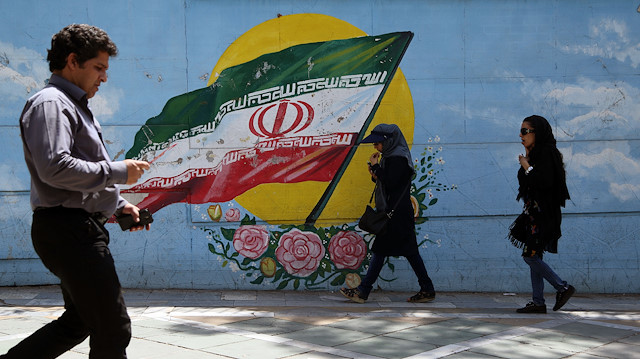
Struggling to cope, Iranians fear more misery from US sanctions
Iranians fear an even more painful squeeze on living costs after additional U.S. sanctions take effect on Monday, from businesses struggling to buy raw materials to the sick and elderly unable to afford life-saving medicines.
The United States will reapply curbs to the country's vital petroleum and banking sectors on Monday in an effort to rein in its arch foe's nuclear, missile and regional activities.
Iran's clerical rulers have played down the U.S. move, but many ordinary Iranians appear apprehensive.
"All the prices are going higher every day ... I cannot imagine what will happen after 13 Aban (Nov. 4). I am scared. I am worried. I am desperate," said elementary school teacher Pejman Sarafnejad, 43, a father of three in Tehran.
"I cannot even buy rice to feed my children or pay my rent."
The daily struggle to make ends meet has been getting harder for months: The economy was battered by the reimposition of a first raft of U.S. curbs in August after Washington's pullout from a nuclear deal between Tehran and global powers in May.
Foreign businesses of all types, ranging from oil companies, trading houses to shipping, have stopped doing business with Iran for fear of incurring U.S. penalties.
A Tehran Grand bazaar grocery shop owner said: "I am very nervous because already there is shortage of some goods in the market and the rial has lost so much value.
"What will happen after the reimposition of new sanctions?"
Iran's leadership says Tehran will not succumb to pressure to halt its missile programmes or to change its regional policy.
"Political Slogans"
Yet while some Iranians back their leaders' defiance, others are fearful that the economy, weakened by years of sanctions, mismanagement and corruption, may collapse when the U.S. puts more pressure on the world's Number 3 crude exporter.
"Statements by government officials that ... the sanctions (will) have no impact are political slogans," said Washington-based lawyer Farhad Alavi, who focuses on U.S. trade regulation and sanctions.
"The fact is that these restrictions significantly increase transaction costs for Iranians."
Since the reimposition of the first round of curbs in August, prices of bread, cooking oil and other staples have soared and the rial national currency has fallen sharply.
The EU, Germany, Britain and France said on Friday in a joint statement that they “deeply regret the further re-imposition of sanctions by the United States".The statement said: “We deeply regret the further re-imposition of sanctions by the United States, due to the latter’s withdrawal from the Joint Comprehensive Plan of Action (JCPoA).”It came shortly after the U.S. announced it is reimposing all sanctions lifted under a 2015 nuclear pact world powers struck with Iran.The new wave of sanctions reimpositions, the second since August, will target Iran's energy, shipbuilding, shipping, and financial sectors.The statement termed the nuclear pact as “a key element of the global nuclear non-proliferation architecture and of multilateral diplomacy, endorsed unanimously by the UN Security Council through Resolution 2231"."It is crucial for the security of Europe, the region, and the entire world,” it said.The countries aim to "protect European economic operators engaged in legitimate business with Iran, in accordance with EU law and with UN Security Council resolution 2231.""As parties to the JCPoA, we have committed to work on, inter alia, the preservation and maintenance of effective financial channels with Iran, and the continuation of Iran’s export of oil and gas."Iran has no concerns over reimposition of new US sanctions: ministry officialIranian planes refused fuel in TurkeyUS oil sanctions on Iran threaten 'paralyzed' economyIran says report of US oil waivers shows market needs Iranian crude
EU, Germany, UK, France deeply regret Iran sanctions
Russian state-owned oil producer Zarubezhneft has pulled out of projects in Iran because of looming U.S. sanctions, two sources at the company told Reuters on Friday.The National Iranian Oil Company has signed a deal with Zarubezhneft to develop two oilfields, Aban and Paydar-e Gharb, in Iran.The 10-year agreement was intended to boost the production of the fields to 48,000 barrels per day from current 36,000 bpd. The fields are expected to produce a total of 67 million barrels of oil over the 10 years.Zarubezhneft has an 80 percent share in the deal and its Iranian partner, Dana Energy, the remaining 20 percent.Iranian planes refused fuel in TurkeyThe cost of developing the fields was estimated at $674 million, with an additional $68 million in indirect costs, according to SHANA, the news site of the Iranian oil ministry.However, a source at the Moscow-headquartered company said imminent U.S. sanctions against Iran meant it had pulled the plug on the projects."Zarubezhneft left all the projects in Iran due to sanctions," a source said. The company declined to comment.The United States is imposing new sanctions from Monday on Iran's oil industry after Washington withdrew from a nuclear deal between Tehran and other global powers earlier this year.US oil sanctions on Iran threaten 'paralyzed' economy"We would lose foreign currency revenue had we'd been hit by the sanctions," the source said, adding that this would also have a negative impact on its partners in other projects.Zarubezhneft's main area of activity has been offshore oil in Vietnam since the 1980s.Another source said the company had no plans to work in Iran.The Iran deal was first struck in March and Zarubezhneft's subsidiary, ZN-Vostok, opened an office in Tehran in April, according to the ownership records in Russian database SPARK.Iran says report of US oil waivers shows market needs Iranian crudeThe database also showed that ZN-Vostok is now controlled by Promsirieimport, a trading unit of Russia's Energy Ministry, which has been involved in Iranian oil trading.The energy ministry declined to comment on Zarubezhneft's decision.In May, Russian oil producer, Lukoil said it had decided not to go ahead with plans to develop projects in Iran at the moment due to the threat of U.S. sanctions.The company was in talks with Iran over development of Abe Timur and Mansuri oilfields.US grants eight countries Iran sanctions waivers
Russian oil producer Zarubezhneft quits Iran projects due to sanctions
Rice, one of the staples of Iran's diet, has more than tripled in price since last year because of the rial's fall.
Ordinary Iranians fear cuts in Iran's oil sales could be the ultimate hammer blow to the economy, since energy exports are still the country's main source of earnings.
Iranian leaders hope sanctions waivers granted to eight buyers of Iranian crude, combined with rising oil prices, will compensate for a reduction oil export volumes.
But even without the new measures due on Monday, Iranian businessmen have been finding it harder to cope.
Some 70 percent of small factories, businesses and workshops have already started to shut down in the past months due to lack of raw materials and hard currency, according to Iranian media.
Life Grows Harder
"I had to close my business. Those European companies that were racing to ink a deal with me last year, now refuse to return my calls," said a businessman in Tehran, who declined to be named.
Mohammad Reza Sadoughi says ordinary people will bear the brunt of the sanctions, in terms of medicines for the sick such as cancer patients and food shortages and currency problems.
"My father has cancer, and with sanctions, the cancer-treatment medicine that his life depends on will only be available in the black market for a higher price," said the 38-year-old government employee in the northern city of Sari.
The U.S. sanctions permits trade in humanitarian goods such as food and pharmaceuticals. Yet measures imposed on banks and trade restrictions will make life hard for Iranian patients.
"At the end of the day, it's the Iranian people with their aspiration to lead a good life who are suffering due to lack of good sense from their own regime who are not ready to compromise with the world power (U.S.)," said Dubai-based businessman Aftab Hasan, a member of the Iranian Business Council in Dubai.
However analysts say that economic grievances are unlikely to revive anti-government unrest such as the demonstrations in December that turned into anti-government rallies.
"I don't care about politics. I don't care who is responsible for our problems. I don't want a regime change. I just want to live peacefully with my family in my country," said housewife Fariba Shakouri, 51, in the central city of Yazd.
The United Arab Emirates' minister of state for foreign affairs, Anwar Gargash, said on Saturday that Iran's "aggressive policies" were "largely responsible" for the reimposition of U.S. sanctions on Tehran.Washington will on Monday reintroduce far-reaching sanctions on Iran's vital oil sales and banking sectors to try to force the Islamic Republic into negotiations to scrap its nuclear energy and ballistic missile programmes and end its support for proxies in conflicts across the Middle East.Iran's top leader was earlier reported as saying that U.S. President Donald Trump's policies face opposition across the world as Washington prepared to reimpose sanctions on Iran's vital oil-exporting and financial sectors.Iran has no concerns over reimposition of new US sanctions: ministry officialIranian planes refused fuel in TurkeyUS oil sanctions on Iran threaten 'paralyzed' economy
UAE blames Iran's 'aggressive policies' for US sanctions
Iran called on Saturday for European assurances of support in the face of Washington's intent to reimpose sanctions on vital Iranian oil sales to force Tehran to curb its nuclear, missile and regional activities.Foreign Minister Mohammad Javad Zarif spoke by telephone with the European Union's foreign policy chief, Federica Mogherini, and his counterparts from Germany, Sweden and Denmark about European measures to counter the U.S. sanctions, the Iranian state news agency IRNA reported."Mogherini and the European ministers ... highlighted the importance of the finance ministers' commitment to Europe's financial mechanism to save the Iran nuclear deal and said the mechanism will be operational in the coming days," IRNA said.Washington will reapply far-reaching sanctions on Iran's petroleum and banking sectors starting on Monday.Diplomats told Reuters last week that the new EU mechanism to facilitate payments for Iranian exports should be legally in place by Nov. 4, when the next phase of U.S. sanctions hit, but will not be operational until early next year.The EU, France, Germany and Britain, said in a joint statement on Friday they regretted U.S. President Donald Trump's decision to restore sanctions on Iran, the world's No. 3 oil ezporter."Our aim is to protect European economic actors who have legitimate commercial exchanges with Iran, in line with European legislation and the United Nations' Security Council resolution 2231," Mogherini and the foreign ministers and finance ministers of the three countries said in their statement.The three biggest European powers are co-signatories, along with Russia and China, to an international 2015 deal with Iran that reined in its nuclear work in exchange for the lifting of most international sanctions on Tehran.With the sanctions clampdown, Trump is seeking to push Iran into stricter curbs on its nuclear programme and a halt to its missile development activity and support for proxy forces in Yemen, Syria, Lebanon and elsewhere in the Middle East.Trump denounced the nuclear deal, signed before he took office, as flawed in Iran's favour and withdrew Washington from the pact in May.Meanwhile, Iranian state television reported that the Islamci Republic had started production of the locally-designed Kowsar fighter plane for use in its air force. Iran has no concerns over reimposition of new US sanctions: ministry officialIranian planes refused fuel in TurkeyUS oil sanctions on Iran threaten 'paralyzed' economyIran says report of US oil waivers shows market needs Iranian crude
Iran seeks European assurances as US oil sanctions loom
Turkish Trade Minister Ruhsar Pekcan said on Saturday that Turkey has received initial indications that it will be among eight countries to be granted a waiver from U.S. sanctions against Iran, but is awaiting clarification on Monday.NATO member Turkey depends heavily on imports to meet its energy needs and neighbouring Iran has been one of its main sources of oil because of its proximity, the quality of its crude and favourable price differentials."Initial information coming in is that Turkey will be amongst eight exempt countries. But we don't know for sure yet. It will be clear on Monday," Pekcan told reporters in Ankara.Iran has no concerns over reimposition of new US sanctions: ministry officialIranian planes refused fuel in Turkey
Turkey expects to know on Monday if has waiver for Iran sanctions