

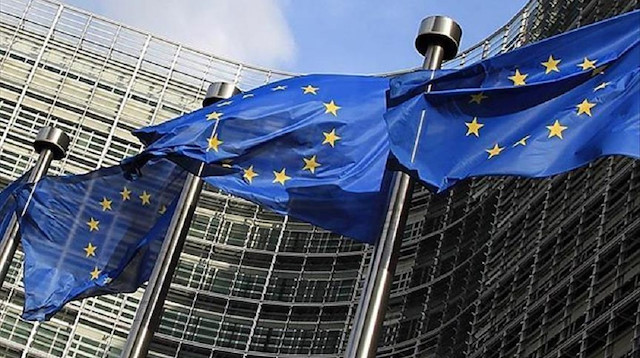
The EU, Germany, Britain and France said on Friday in a joint statement that they “deeply regret the further re-imposition of sanctions by the United States".
The EU, Germany, Britain and France said on Friday in a joint statement that they “deeply regret the further re-imposition of sanctions by the United States".
The statement said: “We deeply regret the further re-imposition of sanctions by the United States, due to the latter’s withdrawal from the Joint Comprehensive Plan of Action (JCPoA).”
It came shortly after the U.S. announced it is reimposing all sanctions lifted under a 2015 nuclear pact world powers struck with Iran.
The new wave of sanctions reimpositions, the second since August, will target Iran's energy, shipbuilding, shipping, and financial sectors.
The statement termed the nuclear pact as “a key element of the global nuclear non-proliferation architecture and of multilateral diplomacy, endorsed unanimously by the UN Security Council through Resolution 2231".
"It is crucial for the security of Europe, the region, and the entire world,” it said.
The countries aim to "protect European economic operators engaged in legitimate business with Iran, in accordance with EU law and with UN Security Council resolution 2231."
"As parties to the JCPoA, we have committed to work on, inter alia, the preservation and maintenance of effective financial channels with Iran, and the continuation of Iran’s export of oil and gas."
Iran said on Friday that it had no concerns over the reimposition of new U.S. sanctions on the country's vital oil and financial sectors, expected to be announced by Washington on Nov. 4."America will not be able to carry out any measure against our great and brave nation ... We have the knowledge and the capability to manage the country's economic affairs," Iran's Foreign Ministry spokesman Bahram Qasemi told state TV. Russian oil producer Zarubezhneft quits Iran projects due to sanctionsUS oil sanctions on Iran threaten 'paralyzed' economyIran says report of US oil waivers shows market needs Iranian crudeUS grants eight countries Iran sanctions waivers
Iran has no concerns over reimposition of new US sanctions: ministry official
The OMV Petrol Ofisi Holding A.Ş., a subsidiary of Vitol Investment Partnership Ltd., refused to provide fuel to Iranian airplanes in Turkey, according to reports.Earlier, Bloomberg reported that U.S. government had agreed to let eight countries, including close allies South Korea and Japan, as well as India, keep buying Iranian oil after it reimposes sanctions on Tehran from next week.Turkey’s Energy Ministry said on Friday it had heard rumors of waivers but added it had not received written notification of any exemption on buying Iran oil after the United States reimposes sanctions on Tehran on Nov. 5.Bloomberg also reported that Tüpraş, which is Turkey's largest industrial enterprise, expects for an exemption from U.S. sanctions. US oil sanctions on Iran threaten 'paralyzed' economyIran says report of US oil waivers shows market needs Iranian crudeIsraeli official says Khashoggi death 'despicable', but Iran greater challengeUS grants eight countries Iran sanctions waivers
Iranian planes refused fuel in Turkey
U.S. President Donald Trump’s sanctions on Iran aim to eliminate its oil trade, "paralyzing" Iran's economy, thus boosting Trump's reelection hopes, even though most countries oppose these sanctions, said a regional analyst late Thursday.The first phase of the U.S. sanctions on Iran impacted sectors like automotive, banking, and mining and the second phase will mainly target the country's oil exports, which Iran's economy depends on, Hakkı Uygur, vice director of the Center for Iranian Studies (IRAM), told a panel on "Iran Sanctions, Impacts on Turkey and the Region" organized by the Foundation for Political, Economic and Social Research (SETA) in the Turkish capital Ankara.In May, Trump unilaterally withdrew his country from the 2015 landmark nuclear deal signed between Iran and the P5 1 group of nations -- the five permanent UN Security Council members: the U.S., Russia, China, Britain, and France, plus Germany. He also announced that he would reinstate sanctions against Tehran, which were lifted by the agreement in exchange for tight restrictions on the country's nuclear program.The U.S. in August re-imposed the first round of economic sanctions on Iran, which mainly target the country’s banking sector.Iran says report of US oil waivers shows market needs Iranian crudeThe second phase of sanctions, targeting Iran’s energy sector, is set to go into effect on Nov. 5."If Trump manages to cut off the country's oil trade, this will lead to a paralyzed Iran economy," Uygur underlined.However, Uygur said, this is not a good way to bring Iran to the table because the Iranian people know Trump wants to create a victory out of this process before he is up for reelection in 2021."Iran has two options,” Uygur explained.“They will either wait for the end of Trump's term, which is the dominant attitude now, or they will see how the sanctions work. But I can say that Iran's hand is strong this time because almost all countries are against the sanctions."Uygur also said Turkey, as a neighbor to Iran, wants stability in the region and imports almost half of its oil needs from the country."Turkey also imports a significant amount of gas and does trade to Central Asia through Iran," he said.Israeli official says Khashoggi death 'despicable', but Iran greater challengeSanction exemption talks between Turkey, USKemal Inat, SETA's assistant general coordinator and director of energy studies, warned that Turkey itself will face U.S. sanctions if the country acts against the U.S.' reimposed Iran sanctions."Turkey is talking with the U.S. about being exempted from the sanctions, but I don’t think they will be successful. If Trump's main aim is eliminating Iran’s oil trade entirely, then he will definitely want Turkey to stop buying oil from Iran at some point," he said.US grants eight countries Iran sanctions waivers
US oil sanctions on Iran threaten 'paralyzed' economy
Iran said on Friday that a report that eight countries had been granted waivers to U.S. sanctions on Iranian oil showed that Iran's crude was needed and could not be withdrawn from the market. "The waivers granted to these eight countries shows that the market needs Iran's oil and it cannot be pulled out of the market ... I don't know whether these waivers are permanent or temporary ones," state TV quoted Iran's deputy Oil Minister Ali Kardor as saying.Bloomberg reported that U.S. government had agreed to let eight countries, including close allies South Korea and Japan, as well as India, keep buying Iranian oil after it reimposes sanctions on Tehran from next week.US grants eight countries Iran sanctions waivers
Iran says report of US oil waivers shows market needs Iranian crude