

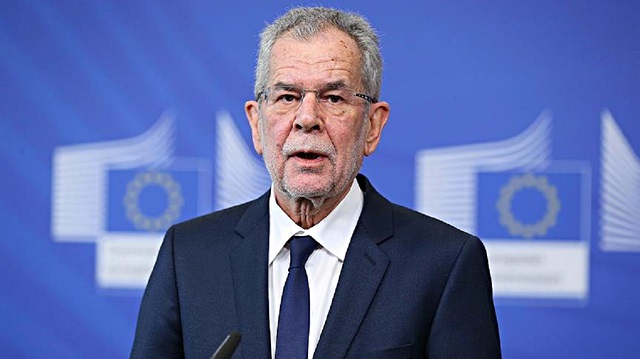
Alexander Van der Bellen
Austria fully supports Serbia's path to the European Union, but first it must resolve its issues with Kosovo, said Austria’s president on Wednesday, on a two-day visit to the capital Belgrade.
"The Union must insist that open bilateral issues, border issues [with Kosovo] must be clarified," said Alexander Van der Bellen at a joint press conference with Serbian President Aleksandar Vucic.
Van der Bellen, whose country currently holds the EU's rotating presidency, added that there is a prevailing opinion in the EU that these issues have to be overcome and he believes Vucic is working hard to resolve them.
Austria may follow the United States and Hungary in backing out of a United Nations agreement on migration, its government said on Wednesday, citing concern about its sovereignty and potential restrictions on its freedom to act.The Global Compact for Safe, Orderly and Regular Migration was approved in July by all 193 U.N. member nations except the United States, which backed out last year.Hungary's right-wing government led by Prime Minister Viktor Orban, an immigration hard-liner, has said it will not sign the final document at a ceremony in December. Poland, which has also clashed with Brussels by resisting national quotas for asylum seekers, is considering taking the same step."We view some of the points in this agreement very critically. We will therefore do everything to maintain the sovereignty of our country and ensure that we as the Republic of Austria can decide for ourselves on migration issues," Chancellor Sebastian Kurz told a news conference.Turkish agency provides jobs to Afghans returning homeKurz led his conservatives to victory in last year's parliamentary election by pledging to prevent any repeat of the European migration crisis that began in 2015, when Austria took in more than 1 percent of its population in asylum seekers.Kurz went into government with the anti-Islam Freedom Party and together they have agreed to restrict immigrants' access to welfare payments as part of an agenda that is also heavy on law and order.Speaking after a weekly cabinet meeting, Kurz and his vice chancellor, the Freedom Party leader Heinz-Christian Strache declined to say specifically which points they were concerned about other than that they affect countries taking in migrants."We are in close contact with states like Switzerland and we in the government will determine a concrete course of action in the coming weeks," Kurz said, adding that Denmark was another country with similar concerns.The Swiss government, however, said in a statement on Wednesday that its own analysis had found that the U.N. pact "corresponds with Switzerland's interests in migration".It described the accord, which aims to set standards for safe and orderly migration, as politically rather than legally binding. Austria said it was examining the extent to which the agreement is binding. "It cannot ... be that any formulations are adopted that could perhaps or possibly be interpreted to mean that migration can be a human right. That can and must not be the case," Strache told the news conference. 
Austria has concerns about UN migration pact, might back out
Kosovo declared independence from Serbia in 2008, but Belgrade insists the country remains part of Serbia. Since then tensions have remained high between Kosovo’s ethnic-Albanian majority and a small Serb minority in the north.
Kosovo is recognized by over 100 countries, including Turkey, U.S., Britain, France, and Germany.
"If there is a conciliatory solution between the two sides, then the European Union, the United States, and all the direct and indirect participants will be very happy to examine this peaceful and agreeable solution," said Van der Bellen.
He added that Serbia is in the leading position among candidates for EU membership.
Opposition leader Christian Kern said on Saturday he would leave politics and not run as the top candidate for the Austrian Social Democrats in European parliamentary elections next year, giving in to pressure from party critics.Just a few weeks after announcing his intention to run in the elections, the 52-year-old former chancellor blamed internal party disputes for his decision, saying he would be unable to focus on European politics."As a former head of government, it is not possible to leave the domestic political stage," Kern said at a last-minute news conference in Vienna. "For me, this is the end as a professional politician."Since losing power last year, the Social Democrats have been preoccupied with internal struggles and have failed to benefit from unpopular reforms - including longer working hours - introduced under the far right coalition led by Sebastian Kurz.Kern said he wanted to give new party chief Pamela Rendi-Wagner the chance to build up a strong opposition without him as a "permanent shadow".
Austria's ex-chancellor Kern quits politics, will not run in European elections
"It is quite clear and I think it is obvious that Austria fully supports the path of Serbia to the EU, and maybe this visit is small proof of that," said Van der Bellen.
Vucic, for his part, said he had told Bellen that Serbia is always ready to talk with Kosovo and hold an open dialogue on key issues, but repeated that a compromise solution is needed.
The two presidents are set to attend a Serbian-Austrian Business Forum, and Van der Bellen will meet with Serbian Prime Minister Ana Brnabic.
On day two of the visit, Van der Bellen and Vucic will take part in the eighth Belgrade Security Forum.
This is the third meeting of the two presidents this year.