

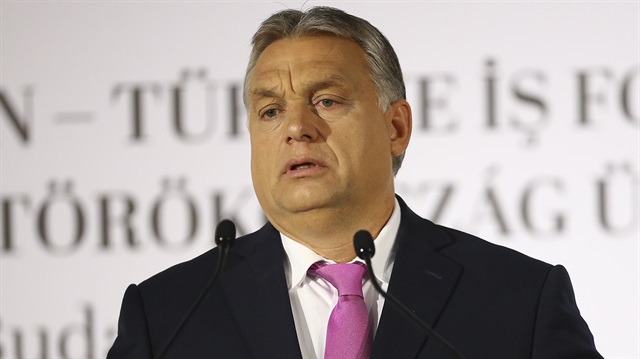
Viktor Orban
Austria may follow the United States and Hungary in backing out of a United Nations agreement on migration, its government said on Wednesday, citing concern about its sovereignty and potential restrictions on its freedom to act.
The Global Compact for Safe, Orderly and Regular Migration was approved in July by all 193 U.N. member nations except the United States, which backed out last year.
Hungary's right-wing government led by Prime Minister Viktor Orban, an immigration hard-liner, has said it will not sign the final document at a ceremony in December. Poland, which has also clashed with Brussels by resisting national quotas for asylum seekers, is considering taking the same step.
"We view some of the points in this agreement very critically. We will therefore do everything to maintain the sovereignty of our country and ensure that we as the Republic of Austria can decide for ourselves on migration issues," Chancellor Sebastian Kurz told a news conference.
The Turkish Red Crescent (Turk Kizilayi) on Wednesday gave two shops to two Afghan nationals, as part of a project to support Afghans who voluntarily return to their countries.The project provides job opportunities to Afghans after their voluntary return to their homeland.In a ceremony held in the Afghan capital Kabul, two Afghan nationals were given a shop and a carpentry workshop within the framework of the project.Speaking at the ceremony, Ibrahim Altan, head of the Turkish Red Crescent, said the Afghan nation liked working and the agency is making efforts to support them.Turkish planes carrying aid arrives in Indonesia's Palu“At the first phase, we have opened a shop and a carpentry workshop for two Afghan brothers who are living in Kabul.“The five-month rent of the shops and all the materials in it were provided by the Turkish Red Crescent,” Altan said.He went onto say that they prepare everything and the Afghan people coming back to the country were having their own businesses straightaway.Altan said the support activities will continue in different fields.Oguzhan Ertugrul, the Turkish ambassador to Kabul, said he knew the living conditions and the security were the biggest problems in the country.“Despite the negativities, no one should lose hope,” said Ertugrul, adding that Turkey would continue to stand with Afghanistan.He said those who make good use of the opportunities provided by the Turkish Red Crescent could contribute to the livelihood of the family.The project is carried out with the support of the Turkey’s Interior Ministry’s Directorate-General of Migration Management, Turkish Embassy in Kabul and Afghanistan’s Ministry of Refugees and Repatriation.
Turkish agency provides jobs to Afghans returning home
Kurz led his conservatives to victory in last year's parliamentary election by pledging to prevent any repeat of the European migration crisis that began in 2015, when Austria took in more than 1 percent of its population in asylum seekers.
Kurz went into government with the anti-Islam Freedom Party and together they have agreed to restrict immigrants' access to welfare payments as part of an agenda that is also heavy on law and order.
Speaking after a weekly cabinet meeting, Kurz and his vice chancellor, the Freedom Party leader Heinz-Christian Strache declined to say specifically which points they were concerned about other than that they affect countries taking in migrants.
"We are in close contact with states like Switzerland and we in the government will determine a concrete course of action in the coming weeks," Kurz said, adding that Denmark was another country with similar concerns.
The Swiss government, however, said in a statement on Wednesday that its own analysis had found that the U.N. pact "corresponds with Switzerland's interests in migration".
It described the accord, which aims to set standards for safe and orderly migration, as politically rather than legally binding. Austria said it was examining the extent to which the agreement is binding. "It cannot ... be that any formulations are adopted that could perhaps or possibly be interpreted to mean that migration can be a human right. That can and must not be the case," Strache told the news conference.