


Saudi Crown Prince Mohammad bin Salman and UAE's Mohammad bin Zayed al-Nahyan
A joint Saudi-Emirati delegation made up of intelligence officers and politicians vowed to finance the U.S.’s so-called “observation posts” along the border with Turkey in northeast Syria.
As Saudi Crown Prince Mohammad bin Salman continues to step up hostilities against Turkey, senior Saudi and Emirati military officials pledged to increase financial support to the Kurdistan Workers’ Party (PKK) terror organization in Syria after visiting the region occupied by the U.S.-backed terrorists.
30,000 terrorists on Saudi-Emirati payroll
Saudi Minister Samir Sabhan, who’s in charge of Middle East affairs, headed the joint Saudi-Emirati delegation after meeting with U.S. President Donald Trump’s Special Representative Brett McGurk.
During the meeting, the two sides agreed to provide funding, training, weapons and ammo to some 30,000 terrorists of the so-called “border guards,” who will be tasked with manning U.S. observations posts.
The United Arab Emirates (UAE) and Saudi Arabia allegedly dispatched troops to Syria’s northeast, which is occupied by the PKK/YPG terror group. The soldiers are purportedly stationed with the U.S.-led coalition.Although there is no estimate of how many troops were posted from the two Gulf countries, the claim comes at a time when Turkey could launch an operation targeting the east of the Euphrates at any given moment.President Recep Tayyip Erdoğan said in late October that Turkey had completed preparations for operations on the eastern side of Euphrates River.“We will trample on terror groups with more effective operations. We have finished all our preparations and plans regarding the issue," Erdoğan said.Saudi king backs political solutions in Yemen, SyriaSaudi FM confirms Arab forceSaudi Foreign Minister Adel al-Jubeir confirmed in April a report published in the Wall Street Journal saying that U.S. troops in Syria could be replaced by an Arab force. Jubeir said Riyadh was in talks with Washington about such a force.“We are in discussion with the U.S. and have been since the beginning of the Syrian crisis about sending forces into Syria,” Jubeir said on Apr. 17.“There are discussions regarding ... what kind of force needs to remain in eastern Syria and where that force would come from, and those discussions are ongoing,” he added.In August, Riyadh pledged $100 million to northeastern Syria, which is occupied by the Kurdistan workers’ Party (PKK) to rebuild and stabilize the area.Turkey and Syrian opposition conduct ‘peace op’ in AfrinCooperation with AssadRecent developments indicate that Saudi Arabia and the UAE are leaning toward cooperating with the regime of Syrian President Bashar al-Assad, who has massacred millions of his own citizens.Last week, the UAE said it was negotiating the reopening of its embassy in Damascus and restoring ties with Syria.Pro-Syrian regime news outlet al-Masdar recently reported that Saudi Arabia and Syria were working through back channels with the UAE’s help to reach political conciliation.US-backed PKK moves drug cultivation industry to Syria’s ManbijFurthermore, there are claims that the UAE seeks to include the Syrian regime in the Arab force.Syria has been locked in a vicious civil war since early 2011 when the Assad regime cracked down on pro-democracy protests with unexpected ferocity.Since then, hundreds of thousands of people have been killed and more than 10 million others were displaced, according to UN officials.Eleventh Astana talks for Syria to be held on Nov. 28-29Turkey’s mini drone neutralizes 18 PKK terrorists
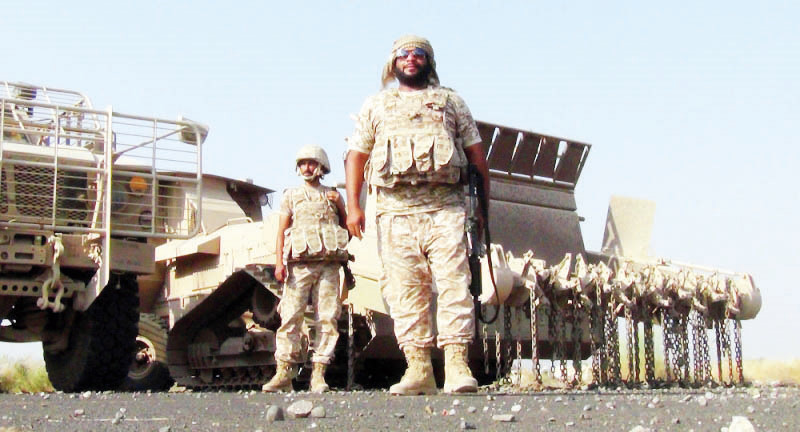
UAE, Saudi Arabia dispatch troops to east of the Euphrates in Syria
PKK terrorists are seizing Turkmen lands in the region under the pretext of establishing U.S. bases along the border.
The joint Saudi and Emirati delegation vowed to cover the cost of the establishment of the border corridor’s observation posts.
In the meantime, the two Gulf countries started to openly support the PKK terror organization as their soldiers were spotted on a battlefield in the eastern province of Deir Ezzor.

PKK digs tunnels near the border
PKK terrorists dug a 20-kilometer tunnel along the border with Turkey under the ruse of redeploying closer to the border under the pretext of setting up U.S. observations posts.
The tunnels, which were dug near the Ras al-Ayn region, are located just two kilometers from the border with Turkey.
Work on digging the tunnels began near the Douweyra village and extended all the way through the regions of Aziziyah and Abu Sawn to the town of Tal Khanzir.
Ahmad Osman, commander of the Free Syrian Army (FSA)-affiliated Sultan Murat Brigade, said Friday that the YPG/PKK terrorist group was operating in eastern Syria on the pretext of fighting Daesh militants who, he asserted, were not actually in the area.He went on to say that the FSA was “ready to conduct operations” in Syria’s northeastern Tal Abyad, Raqqah and Al-Hasakah regions.In an interview with Anadolu Agency, Osman commented on Iran's role in Syria, the strategies of the Assad regime, and the ongoing YPG/PKK presence in areas east of the Euphrates River.Stating that Iran-backed foreign terrorist groups were changing Syria’s demographic composition, he said: “They have changed street signs in the capital. The Sayyidah Zaynab Mosque has been turned into their headquarters. Shia militias have even bought homes in Damascus.”Over 30 arrested for suspected PKK/KCK links in TurkeyThe FSA commander also stated that there were similar problems in Syria’s eastern Deir ez-Zor province.“We are aware that Iran has occupied Syria. Iran has taken over the country’s education and construction sectors,” he said.According to Osman, the Assad regime has ignored Iran's activities while likening Turkish forces in the region to “invaders”.“The Turks have repeatedly said they don’t have any territorial ambitions in Syria; that their sole objective is to safeguard their national security,” Osman said, pointing out that the PKK terrorist group “still maintains a presence near the Syria-Turkey border”.He also said that the FSA was “ready” to take part in operations east of the Euphrates.“Preparations are already underway; we have many well-trained fighters,” he said.“The only problem is the U.S. troop presence in the region,” he added. “I'm hoping the U.S. withdraws and the Turkish army -- backed by the FSA -- expels the PKK from areas east of the river, where it is pretending to be fighting Daesh.”Turkey neutralizes PKK terrorist on wanted list“In reality, there is no Daesh presence in Raqqah, Al-Hasakah and Tal Abyad; therefore, we can carry out operations there,” Osman said. “But the U.S. wants to remain in this area, meaning that U.S. support for the PKK is hindering operations east of the Euphrates.”“Fortunately, we cleared one end of the border [of terrorists] following the [Turkey-led] Operation Olive Branch. Now, there are civilian administrations operating effectively in these areas,” he added, referring in particular to Syria’s Afrin region.Osman also hailed ongoing Turkish support for the region’s civilian population.“Turkish NGOs remain very active in the area and have provided aid for numerous development projects,” he said. “The Iranians, by contrast, are operating in accordance with their own agenda and religious beliefs.”He added: “The Turkish presence and the Iranian presence in Syria are completely different in nature.”“If Syrian citizens can’t prove ownership of their property within a year, it will be confiscated by the regime,” Osman continued. “And the regime will then use this as an excuse to sell the property to Iranian buyers.”According to Osman, the Assad regime never sought a political solution to the country’s seven-year conflict.“The regime's only goal is to reestablish control of the country through a military solution,” he said.“Damascus doesn't care about Astana, Geneva or any other talks,” he added. “Regime officials only attend these meetings as a result of Russian pressure. The regime doesn't want negotiations, which would mean granting the people their rights.”Turkey: Terror-hit mosque to be reopened in 2019
FSA ‘ready’ to conduct ops east of Euphrates: Commander
The U.S. dispatched vehicles and equipment to the region throughout the digging and construction period as the resulting structures bear striking resemblance to those found in Afrin, which have been turned into weapons and munitions depots.
The PKK’s ultimate goal is to dig tunnels that extend 150 kilometers along with the border with Turkey, and hinder the advance of the Turkish Armed Forces (TAF) through the level grounds in the case of a possible operation in the area.
At least seven PKK terrorists working at the digging site were killed in a landslide on Tuesday.