

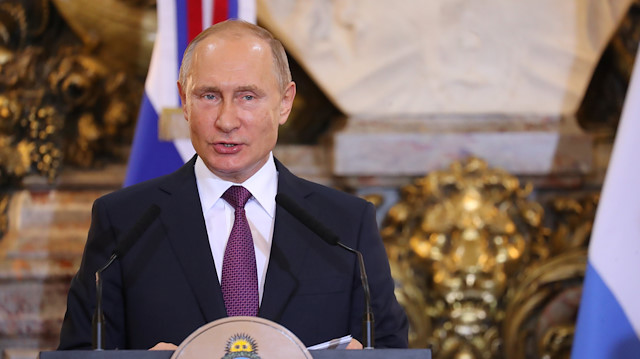
Russia's President Vladimir Putin
President Vladimir Putin said on Saturday that had no concrete figures on possible oil output cuts though Russia would continue with its contribution to reducing global output.
Russia, one of the world's major crude producing nations, has been bargaining with OPEC's leader, Saudi Arabia, over the timing and volume of any reduction. OPEC and non-OPEC oil producers will hold a ministerial meeting Dec. 6-7.
Russian President Vladimir Putin and Saudi Arabia's Crown Prince Mohammed bin Salman exchanged a high-five and laughed heartily together on Friday as they took seats next to each other at a plenary session of the Group of 20 summit.Putin's friendly behaviour towards the crown prince contrasted sharply with that of other leaders at the Buenos Aires summit, amid suspicions of his possible involvement in the killing of Saudi journalist Jamal Khashoggi at the Saudi consulate in Istanbul in October.Saudi Arabia has said the prince had no prior knowledge of the murder, which has sorely tested the kingdom's relations with the United States, other Western nations and Turkey.Earlier, Prince Mohammed was sidelined during the official "family photo" of world leaders at Friday's gathering and was largely ignored. He then quickly exited the stage without shaking hands or talking with the other leaders.Video: Putin, bin Salman high five at G20Russia has refrained from criticising Saudi Arabia or the crown prince over the killing. Putin said in October he lacked information about the matter and said Russia would not tear up its relations with Saudi Arabia because of it.However, Moscow has also fostered strong ties with Saudi Arabia's regional arch foe Iran. Russia and Iran back President Bashar al-Assad in Syria's civil war, while Saudi Arabia along with Western countries have backed some rebel groups.Putin and Prince Mohammed are due to hold bilateral talks on Saturday, according to Kremlin documents seen by Reuters.The Organization of the Petroleum Exporting Countries as well as Russia and other leading oil producers will meet in Vienna on Dec 6-7 to discuss further steps on the oil market as prices have been declining due to oversupply.Riyadh has suggested OPEC and its allies reduce output by 1 million barrels per day from January 2019 to stem the price falls.
Putin warmly greets Saudi crown prince at G20 summit
The European Union and the United States should consider banning from their ports Russian ships originating from the Sea of Azov after Russia captured three Ukrainian vessels there, German Chancellor Angela Merkel's protege said on Friday.Annegret Kramp-Karrenbauer, who is leading the race to succeed Merkel as leader of her ruling conservatives, also said Germany must be ready to take more responsibility in foreign policy and to spend more on defence.Russia seized the Ukrainian vessels and their crews on Sunday near Crimea, the Ukrainian region which Moscow annexed in 2014, over what it said was their illegal entry into Russian waters, which Ukraine denies."If it's confirmed that the aggression came from Russia ... then I think there must be a clear answer," Kramp-Karrenbauer told Reuters in a television interview."One answer might be, for example, to stop Russian ships coming from the region - from the Sea of Azov - from entering European or U.S. ports until this situation with Ukraine is resolved," she said.The comments from Kramp-Karrenbauer, 56, mark a tougher tone than the posture adopted by Merkel, who has called for de-escalation and dialogue.Kramp-Karrenbauer, sometimes referred to as AKK or "mini Merkel", is locked in a close race for the leadership of Germany's Christian Democratic Union (CDU) with Friedrich Merz, a long-time Merkel rival who promises more radical change.Polls show she is more popular with CDU members and voters at large. The winner, to be decided in a vote by 1,001 delegates at a party congress on Dec. 7-8, will take pole position in the race to succeed Merkel as chancellor.On foreign and defence policy, Kramp-Karrenbauer said Germany must be ready to do more -- a message sure to please U.S. President Donald Trump who has repeatedly pressed the German government to raise its defence spending."Europe - and in particular Germany - must assume more responsibility," Kramp-Karrenbauer said."We must be ready to take on this responsibility and that has consequences domestically. That means, for example, we must be ready to spend more money on defence at home and abroad."Ukraine files complaint against Russia at European rights courtAuto AngstTurning to trade tensions with the United States, Kramp-Karrenbauer said she was concerned about plans by top executives from German carmakers Volkswagen, BMW and Daimler to meet U.S. officials at the White House next week.Trump has been threatening for months to impose tariffs on all EU-assembled vehicles, a move that could upend the industry's business model for selling cars in the United States."In the past, it has only been possible to avert punitive tariffs when we maintained a clear and strong position, for instance as the European Union," Kramp-Karrenbauer said."Given that, one must take care not to undermine such a strong, united political position through bilateral discussions."The United States currently imposes import tariffs on cars assembled in the EU of 2.5 percent, compared with 10 percent tariffs for U.S.-built cars entering the European market.
Merkel protege suggests blockade of Russian ships over Ukraine crisis
Ukraine's state security service said it raided the residence of a senior Russian-backed Orthodox priest on Friday, who heads one of the country's holiest sites, citing a clause in the criminal code relating to whipping up religious hatred.Ukraine and Russia are at odds over Kiev's bid to set up an independent national Orthodox church and break centuries-old ties between the Ukrainian and Russian clergy.Ukrainian leaders accuse the Moscow-backed church, widely known as the Moscow Patriarchate, of promoting the Kremlin's interests and spreading propaganda as relations between the countries plummet.The raid is even more sensitive since the cleric in question, Metropolitan Pavel, heads the Kiev Pechersk Lavra, one of Ukraine's most famous monasteries and a tourist site where mummified monks rest in labyrinthine underground caves.EU's Tusk says sure EU will roll over Russia sanctionsThe state security service was investigating him under an article in the criminal code covering "violations of citizens' equality depending on racial ethnicity, religious convictions, incitement of inter-confessional hostility," SBU official Ihor Huskov said.The Moscow Patriarchate confirmed the investigation. It has consistently denied acting on behalf of Russian interests against Ukraine."Today there are many questions about whether the actions of our state authority in relation to the church are legitimate. To a certain extent they are illegal," Pavel said in a statement."There is a pressure on me personally, threats are being heard, all sorts of attacks not only on me, but also on other bishops and priests. For what reason I do not know."Jailed Ukrainian sailors moved to MoscowThe religious rift follows the broader collapse in relations between the two neighbours following Russia's seizure of Crimea in 2014 and backing of separatist uprisings in eastern Ukraine that have killed more than 10,000 people.Hostilities escalated further following Russia's seizure of three Ukrainian vessels last weekend, which Kiev fears could be a precursor to a full invasion.Ukraine sees the creation of an independent church as vital to tackling Russian influence on its soil.Opponents of Ukraine's plan to form an independent church say it would lead to street violence and forcible seizures of church property, claims which the Kiev authorities deny.Ukraine receives 500 million euros in EU assistanceThe raid came a day after President Petro Poroshenko announced Ukraine was close to setting up an independent church under a charter from the Ecumenical Patriarch in Istanbul, the global spiritual head of Orthodox Christians.Both Ukraine and Russia trace their Orthodox Christian roots to Volodymyr the Great, the prince whose baptism in 988 in Kiev led to the christianisation of the region known as "Kievan Rus". 
Ukraine's security service raids home of Russian-backed monastery head