

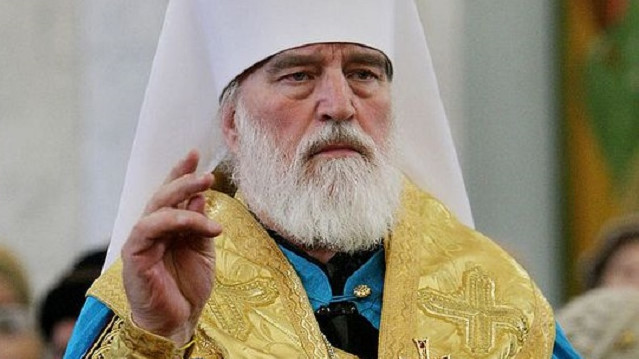
Metropolitan Pavel
Ukraine's state security service said it raided the residence of a senior Russian-backed Orthodox priest on Friday, who heads one of the country's holiest sites, citing a clause in the criminal code relating to whipping up religious hatred.
Ukraine and Russia are at odds over Kiev's bid to set up an independent national Orthodox church and break centuries-old ties between the Ukrainian and Russian clergy.
Ukrainian leaders accuse the Moscow-backed church, widely known as the Moscow Patriarchate, of promoting the Kremlin's interests and spreading propaganda as relations between the countries plummet.
The raid is even more sensitive since the cleric in question, Metropolitan Pavel, heads the Kiev Pechersk Lavra, one of Ukraine's most famous monasteries and a tourist site where mummified monks rest in labyrinthine underground caves.
European Council President Donald Tusk said on Friday he was sure that EU leaders will roll over sanctions on Russia at a summit he will chair in two weeks due to Moscow's action against Ukraine's navy in the Sea of Azov.Europe is united in our support for Ukraine’s sovereignty and territorial integrity. This is why I am sure that the EU will roll over the sanctions against Russia in December.“Europe is united in our support for Ukraine’s sovereignty and territorial integrity,” Donald Tusk said in a Twitter post.Tusk was speaking to reporters during a G20 meeting in Buenos Aires.Russia set to limit warships crossing Northeast PassageNo deal or no Brexit if UK parliament rejects dealBritain's choice would be to leave the European Union without a deal or abandon Brexit altogether if its parliament rejects an agreement between the EU and Prime Minister Theresa May, European Council President Donald Tusk said on Friday."A few days before the vote in the House of Commons, it is becoming more and more clear that this deal is the best possible -- in fact, the only possible one," Tusk said, ruling out any renegotiation by the EU if the British parliament votes down last Sunday's deal on Dec. 11."If this deal is rejected in the Commons, we are left with ... an alternative: no deal or no Brexit at all. I want to reassure you that the EU is prepared for every scenario," he said told Reuters during the G20 meeting in Argentina.Tusk will chair an EU summit two days after the British parliament votes on a deal that May has also said is the best London can get. Britain is due to leave the EU on March 29, although some campaigners hope the withdrawal can be stopped.Russian central banker retires, tied to suspected agent held by US
EU's Tusk says sure EU will roll over Russia sanctions
The state security service was investigating him under an article in the criminal code covering "violations of citizens' equality depending on racial ethnicity, religious convictions, incitement of inter-confessional hostility," SBU official Ihor Huskov said.
The Moscow Patriarchate confirmed the investigation. It has consistently denied acting on behalf of Russian interests against Ukraine.
"Today there are many questions about whether the actions of our state authority in relation to the church are legitimate. To a certain extent they are illegal," Pavel said in a statement.
"There is a pressure on me personally, threats are being heard, all sorts of attacks not only on me, but also on other bishops and priests. For what reason I do not know."
All 24 Ukrainian sailors, nabbed at a strait near Crimea last week, were moved to a Moscow pretrial detention centre on Friday.The servicemen, including two security service agents, were arrested on Sunday, when three Ukrainian naval vessels in the Black Sea tried to enter the Kerch Strait to reach the Sea of Azov.Russia's Investigative Committee has accused the Ukrainians of illegal border crossing.In a tit-for-tat, Ukrainian President Petro Poroshenko has forbidden Russian male citizens from ages 16-60 to enter the country.Russia and Ukraine have been at loggerheads since 2014, when Russia annexed Crimea after a controversial referendum.Turkey, as well as the UN General Assembly, viewed the annexation as illegal.Ukraine has also blamed Kremlin for separatist violence in eastern Ukraine, near the border with Russia.Ukraine receives 500 million euros in EU assistanceRussia thinks Trump cancelled Putin meeting for domestic reasonsRussia has no plans to ban entry to Ukrainian menUkraine bars entry to Russian men of combat age citing invasion fearsTrump cancels G20 Putin meeting over Ukraine
Jailed Ukrainian sailors moved to Moscow
The religious rift follows the broader collapse in relations between the two neighbours following Russia's seizure of Crimea in 2014 and backing of separatist uprisings in eastern Ukraine that have killed more than 10,000 people.
Hostilities escalated further following Russia's seizure of three Ukrainian vessels last weekend, which Kiev fears could be a precursor to a full invasion.
Ukraine sees the creation of an independent church as vital to tackling Russian influence on its soil.
Opponents of Ukraine's plan to form an independent church say it would lead to street violence and forcible seizures of church property, claims which the Kiev authorities deny.
Ukraine has received 500 million euros ($568 million) in assistance from the European Commission, President Petro Poroshenko said in a statement on Facebook.The EU, United States and the International Monetary Fund have supported Ukraine's economy since the annexation of Crimea in 2014.Poroshenko said the disbursal of 500 million euros was a "very important signal of the unwavering assistance of the European Union against the recent challenges from the Russian aggressor."Russia has no plans to ban entry to Ukrainian menUkraine bars entry to Russian men of combat age citing invasion fearsTrump cancels G20 Putin meeting over Ukraine
Ukraine receives 500 million euros in EU assistance
The raid came a day after President Petro Poroshenko announced Ukraine was close to setting up an independent church under a charter from the Ecumenical Patriarch in Istanbul, the global spiritual head of Orthodox Christians.
Both Ukraine and Russia trace their Orthodox Christian roots to Volodymyr the Great, the prince whose baptism in 988 in Kiev led to the christianisation of the region known as "Kievan Rus".