

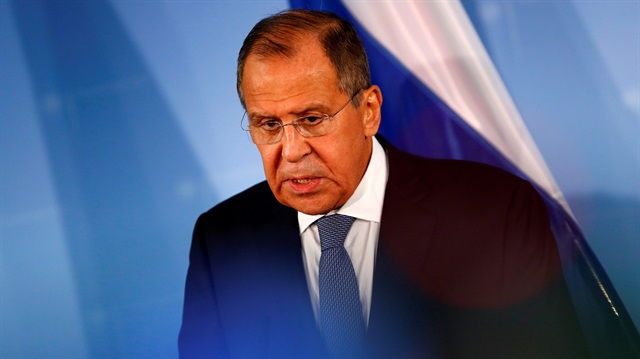
Russian Foreign Minister Sergei Lavrov
Russian and Turkish armies have reached an agreement on the border of the demilitarized zone in Syria’s Idlib, Russian Foreign Minister Sergei Lavrov said on Friday.
Turkey's defense ministry confirmed Lavrov's statement later on Friday, noting that the borders were agreed upon in meetings with a Russian committee.
The borders were agreed taking into account the area's geographical structure and residential areas, the ministry said, adding that the meetings were held between Sept. 19-21 at Turkey's defence ministry.
Lavrov also said that the United States' control over the eastern bank of the Euphrates river posed the main threat to Syria's territorial integrity.
Ankara and Moscow signed an agreement Monday that calls for the demilitarization of Idlib, following a summit in Russia's coastal Black Sea town of Sochi.
Turkey, ramping up its intensive efforts to prevent bloodshed and ensure the safety of civilians in the last opposition-held stronghold of Syria’s Idlib, has prepared a list of 400 terror suspects to be arrested. Turkish intelligence units have completed a list of suspected terrorists, including some who are in Assad’s intelligence organization al-Muhaberat, Kurdistan Workers’ Party (PKK) and Daesh terrorists.Turkish security units also aim to take necessary measures against foreign fighters.Normalization process for Idlib Turkish President Recep Tayyip Erdoğan and his Russian counterpart Vladimir Putin agreed to turn Syria's northwestern Idlib province into a demilitarized zone that will extend between 15 to 20 kilometers (9-12 miles) into Idlib by Oct. 15. The weapon-free zone will be formed between the Assad regime forces and opposition groups, while Russia will guarantee that there will be no intervention targeting Idlib. The region is planned to be normalized in six months by prioritizing security, education and health issues.Located near the Turkish border, Idlib is home to more than 3 million Syrians, many of whom fled to other cities following attacks by Assad regime forces.HTS terrorists will be purgedThe region will also be cleared of terrorists from Tahrir al-Sham (HTS), including the al-Qaeda-linked group formerly known as the Nusra Front, which is one of the most powerful terror alliances in Idlib.With the evacuation of foreign fighters, it is predicted that the issue of the HTS, which Turkey designated as a terror group in August 2018, will be mostly solved.The number of foreign fighters from Egypt, Saudi Arabia, Morocco, Jordan and the United Arab Emirates (UAE) reportedly exceeds 4,000. Turkey, Russia agree on 'weapons-free zone' in IdlibThose allegedly defending Syria’s territorial integrity dividing country: ErdoğanTurkey deploys large military convoy to Syria as Idlib offensive loomsTurkey's resolve to stop displacement in Syria's IdlibUN chief urges full implementation of Idlib pact
Turkish intelligence prepares arrest warrant list for 400 terrorists in Syria’s Idlib
Opposition groups in Idlib will remain in areas in which they are already present, while Russia and Turkey will conduct joint patrols in the area to prevent any renewal of fighting.
Located near the Turkish border, Idlib is home to more than 3 million Syrians, many of whom fled to other cities following attacks by Assad regime forces.
Last month, the regime announced plans to launch a major military offensive in Idlib, Syria’s last opposition stronghold.
The U.S. State Department omitted the PYD/YPG terrorist group from its 2017 Country Reports on Terrorism, which was released Wednesday. The previous edition of the report noted that Turkey views the Syria-based PYD/YPG as an extension of the PKK terror group.With this move, Washington has made public its support of terrorism and its desire to split Syria. The activity in the region shows that Washington is laying the foundations for a terror state.Arms deploymentThe U.S. has accelerated its arms deployment to the PYD/PKK terror group. The U.S. dispatched 250 heavy weapons and armored vehicles to the Democratic Syrian Armed Forces (SDF), which is dominated by the YPG, in June. Over 200 trucks loaded with supplies were sent to the SDF on Aug. 6, and another deployment of several armored vehicles and 250 trucks with weapons and ammunition was sent on Aug. 15.The Syrian Observatory for Human Rights reported that over 1,200 shipments and trucks entered Syria in August alone.Syria’s Idlib under siege by foreign terroristsOccupation expandingThe PKK/YPG claims that the U.S.-supplied weapons will be used in an offensive against Daesh, however the Syrian Observatory for Human Rights has reported that Washington is working to expand several bases in Kobani, Aleppo and Hasakah.The PKK/YPG is extending its occupation to the east of the Euphrates with Washington’s support. Raqqa and Deir ez-Zor are under the siege of the terror group under the guise of fighting against Daesh. The terror group has also taken control of the region’s petrol and water sources.The YPG-dominated SDF controls an area of about 53,000 square kilometers with a percentage of 28.6 of Syrian territory.Details of Turkish-Russian Idlib deal revealedNew administration in NE Syria formed with Washington’s supportWith the support of the U.S., a new administration was created for northeastern Syria during a meeting for the Syrian Democratic Council (SDC) in Ayn Issa in early September. The new administration has been dubbed a coordination body that will connect the self-administrations of the Kurdish majority areas and the civil administrations in Arab majority areas that have their own civil councils.The self-administrations in the Euphrates, Afrin, and Jazeera region with the civil councils in Raqqa, Manbij, Tabqa, and Deir ez-Zor will be linked by the new administration.Top U.S. official visits terror groupWilliam Roebuck, the U.S. ambassador to Bahrain, visited northern Syria on Aug. 26 amid negotiations between the so-called Rojava canton and Damascus over the future of the region.“We are prepared to stay here, as the president (Donald Trump) has made clear,” Roebuck said during his trip.James Jeffrey, the former U.S. ambassador to Turkey who was named U.S. special representative to Syria on Aug. 17, echoed Roebuck’s sentiment as he declared that Washington would remain in the region until it was completely cleared of Daesh.US removes PYD/YPG from annual terrorism reportThe U.S has supplied the PYD terror organization and its armed wing, the YPG, with more than 5,000 truckloads of weapons to allegedly use in the fight against Daesh, despite Ankara’s warnings that the fact they are the Syrian offshoots of the PKK terror organization.Pentagon’s no-fly zone strategyThe Washington administration, which intends to maintain a permanent presence in Syria, has completed the construction of three advanced radar systems in Syria’s Hasakah-Tal Baidar countryside along with the Ayn al-Arab and Sarrin regions, and has set up 13 portable and fixed observation-intelligence radar systems.Pentagon’s preparation for a no-fly-zone indicates that the U.S. administration also wants to interfere in Turkey’s military operations to ensure the safety of PKK terrorists after Ankara’s successful ops conducted in Syria’s Hasakah, Qarrah Chouk Mountains and Iraq’s Sinjar.Sean Ryan, spokesperson for the U.S.-led Coalition against Daesh stated: “The Coalition installs satellites or other necessary equipment wherever needed within our area of operations.”US sends Castle International mercenaries to fight alongside YPG/PKK in SyriaU.S. spreads bases across SyriaWith its initial base establishing activities that were initiated in October 2015, Washington set up two air bases in al-Hasakah, and eight operational military bases in Raqqa and Manbij. Since July 2017, the U.S. has established five new bases, two of which were constructed in Manbij and close to the Euphrates Shield area. Two military bases were also established southwest of Tal Abyad.U.S. sends mercenaries to fight alongside YPG/PKK in SyriaIt has been found that the U.S. works with Castle International, an American giant in the international military services marketplace, in Syria.Specialized in aviation and medical support, Castle International mercenaries are employed by the U.S. in order to fight alongside YPG/PKK terrorists in Syria. Castle International’s social media accounts posted photographs of heavily armed commandos fighting and training beside YPG/PKK terrorists.
US bolsters support to PKK terror group in Syria
Russia says it is taking steps to lower dependence on U.S., dollar
Russia is working on ways to lower its dependence on the United States and the dollar system, Lavrov said, addressing the issue of U.S. sanctions.
"We are already drawing conclusions, doing all necessary not to depend on those countries that are acting that way with their international partners," Interfax quoted Lavrov as saying. Speaking during a visit to Sarajevo, Lavrov also said that new U.S. sanctions undermine global trust in the U.S. dollar.