

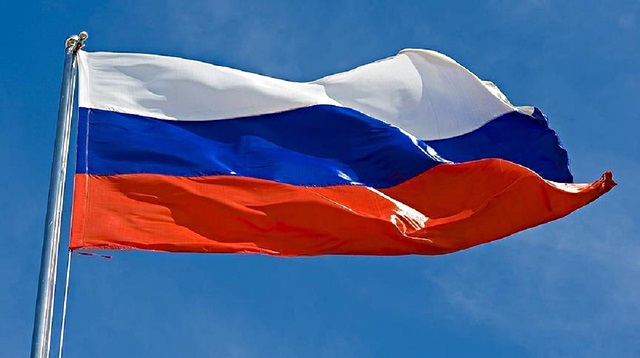
The US government charged a Russian national with playing a key financial role in a Kremlin-backed plan to conduct "information warfare" against the United States.
The U.S. government on Friday charged a Russian national with playing a key financial role in a Kremlin-backed plan to conduct "information warfare" against the United States, including ongoing attempts to influence next month's congressional elections.
Elena Alekseevna Khusyaynova, 44, became the first person charged with a crime for attempting to interfere in the 2018 U.S. midterm elections, according to a government official with knowledge of the investigation.
Khusyaynova was the chief accountant for Project Lakhta, an operation started in 2014 and financed by a Russian oligarch close to Russian President Vladimir Putin and two companies he controls, according to a criminal complaint.
The oligarch, Evgeny Viktorovich Prigozhin, and his two companies were indicted in February in Special Counsel Robert Mueller's separate investigation of alleged Russian meddling in the 2016 U.S. presidential election to boost eventual winner Donald Trump over his Democratic opponent, Hillary Clinton.
The case against Khusyaynova was unsealed on the same day that U.S. law enforcement and intelligence agencies issued a warning about attempts by Russia, China, Iran and other foreign entities to interfere with Nov. 6 congressional elections, in which Trump's Republicans are trying to maintain majority power in Congress, and national elections in 2020.
The complaint detailed new examples of Russians using fake personas on social media to stoke divisions over race, gun rights, voter fraud and other contentious issues. Some messages targeted next month's elections, indicating the operation has not been deterred by Mueller's indictments earlier this year.
"This one shows that the threat from Russia is not over," said Barbara McQuade, a former U.S. Attorney in Michigan. "This is a true propaganda war."
Russia called the allegations an attempt by the United States to fabricate a pretext to impose sanctions as part of a "disgraceful slander campaign" against Moscow.
"Have been spreading impudent lies about the mythical 'hand of Moscow' for more than two years - since the previous presidential election - Washington is now trying to play the same card," Deputy Foreign Minister Sergei Ryabkov said in a statement on Saturday.
"The United States clearly overestimates its own capabilities. By demonstrating hostility towards Russia and a contemptuous attitude towards the whole world, it will only be getting an increasingly strong pushback," he added.
Using social media and other avenues, the Russians are waging "information warfare against the United States," to sow distrust in the political system, according to the complaint, which charged Khusyaynova with conspiracy to defraud the United States.
The complaint included Facebook and Twitter posts that were both critical of Republicans and supportive of President Donald Trump. One post in March, for example, suggested Trump deserved the Nobel Peace Prize for his negotiations with North Korean leader Kim Jong Un aimed at denuclearization.
Trump, who at a news conference in Helsinki in July with Putin cast doubt on his own intelligence agencies' findings that Russia had meddled with the 2016 election, dismissed the latest charge against Russia as unrelated to him.
"It had nothing to do with my campaign," Trump told reporters in Scottsdale, Arizona. "If they are hackers, a lot of them probably like Hillary Clinton better than me."
The Kremlin said on Friday President Vladimir Putin plans to meet U.S. National Security Adviser John Bolton when he visits Moscow on Oct. 22-23, the RIA news agency reported.Kremlin spokesman Dmitry Peskov was quoted as saying: "We are preparing a meeting with president Putin and we expect that the meeting will take place."Bolton is also expected to meet Russian Foreign Minister Sergei Lavrov and Security Council Secretary Nikolai Patrushev.Russia and Uzbekistan start work on nuclear power plantRussia's Putin to discuss Syrian refugees at summit in Istanbul
Russia's Putin to meet US security adviser Bolton next week
Russia and Uzbekistan began preliminary work on Friday on the first Uzbek nuclear power plant project which Moscow estimates will cost $11 billion.The plant, to be largely financed by a soft loan from Russia, will allow Uzbekistan to use more of its natural gas for other purposes such as chemicals production or exports.Russian President Vladimir Putin and Uzbek President Shavkat Mirziyoyev pressed a symbolic button together at a ceremony in a conference hall in Tashkent to mark the start of geological surveying to decide on a location for the facility.Uzbekistan expects to pour first concrete no earlier than 2020 because of the project's complexity. The two-block, 2.4 gigawatt plant is expected to start producing power in 2028.Russia's Putin to discuss Syrian refugees at summit in IstanbulToday, most electric power in Uzbekistan is generated by gas turbines, but the Central Asian, formerly Soviet republic says it wants to use its large natural gas reserves more efficiently and extract more added value from them.Tashkent signed agreements with Gazprom and several other Russian companies aimed at exploration and development of a few new hydrocarbon deposits as well as building a new chemical plant.Producing the same amount of energy as a nuclear power plant using modern gas turbines would consume over 3.5 billion cubic metres of gas a year, according to Jurabek Mirzamahmudov, head of Uzbekistan's nuclear energy agency UzAtom."This is feedstock for one petrochemicals plant which could produce half a million tonnes of polymers," he told reporters this week.Uzbekistan also exports gas to Russia and China.Mirzamahmudov said it was possible Uzbekistan would add two more blocks to the plant in the future, doubling its capacity.So far, however, the cost is unclear even for the first two blocks. Moscow has put it at $11 billion, but Mirzamahmudov said talks on the matter would start next year and Tashkent hoped the figure could be reduced.And, although fuel will make up less than a tenth of the final energy cost, it could also be made cheaper by using a tolling scheme where Uzbek-mined uranium would be processed by Russia, officials say. 
Russia and Uzbekistan start work on nuclear power plant
The top U.S. general in Afghanistan said on Friday he did not believe he was the target of an attack that killed a powerful police chief, and Afghan officials said the gunman may have deliberately avoided hitting him.The gunman assassinated the police chief of Kandahar province on Thursday along with a top Afghan intelligence agency officer, but the U.S. commander of Afghanistan's NATO-led force, General Scott Miller, who was standing nearby when the attack occurred, was not hurt."My assessment is that I was not the target. It was a very close confined space. But I don't assess that I was the target," Miller told Afghanistan's Tolo News TV in an interview.General Abdul Razeq, police commander of the southern province and one of Afghanistan's most powerful security officials, was fatally wounded by a bodyguard of the provincial governor as he came from a meeting with officials on Thursday.Election in Afghan province of Kandahar to be delayed a weekIn addition, the local head of the NDS intelligence service was killed and the provincial governor severely wounded, while the attacker himself was killed.Miller was also at the meeting and was heading to his helicopter to return to Kabul when the gunman opened fire.The Taliban claimed the attack in a statement saying both Razeq and Miller were the targets.Two Americans and a coalition contractor were wounded, however Afghan security officials, who believe Pakistan was involved in the plan, said they believed the attacker deliberately avoided killing Miller.Afghanistan in shock after death of powerful police commander"They didn't want repercussions from the U.S. and the international community. It was a pure warning for Miller that they can hit him if they want to," one of the Afghan officials, who spoke on condition of anonymity, said.Razeq himself was a fierce critic of Pakistan and its intelligence service, which Afghan officials regularly accuse of supporting Taliban operations, a charge Islamabad denies.On Friday, the chief of the Pakistan army staff issued a statement condemning the Kandahar violence and saying it supported initiatives towards peace in the region.A foreign security official said Razeq had stopped visiting the governor's house in recent months because he feared it had been infiltrated and had only gone because Miller and his delegation were there.The identity of the killer, named by Afghan officials as Gulbuddin, was known immediately, and police have made three arrests, but details of his background or why he carried out the attack remained unclear.One senior foreign security official briefed on the case said the attacker had been recruited this year as part of the governor's security detail.No one had claimed his body, but his colleagues in the security team said his family members lived in the outskirts of Kandahar. 
US general doesn't believe he was target of Kandahar attack
Not Mueller's Case
The Khusyaynova case is being prosecuted by assistant U.S. attorneys in the Eastern District of Virginia. It is not being handled by Mueller because it touches on the 2018 elections, which is not part of his remit, the government official said.
Khusyaynova oversaw the financial operations for the project, which had a proposed budget of $35 million for January 2016 to June 2018 and used those funds to wage similar campaigns in the European Union and Ukraine, in addition to the United States.
"It is a global campaign for a regime that views democracy as an existential threat," said John Carlin, former U.S. Assistant Attorney General for National Security.
Khusyaynova, who is a resident of St. Petersburg, Russia, and is not in U.S. custody, billed Prigozhin and his companies to pay for advertisements on Facebook, bloggers, and for "development accounts" on Twitter, the complaint says.
Prigozhin has been dubbed "Putin's cook" by Russian media because his catering business has organized banquets for the Russian leader and other senior political figures. He has been hit with sanctions by the U.S. government.
The criminal complaint said there was no evidence that Khusyaynova or others in the conspiracy succeeded in impacting the outcome of any U.S. election.
In their joint statement on Friday the Office of the Director of National Intelligence, Justice Department, FBI and Department of Homeland Security also said they did not have any evidence that anyone went far enough to prevent voting or change vote counts. Some state and local governments, which run polling sites, have reported attempts to access their networks, but officials were able to "prevent access or quickly mitigate these attempts," the statement said.
Mueller's office has not announced any new indictments since July when it charged 12 Russian intelligence officers who were accused of hacking Democratic computer networks as part of Russian meddling in the 2016 U.S. election.
Mueller has been widely expected to remain quiet in the run-up to the November elections to avoid actions that might sway votes.
But the decision to unseal the Khusyaynova case now appears to reflect changes to Justice Department guidelines last month instructing U.S. attorneys to lean towards disclosing foreign influence operations as a means of deterrence, Carlin said.
The Khusyaynova case shows "in detail that when we talk about Russian interference it is not something in history it is now," Carlin said. "Making it public is an important way to neutralize them."
The Kremlin said on Friday President Vladimir Putin plans to meet U.S. National Security Adviser John Bolton when he visits Moscow on Oct. 22-23, the RIA news agency reported.Kremlin spokesman Dmitry Peskov was quoted as saying: "We are preparing a meeting with president Putin and we expect that the meeting will take place."Bolton is also expected to meet Russian Foreign Minister Sergei Lavrov and Security Council Secretary Nikolai Patrushev.Russia and Uzbekistan start work on nuclear power plantRussia's Putin to discuss Syrian refugees at summit in Istanbul Russia's Putin to meet US security adviser Bolton next week
Russia and Uzbekistan began preliminary work on Friday on the first Uzbek nuclear power plant project which Moscow estimates will cost $11 billion.The plant, to be largely financed by a soft loan from Russia, will allow Uzbekistan to use more of its natural gas for other purposes such as chemicals production or exports.Russian President Vladimir Putin and Uzbek President Shavkat Mirziyoyev pressed a symbolic button together at a ceremony in a conference hall in Tashkent to mark the start of geological surveying to decide on a location for the facility.Uzbekistan expects to pour first concrete no earlier than 2020 because of the project's complexity. The two-block, 2.4 gigawatt plant is expected to start producing power in 2028.Russia's Putin to discuss Syrian refugees at summit in IstanbulToday, most electric power in Uzbekistan is generated by gas turbines, but the Central Asian, formerly Soviet republic says it wants to use its large natural gas reserves more efficiently and extract more added value from them.Tashkent signed agreements with Gazprom and several other Russian companies aimed at exploration and development of a few new hydrocarbon deposits as well as building a new chemical plant.Producing the same amount of energy as a nuclear power plant using modern gas turbines would consume over 3.5 billion cubic metres of gas a year, according to Jurabek Mirzamahmudov, head of Uzbekistan's nuclear energy agency UzAtom."This is feedstock for one petrochemicals plant which could produce half a million tonnes of polymers," he told reporters this week.Uzbekistan also exports gas to Russia and China.Mirzamahmudov said it was possible Uzbekistan would add two more blocks to the plant in the future, doubling its capacity.So far, however, the cost is unclear even for the first two blocks. Moscow has put it at $11 billion, but Mirzamahmudov said talks on the matter would start next year and Tashkent hoped the figure could be reduced.And, although fuel will make up less than a tenth of the final energy cost, it could also be made cheaper by using a tolling scheme where Uzbek-mined uranium would be processed by Russia, officials say. Russia and Uzbekistan start work on nuclear power plant
Russian President Vladimir Putin will discuss conditions for the return of refugees to Syria at a summit next week in Istanbul of the leaders of Russia, Turkey, France and Germany, the Interfax news agency cited the Kremlin as saying on Friday.Putin also plans to discuss the reconstruction of infrastructure in Syria at the summit on Oct. 27, the Kremlin was cited as saying. 'Istanbul summit on Syria aimed at avoiding new humanitarian disaster'
Russia's Putin to discuss Syrian refugees at summit in Istanbul