

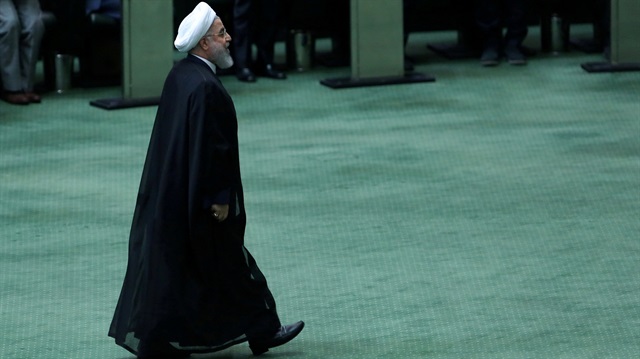
Iranian President Hassan Rouhani attends a parliamentary session in Tehran, Iran August 28, 2018.
Iranian lawmakers launched impeachment proceedings against the education minister on Wednesday, ramping up pressure on the president who is under unprecedented attack from parliament over his handling of the economy in the face of new U.S. sanctions.
The move came only three days after lawmakers sacked the minister of economy and finance blaming him for the collapse of the rial currency and surging unemployment. They had, weeks earlier, dismissed the labour minister.
Another motion, signed by 70 lawmakers, aims to impeach the minister of industry, mines and business.
Iran will maintain its military presence in Syria despite U.S. pressure for its withdrawal, a senior Iranian official said on Tuesday, revealing more details about a military cooperation deal that Tehran and Damascus signed this week.Iranian Defence Minister Amir Hatami visited Damascus on Saturday for talks with Syrian President Bashar al-Assad and senior military officials. He signed a deal for military cooperation in a meeting with his Syrian counterpart, but details of the accord were not revealed."The continued presence of Iranian (military) advisers in Syria was part of this military cooperation agreement between Tehran and Damascus," the state news agency IRNA quoted Tehran's military attache to Damascus, Abolqassem Alinejad, as saying.Iran president defends economic performance before MPsThe accord also emphasised the importance of Syria's territorial integrity and sovereignty, he said, adding that it came into effect on the day of its signing."Iran will help Syria in clearing minefields in different parts of the country... Iran will help Syria to rebuild the military factories that were damaged in the war," Alinejad said.Iran’s Revolutionary Guards have sent weapons and thousands of soldiers to Syria to help shore up Assad during the seven-year-long civil war there.Iran shuts down scores of military-run companiesU.S. National Security Adviser John Bolton reiterated last week Washington's call for Iran to remove all its forces from Syria.The United States has reimposed economic sanctions against Iran partly over its involvement in conflicts in Syria, Iraq and Yemen as well as over its nuclear and missile programmes.Israel has accused Tehran of seeking a permanent military presence in Syria. Iran has repeatedly said its military presence in Syria is at the invitation of the Assad government and that it has no immediate plans to withdraw.Iran and Syria sign deal for military cooperationMore than 1,000 Iranians, including senior members of the elite Revolutionary Guards, have been killed in Syria since 2012.The Guards initially kept quiet about their role in the Syria conflict. But in recent years, as casualties have mounted, they have been more outspoken about their engagement, framing it as an existential struggle against Daesh.
Iran says to maintain military presence in Syria despite US pressure
President Hassan Rouhani won two landslide elections on a platform of economic reform and opening Iran up to the outside world, and his pragmatic supporters have a majority in the parliament.
But his reputation and political influence have taken a sharp hit as his promised economic gains have failed to materialise.
He is, in particular, facing a backlash at home since U.S. President Donald Trump in May pulled out of an international accord that had curbed Iran's nuclear ambitions in return for sanctions relief.
Iranian President Hassan Rouhani on Tuesday attempted to defend his government’s economic performance before parliament, according to reports on Iranian state television.Rouhani answered five economy-related questions posed by lawmakers on U.S. sanctions, unemployment, and the devaluation of the Iranian rial.The president defended his government’s performance, attributing the country’s economic difficulties to the recent re-imposition of U.S. sanctions.While lawmakers expressed satisfaction with one of Rouhani’s answers (that pertaining to sanctions on the local banking sector), they voiced dissatisfaction with the remaining four, the subjects of which will be referred to judicial authorities for investigation.The findings of this investigation will then be referred back to parliament, which will then decide whether or not to register confidence in Rouhani’s government.In recent months, Iran has seen steady declines in several economic indicators amid sporadic popular protests against mounting unemployment and deteriorating living conditions.Earlier this month, the U.S. re-imposed sanctions on Iran after withdrawing in May from a landmark nuclear deal with the P5 1 group of nations (the five permanent UN Security Council members plus Germany).The sanctions are intended to hinder Tehran's acquisition of U.S. currency; its precious metals trade; bank transactions denominated in Iranian currency; activities related to Iran's sovereign debt; and the country’s automotive sector.Iran parliament censures Rouhani in sign pragmatists losing swayUS: Iran misusing World Court with suit aimed at lifting sanctionsIran oil exports set to drop in August ahead of US sanctionsIran’s parliament blames Rouhani for economic troubles, refers him to judiciaryRouhani vows to defeat 'anti-Iranian' officials in the White House
Iran president defends economic performance before MPs
Washington has imposed sanctions on the acquisition of U.S. dollars by Iran and it will reimpose sanctions on Tehran's oil exports and banking sector in November.
A group of 20 lawmakers signed a motion on Wednesday accusing Education Minister Mohammad Bathaei of failing to reform the education system and rejuvenate schools, state news agency IRNA reported.
That is enough votes to force Bathaei to come to parliament to answer questions on his record in the next 10 days. If lawmakers are unhappy with his answers, they can vote to impeach and sack him.
Iran's parliament voted on Tuesday to reject President Hassan Rouhani's explanations for economic hardship after a dramatic grilling on live TV, a sign his pragmatic faction is losing sway to hardline rivals as new U.S. sanctions begin to bite.The vote in parliament came two days after lawmakers sacked the minister of economy and finance and weeks after they sacked the labour minister, blaming them for the collapse of the rial currency and surging inflation.Rouhani won two landslide elections on a platform of economic reform and opening Iran up to the outside world, and his pragmatic supporters have a majority in the parliament. But his reputation and political influence have taken a sharp hit as his promised economic gains have failed to materialise.US: Iran misusing World Court with suit aimed at lifting sanctionsHis highest profile achievement was to negotiate the lifting of financial sanctions on Iran in a 2015 deal with world powers over its nuclear programme, but U.S. President Donald Trump pulled out in May and Washington has re-imposed sanctions.Rouhani spoke out in parliament in defence of his economic record, blaming the country's woes on the U.S. sanctions rather than his team's management. But a majority of lawmakers voted to reject his explanation in four out of five areas.There were conflicting reports about what would follow from the vote: several Iranian news agencies said Rouhani's case would now be referred to the judiciary, although the spokesman for the parliamentary leadership, Behrouz Nemati, said lawmakers must hold further discussion before that would take place.Iran oil exports set to drop in August ahead of US sanctionsThe action in parliament is a further sign of how the Trump administration's decision to re-impose sanctions could affect Iran's leadership and its relationship with the outside world, potentially for decades to come.Iran's rulers have been divided between a pragmatic faction that aims for better international relations, and hardliners who are wary of reforms. Trump's decision to abandon the nuclear deal was opposed by U.S. allies in Europe, who argued that he undermined Rouhani and strengthened the hands of the hardliners.While Rouhani and his cabinet run Iran's day-to-day affairs, ultimate authority lies with the Supreme Leader, 79-year-old Ayatollah Ali Khamenei, in power since 1989. Weakening the pragmatists now could affect the choice of Khamenei's successor.Iran’s parliament blames Rouhani for economic troubles, refers him to judiciaryFor now, Rouhani's own position appears safe. The judiciary could determine that he broke the law and parliament has the power to impeach him, but experts on Iranian politics say power struggles are more likely to play out indirectly."The parliament's move is politically motivated and indicates that tensions would increase in the Islamic Republic in coming months," Saeed Laylaz, an Iranian economist, told Reuters by telephone from Tehran."Iranian political factions have always used international issues to pursue their domestic gains," he added.Rouhani vows to defeat 'anti-Iranian' officials in the White HouseAfter the sacking of the two ministers this month, Tasnim news agency reported that 70 lawmakers had signed a motion to impeach a third: the Minister of Industry, Mines and Business.Rouhani has bowed to pressure and fired the head of the central bank. A deputy central bank governor was arrested by the judiciary on corruption charges in a crackdown that also saw foreign exchange dealers rounded up."U.S. PLOT"The lawmakers asked Rouhani on Tuesday about five subjects: unemployment, slow economic growth, the fall of the rial, cross-border smuggling, and the lack of access by Iranian banks to global financial services. The parliament found only Rouhani's answer about banks satisfactory."I want to assure the Iranian nation that we will not allow the U.S. plot against the Islamic Republic to succeed," Rouhani told parliament. "We will not let this bunch of anti-Iranians in the White House be able to plot against us."Iran's official unemployment rate is 12 percent, with youth unemployment as high as 25 percent in a country where 60 percent of the 80 million population is under 30. The rial has lost more than two-thirds of its value in a year.Iran's economy has suffered not only from sanctions but also from pervasive corruption and the concentration of its wealth and trade in the hands of big firms controlled by the hardline Revolutionary Guards military force.Washington imposed a new round of sanctions in August targeting Iran’s trade in gold and other precious metals, its purchases of U.S. dollars and its car industry. Worse is yet to come, with a new round of sanctions to be imposed in November that Washington says aims to cut Iran's oil exports to zero.The plunge in the currency and soaring inflation have sparked sporadic demonstrations against profiteering and corruption, with many protesters chanting slogans against both the government and Supreme Leader Khamenei.Rouhani said such anti-government protests had encouraged Trump to try to provoke more unrest by harming Iran's economy."The protests tempted Trump to withdraw from the nuclear deal," he said, asking lawmakers to support his cabinet and not add to anti-government sentiment.Although the economic problems were critical, Rouhani said: "More important than that is that many people have lost their faith in the future of the Islamic Republic and are in doubt about its power."
Iran parliament censures Rouhani in sign pragmatists losing sway
Iran's parliament voted on Tuesday to reject Rouhani's explanations for economic hardship after a dramatic grilling, a sign his pragmatic faction is losing sway to hardline rivals as new U.S. sanctions begin to bite.
Some hardline lawmakers are now considering to refer the case to the judiciary as a breach of law, but the Speaker of the Parliament, Ali Larijani said on Wednesday that was not "legally feasible."
A senior member in a top Iranian constitutional body also was quoted as saying by Tasnim news agency that there were "ambiguities" about the authority lawmakers could exercise to open a judicial case against Rouhani after summoning him to the parliament.
Iran's official unemployment rate is 12 percent, with youth unemployment as high as 25 percent in a country where 60 percent of the 80 million population is under 30. The rial has lost more than two-thirds of its value in a year.