

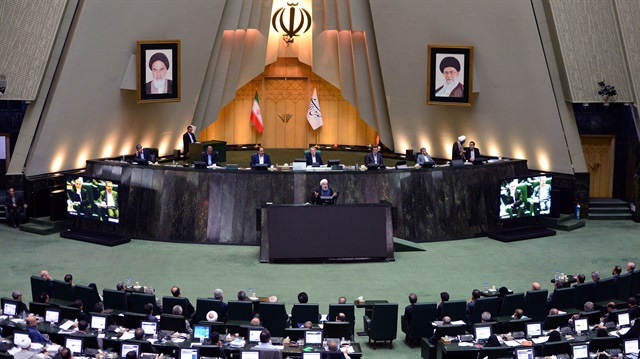
Iranian President Hassan Rouhani arrives to answer questions during a Parliament session in Tehran, Iran, on August 28, 2018.
Iran's parliament voted on Tuesday to reject President Hassan Rouhani's explanations for economic hardship after a dramatic grilling on live TV, a sign his pragmatic faction is losing sway to hardline rivals as new U.S. sanctions begin to bite.
The vote in parliament came two days after lawmakers sacked the minister of economy and finance and weeks after they sacked the labour minister, blaming them for the collapse of the rial currency and surging inflation.
Rouhani won two landslide elections on a platform of economic reform and opening Iran up to the outside world, and his pragmatic supporters have a majority in the parliament. But his reputation and political influence have taken a sharp hit as his promised economic gains have failed to materialise.
U.S. lawyers urged the International Court of Justice (ICJ) on Tuesday to dismiss an Iranian lawsuit calling for a lifting of U.S. sanctions against Tehran, saying its real aim was to restore a 2015 nuclear pact rejected by President Donald Trump.The ICJ is the United Nations' highest court for resolving disputes between nations. Its rulings are binding, but it has no power to enforce them, and the United States and Iran are both among a handful of countries that has ignored its decisions.Iran argues that the reimposed U.S. sanctions, which are undermining its already weak economy, violate a 1955 friendship treaty between the two countries - signed before Iran's 1979 Islamic revolution and the sharp deterioration in bilateral ties that has endured until today.Video: World Court hears Iran suit to have US sanctions liftedBut U.S. State Department Legal Adviser Jennifer Newstead said on the second day of oral arguments in the case that Iran's appeal based on the 1955 Treaty of Amity was a legal dodge."Iran is endeavouring to use the procedures of the Treaty of Amity to enforce rights that it claims under an entirely different (agreement) that specifically excludes judicial remedies," she said.Newstead said U.S.-Iranian disagreements should be resolved through diplomacy and not by the court.Iran oil exports set to drop in August ahead of US sanctionsTrump pulled out of what he described as a flawed 2015 pact between Iran and major world powers under which sanctions were lifted in return for Tehran accepting curbs on its nuclear programme. The Trump administration then announced unilateral plans to restore sanctions against Tehran.BUSINESS CONCERNSAlthough Washington’s European allies protested against the move, most Western companies intend to adhere to the sanctions, preferring to lose business in Iran than be punished by the United States or barred from doing business there."This case is entirely about an attempt to compel the U.S. by order of this court to resume" the 2015 nuclear deal, Newstead said.Iran’s parliament blames Rouhani for economic troubles, refers him to judiciaryThe Trump administration has said its decision to quit the 2015 deal were prompted by U.S. national security concerns, including the threat it says is posed by Iran's nuclear programme and Tehran's involvement in conflicts in Syria, Iraq and Yemen.Iran asked the ICJ, which is also known as the World Court, on Monday to order Washington to suspend the sanctions temporarily while it hears Iran's case in full, a process that could take years. Washington says that request must be rejected.A provisional ruling is expected within a month, though no date has been set. Rouhani vows to defeat 'anti-Iranian' officials in the White House
US: Iran misusing World Court with suit aimed at lifting sanctions
His highest profile achievement was to negotiate the lifting of financial sanctions on Iran in a 2015 deal with world powers over its nuclear programme, but U.S. President Donald Trump pulled out in May and Washington has re-imposed sanctions.
Rouhani spoke out in parliament in defence of his economic record, blaming the country's woes on the U.S. sanctions rather than his team's management. But a majority of lawmakers voted to reject his explanation in four out of five areas.
There were conflicting reports about what would follow from the vote: several Iranian news agencies said Rouhani's case would now be referred to the judiciary, although the spokesman for the parliamentary leadership, Behrouz Nemati, said lawmakers must hold further discussion before that would take place.
Iran's crude oil and condensate exports in August are set to drop below 70 million barrels for the first time since April 2017, well ahead of the Nov. 4 start date for a second round of U.S. economic sanctions.The United States has asked buyers of Iranian oil to cut imports to zero starting in November to force Tehran to negotiate a new nuclear agreement and to curb its influence in the Middle East.The total volume of crude and condensate, an ultra-light oil produced from natural gas fields, to load in Iran this month is estimated at 64 million barrels, or 2.06 million barrels per day (bpd), versus a peak of 92.8 million barrels, or 3.09 million bpd, in April, preliminary trade flows data on Thomson Reuters Eikon showed.The National Iranian Oil Co has slashed its crude prices to keep buyer interest amid the August export drop. It has set the official selling price (OSP) for Iranian Heavy crude for September loading at the biggest discount since 2004, according to Reuters and trade data.Iran’s parliament blames Rouhani for economic troubles, refers him to judiciaryIran is currently the third-largest producer among the members of the Organization of the Petroleum Exporting Countries and benchmark oil futures traded in London have surged to their highest since June in anticipation of the loss of Iranian supply.Imports by its key customers have all dropped in August as some buyers, banks and insurance companies have already suspended dealings in Iranian oil.Loadings bound for top customer China are set to fall to 18.4 million barrels in August, from 24 million barrels in July which was its highest monthly volume this year, the data showed.China has switched to using Iranian tankers to deliver the country's crude since July to side-step the sanctions and sustain Iranian oil imports until at least October.Rouhani vows to defeat 'anti-Iranian' officials in the White HouseThe volume of oil heading to India is 8.2 million barrels, down from more than 20 million barrels in each month since April.Exports to India could still rise as the destination for about 11 million barrels of Iranian oil loading this month are yet to be identified.Japan-bound loadings have been scaled back to 3.4 million barrels in August, down for a second straight month. Japanese refiners are expected to load their last Iranian oil by mid-September so they will arrive in Japan before November.Iran has not loaded any oil bound for South Korea since July.Cargoes loading for Europe have been falling from a peak of 22.2 million barrels in March down to about 12 million barrels in August, the data showed.European companies such as France's Total are walking away from Iran for fear of triggering U.S. sanctions although Iran's president has urged the remaining signatories to its 2015 nuclear agreement to save the pact.The United States withdrew from the agreement in May and ordered the renewed sanctions, the first of which went into effect on Aug. 7.
Iran oil exports set to drop in August ahead of US sanctions
The action in parliament is a further sign of how the Trump administration's decision to re-impose sanctions could affect Iran's leadership and its relationship with the outside world, potentially for decades to come.
Iran's rulers have been divided between a pragmatic faction that aims for better international relations, and hardliners who are wary of reforms. Trump's decision to abandon the nuclear deal was opposed by U.S. allies in Europe, who argued that he undermined Rouhani and strengthened the hands of the hardliners.
While Rouhani and his cabinet run Iran's day-to-day affairs, ultimate authority lies with the Supreme Leader, 79-year-old Ayatollah Ali Khamenei, in power since 1989. Weakening the pragmatists now could affect the choice of Khamenei's successor.
Pressures mounted on Iranian President Hassan Rouhani on Tuesday as lawmakers summoned him to answer questions on weak economic growth and rising prices, but the parliament was not convinced by his answers and referred the case to the judiciary.Defending his cabinet's performance, Rouhani said the economic troubles only began when Washington reimposed sanctions on Tehran, but many lawmakers were not satisfied with the answer according to vote results at the end of the session.If the majority of lawmakers are not convinced with the president’s answers, they can see it as "a breach of law" and refer the case to the judiciary.The lawmakers have the power to impeach the president, and vote on his lack of competence, but such a motion is not before parliament at this stage.Rouhani vows to defeat 'anti-Iranian' officials in the White HouseOn Sunday, Iran's parliament sacked the minister of economic affairs and finance due to the sharp fall in the rial currency and the deterioration in the economic situation. In early August Iranian lawmakers voted out the minister of labour and last month Rouhani replaced the head of the central bank.Rouhani, a pragmatist who reduced tension with the West by striking a nuclear deal with world powers in 2015, now himself faces a backlash from hardliners after U.S. President Donald Trump pulled out of the pact in May.Rouhani said anti-government protests in early January encouraged Trump to withdraw from the nuclear deal as he was hopeful that economic hardship would stir more unrest in Iran.The demonstrations, which began over economic hardship and high prices and included chants slogans against the government and Supreme Leader Ayatollah Ali Khamenei, spread to more than 80 cities and towns and resulted in 25 deaths.US vows to fight Iran world court action"The protests tempted Trump to withdraw from the nuclear deal," he said, asking lawmakers to support his cabinet and not add to anti-government sentiment.Although the economic problems were critical, Rouhani said: "More important than that is that many people have lost their faith in the future of the Islamic Republic and are in doubt about its power."LAWMAKERS DEMAND ANSWERSThe nuclear deal had lifted sanctions on Tehran in return for curbs on its nuclear programme.But Washington imposed a new round of sanctions in August targeting Iran’s trade in gold and other precious metals, its purchases of U.S. dollars and its car industry. A new round of sanctions to be imposed in November targets Iranian oil sales.Iran expects remaining nuclear deal partners to act faster to preserve it: Rouhani"I want to assure the Iranian nation that we will not allow the U.S. plot against the Islamic Republic to succeed," Rouhani said told parliament in a session that was broadcast live on state television."We will not let this bunch of anti-Iranians in the White House be able to plot against us."The lawmakers asked Rouhani about the government's failure in tackling the rise of unemployment, slow economic growth, and the fall of the country's currency rial - as well as revenue-sapping cross-border smuggling operations.Rouhani said his government had asked the powerful Revolutionary Guards to help them in tackling the smuggling.Iran shuts down scores of military-run companiesLawmakers also asked why the government had not adopted reforms in the financial sector and foreign exchange market, and sought an explanation why, more than two years after the nuclear deal, Iranian banks still had only limited access to global financial services.The parliament only found Rouhani's answer about the banking satisfactory and referred the rest to the hardline judiciary. Iran says it has full control of Gulf and US navy does not belong thereIran and Syria sign deal for military cooperation
Iran’s parliament blames Rouhani for economic troubles, refers him to judiciary
For now, Rouhani's own position appears safe. The judiciary could determine that he broke the law and parliament has the power to impeach him, but experts on Iranian politics say power struggles are more likely to play out indirectly.
"The parliament's move is politically motivated and indicates that tensions would increase in the Islamic Republic in coming months," Saeed Laylaz, an Iranian economist, told Reuters by telephone from Tehran.
"Iranian political factions have always used international issues to pursue their domestic gains," he added.
Iran will overcome newly reimposed U.S. measures against Tehran, sanctions that will only serve to unify the nation, President Hassan Rouhani said on Tuesday.In a speech broadcast live on state television, Rouhani said his government would overcome the economic challenges and show "the anti-Iranian officials in the White House" that the sanctions would fail."The economic problems are critical, but more important than that is that many people have lost their faith in the future of the Islamic Republic and are in doubt about its power," Rouhani said, while answering lawmakers' questions about his handling of the economy, amid rising prices and unemployment."We are not afraid of America or the economic problems," he said. "We will overcome the troubles." US vows to fight Iran world court actionWorld Court hears Iran lawsuit to have US sanctions liftedIran shuts down scores of military-run companiesIran says it has full control of Gulf and US navy does not belong there
Rouhani vows to defeat 'anti-Iranian' officials in the White House
After the sacking of the two ministers this month, Tasnim news agency reported that 70 lawmakers had signed a motion to impeach a third: the Minister of Industry, Mines and Business.
Rouhani has bowed to pressure and fired the head of the central bank. A deputy central bank governor was arrested by the judiciary on corruption charges in a crackdown that also saw foreign exchange dealers rounded up.
"U.S. PLOT"
The lawmakers asked Rouhani on Tuesday about five subjects: unemployment, slow economic growth, the fall of the rial, cross-border smuggling, and the lack of access by Iranian banks to global financial services. The parliament found only Rouhani's answer about banks satisfactory.
"I want to assure the Iranian nation that we will not allow the U.S. plot against the Islamic Republic to succeed," Rouhani told parliament. "We will not let this bunch of anti-Iranians in the White House be able to plot against us."
Iran's official unemployment rate is 12 percent, with youth unemployment as high as 25 percent in a country where 60 percent of the 80 million population is under 30. The rial has lost more than two-thirds of its value in a year.
Iran's economy has suffered not only from sanctions but also from pervasive corruption and the concentration of its wealth and trade in the hands of big firms controlled by the hardline Revolutionary Guards military force.
Washington imposed a new round of sanctions in August targeting Iran’s trade in gold and other precious metals, its purchases of U.S. dollars and its car industry. Worse is yet to come, with a new round of sanctions to be imposed in November that Washington says aims to cut Iran's oil exports to zero.
The plunge in the currency and soaring inflation have sparked sporadic demonstrations against profiteering and corruption, with many protesters chanting slogans against both the government and Supreme Leader Khamenei.
Rouhani said such anti-government protests had encouraged Trump to try to provoke more unrest by harming Iran's economy.
"The protests tempted Trump to withdraw from the nuclear deal," he said, asking lawmakers to support his cabinet and not add to anti-government sentiment.
Although the economic problems were critical, Rouhani said: "More important than that is that many people have lost their faith in the future of the Islamic Republic and are in doubt about its power."