

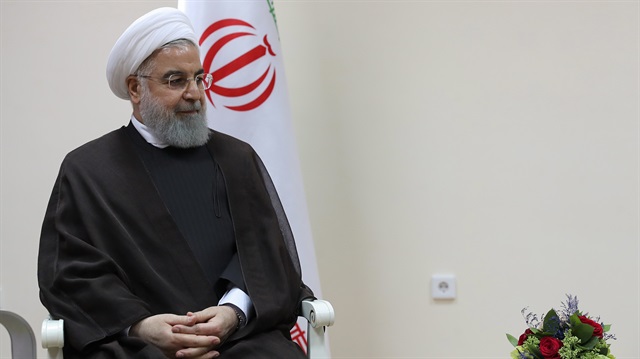
Hassan Rouhani
Pressures mounted on Iranian President Hassan Rouhani on Tuesday as lawmakers summoned him to answer questions on weak economic growth and rising prices, but the parliament was not convinced by his answers and referred the case to the judiciary.
Defending his cabinet's performance, Rouhani said the economic troubles only began when Washington reimposed sanctions on Tehran, but many lawmakers were not satisfied with the answer according to vote results at the end of the session.
If the majority of lawmakers are not convinced with the president’s answers, they can see it as "a breach of law" and refer the case to the judiciary.
The lawmakers have the power to impeach the president, and vote on his lack of competence, but such a motion is not before parliament at this stage.
Iran will overcome newly reimposed U.S. measures against Tehran, sanctions that will only serve to unify the nation, President Hassan Rouhani said on Tuesday.In a speech broadcast live on state television, Rouhani said his government would overcome the economic challenges and show "the anti-Iranian officials in the White House" that the sanctions would fail."The economic problems are critical, but more important than that is that many people have lost their faith in the future of the Islamic Republic and are in doubt about its power," Rouhani said, while answering lawmakers' questions about his handling of the economy, amid rising prices and unemployment."We are not afraid of America or the economic problems," he said. "We will overcome the troubles." US vows to fight Iran world court actionWorld Court hears Iran lawsuit to have US sanctions liftedIran shuts down scores of military-run companiesIran says it has full control of Gulf and US navy does not belong there
Rouhani vows to defeat 'anti-Iranian' officials in the White House
On Sunday, Iran's parliament sacked the minister of economic affairs and finance due to the sharp fall in the rial currency and the deterioration in the economic situation. In early August Iranian lawmakers voted out the minister of labour and last month Rouhani replaced the head of the central bank.
Rouhani, a pragmatist who reduced tension with the West by striking a nuclear deal with world powers in 2015, now himself faces a backlash from hardliners after U.S. President Donald Trump pulled out of the pact in May.
Rouhani said anti-government protests in early January encouraged Trump to withdraw from the nuclear deal as he was hopeful that economic hardship would stir more unrest in Iran.
The demonstrations, which began over economic hardship and high prices and included chants slogans against the government and Supreme Leader Ayatollah Ali Khamenei, spread to more than 80 cities and towns and resulted in 25 deaths.
The United States views Iran's filing with the International Court of Justice as an attempt to interfere with its rights to take actions on national security grounds and will fight Tehran's claims, the State Department said on Monday as oral proceedings began before the court."Iran’s filing with the ICJ is an attempt to interfere with the sovereign rights of the United States to take lawful actions, including re-imposition of sanctions, which are necessary to protect our national security. The proceedings instituted by Iran are a misuse of the Court," Secretary of State Mike Pompeo said in a statement. Video: World Court hears Iran suit to have US sanctions liftedIran applies to UN court against US sanctions
US vows to fight Iran world court action
"The protests tempted Trump to withdraw from the nuclear deal," he said, asking lawmakers to support his cabinet and not add to anti-government sentiment.
Although the economic problems were critical, Rouhani said: "More important than that is that many people have lost their faith in the future of the Islamic Republic and are in doubt about its power."
LAWMAKERS DEMAND ANSWERS
The nuclear deal had lifted sanctions on Tehran in return for curbs on its nuclear programme.
But Washington imposed a new round of sanctions in August targeting Iran’s trade in gold and other precious metals, its purchases of U.S. dollars and its car industry. A new round of sanctions to be imposed in November targets Iranian oil sales.
Iranian President Hassan Rouhani on Monday urged the remaining signatories to its 2015 nuclear agreement to act to save the pact, though France's leader called again for broader talks on Tehran's missile program and its role in the Middle East region.In a phone call to French President Emmanuel Macron, Rouhani said Iran wanted the Europeans to give guarantees on banking channels and oil sales as well as in the field of insurance and transportation, according to the state-run Iranian news agency IRNA."Iran has acted upon all its promises in the nuclear agreement and, with attention to the one-sided withdrawal of America ... expects the remaining partners to operate their programs more quickly and transparently," Rouhani was quoted as saying.Iran applies to UN court against US sanctionsRouhani was speaking in the light of U.S. sanctions re-imposed by Washington after President Donald Trump pulled out of a 2015 nuclear deal between Iran and world powers in May.Macron reiterated France's commitment to maintaining the accord, a remark aimed at soothing Tehran.But he repeated his earlier calls for broader discussions with all relevant parties that would include Iran's nuclear programme after 2025, its ballistics programme and its influence in the wider Middle East region.Iran shuts down scores of military-run companies"We will do everything so that the talks help avoid a serious crisis in the months ahead," Macron said in an annual speech to French ambassadors.Separately, the head of the navy of Iran's Revolutionary Guards, General Alireza Tangsiri, said on Monday that Iran had full control of the Gulf and the U.S. Navy did not belong there, according to the Tasnim news agency.Tehran has suggested it could take military action in the Gulf to block other countries' oil exports in retaliation for U.S. sanctions intended to halt its sales of crude. Washington maintains a fleet in the Gulf that protects oil shipping routes.Iran says it has full control of Gulf and US navy does not belong thereTangsiri said Iran had full control of the Gulf and the Strait of Hormuz that leads into it. Closing the strait would be the most direct way of blocking shipping."We can ensure the security of the Persian Gulf and there is no need for the presence of aliens like the U.S. and the countries whose home is not in here," he said in the quote, which appeared in English translation on Tasnim.He added, "All the carriers and military and non-military ships will be controlled and there is full supervision over the Persian Gulf. Our presence in the region is physical and constant and night and day."Iran and Syria sign deal for military cooperationThe head of the Revolutionary Guards, Major General Mohammad Ali Jafari, said on Monday that Iran's enemies would not prevail in a conflict."The enemies are strictly avoiding any conflict with Iran because they know that it will not be beneficial for them," Jafari said, according to Tasnim.As tension has escalated between Iran and the United States senior U.S. officials have said they aim to reduce Iran's oil exports to zero.Iran's Supreme Leader Ayatollah Ali Khamenei, the most senior authority in the Islamic Republic, said last month that he supported the idea that if Iran is not allowed to export oil then no country should export oil from the Gulf. 
Iran expects remaining nuclear deal partners to act faster to preserve it: Rouhani
"I want to assure the Iranian nation that we will not allow the U.S. plot against the Islamic Republic to succeed," Rouhani said told parliament in a session that was broadcast live on state television.
"We will not let this bunch of anti-Iranians in the White House be able to plot against us."
The lawmakers asked Rouhani about the government's failure in tackling the rise of unemployment, slow economic growth, and the fall of the country's currency rial - as well as revenue-sapping cross-border smuggling operations.
Rouhani said his government had asked the powerful Revolutionary Guards to help them in tackling the smuggling.
Iran’s Defense Ministry has shut down more than 130 of its companies, Defense Minister Amir Hatami said Monday.In statements, the minister said the closed companies were active in the fields of transportation, energy and construction.“The ministry has given up its shares in Wagon Pars and Iran Air Tours,” he said.Wagon Pars is an Iranian train manufacturing company, whose products include locomotives, trains, metros, freight and fuel wagons, and aircraft equipment.Iran Air Tours is a Tehran-based airline.Hatami said the closure aims to reduce the role of the military in the economic sector.The defense minister said former governments had privatized many companies owned by the military.He went on to stress that the military was ready to transfer 72 percent of projects being carried out by the military-run companies to the private sector.Last January, Hatami said that Iranian Supreme Leader Ayatollah Ali Khamenei has ordered the military to withdraw from the country's economic sector.
Iran shuts down scores of military-run companies
Lawmakers also asked why the government had not adopted reforms in the financial sector and foreign exchange market, and sought an explanation why, more than two years after the nuclear deal, Iranian banks still had only limited access to global financial services.
The parliament only found Rouhani's answer about the banking satisfactory and referred the rest to the hardline judiciary.
Iran has full control of the Gulf, and the U.S. Navy does not belong there, the head of the navy of Iran's Revolutionary Guards, General Alireza Tangsiri, said on Monday, according to the Tasnim news agency.The remarks come at a time when Tehran has suggested that it could take military action in the Gulf to block oil exports of other regional countries in retaliation for U.S. sanctions intended to halt its oil sales. Washington maintains a fleet in the Gulf which protects oil shipping routes.Tangsiri said Iran had full control of both the Gulf itself and the Strait of Hormuz that leads into it. Closing off the strait would be the most direct way of blocking shipping.Iran and Syria sign deal for military cooperation"We can ensure the security of the Persian Gulf and there is no need for the presence of aliens like the U.S. and the countries whose home is not in here," he said in the quote, which appeared in English translation on Tasnim.Tension between Iran and the United States has escalated since President Donald Trump pulled out of a 2015 nuclear deal between Iran and world powers in May and reimposed sanctions.Senior U.S. officials have said they aim to reduce Iran's oil exports to zero.Iran's Supreme Leader Ayatollah Ali Khamenei, the most senior authority in the Islamic Republic, said last month that he supports the idea that if Iran is not allowed to export oil then no country should export oil from the Gulf. Iran defence minister Amir Hatami arrives in SyriaAmerica is waging 'psychological war' against Iran
Iran says it has full control of Gulf and US navy does not belong there
Iran and Syria signed a deal for military cooperation in a meeting between the defence ministers of the two countries in Damascus, the Tasnim news agency reported on Monday.Iranian Defence Minister Amir Hatami travelled to Damascus on Sunday for a two-day visit, meeting Syrian President Bashar al-Assad and senior military officials, Tasnim reported.Iran foreign minister hails relations with TurkeyIran defence minister Amir Hatami arrives in SyriaIranian forces have backed Assad in the country’s civil war.Tasnim did not provide any details about the military cooperation deal.U.S. National Security Adviser John Bolton said last week that Iran should remove its forces from Syria.Senior Iranian officials have said their military presence in Syria is at the invitation of the Assad regime and they have no immediate plans to withdraw.
Iran and Syria sign deal for military cooperation