

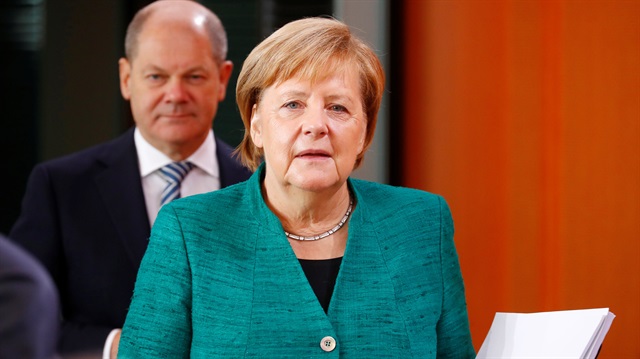
German Chancellor Angela Merkel
Palestinians have appealed to German Chancellor Angela Merkel to intervene to save the Bedouin community of Khan al-Ahmar, which is at the risk of demolition by Israeli authorities.
Merkel is scheduled to arrive in Israel later Wednesday for a two-day visit during which she will hold talks with Israeli officials on relations between the two countries.
She will meet with Israeli Prime Minister Benjamin Netanyahu and President Reuven Rivlin before attending a round-table discussion between German and Israeli officials.
Merkel, however, will not visit Ramallah or meet Palestinian officials during her visit.
The holy city of Jerusalem, which Salahuddin al-Ayyubi salvaged from the invasion of the Crusaders 831 years ago, is falling completely into Israel's hands as a result of persistent judaization policies.Jerusalem, one of the oldest cities in history, has great importance for all three Abrahamic religions.It was first conquered in 638 by the second Muslim caliph, Umar bin al-Khattab. It was invaded by the Crusaders in 1099.Jerusalem encompassing the first qibla of Muslims, Masjid al-Aqsa, was reconquered by Ayyubi in 1187.Israel denies mediation on Hamas prisoner swap dealExcept for an 11-year occupation, the city remained under the control of Muslims until 1917 after Ayyubi's conquest.After the British invaded Jerusalem on Dec. 9, 1917, which till then had been under the control of the Ottoman Empire for 400 years, they turned a blind eye to Jewish settlements in the region.The Jewish population in the historic Palestinian territory in 1917 is said to be around 60,000.It ballooned to 800,000 in 1948, when Israel declared its independence.US enforces $38bln military aid package to help Israel fight ‘Iran-sponsored terrorists’According to the Palestinian sources, the Jewish population in Jerusalem in 1922 was approximately 34,000 while the Arab population was about 28,000.In 1946, the Jewish population in the city rose to 99,000 while the number of Palestinian Arabs remained 65,000.Israel declared it independence on May 14, 1948 whereas Arab countries including Egypt, Jordan, Lebanon and Syria waged a war against Israel on May 15, 1948.Israel, which won the war, began to implement its plan for judaizing the city by invading West Jerusalem.Israel arrests 21 Palestinians in West Bank raidsAfter the 1948 war, Israel invaded East Jerusalem and the West Bank during the six-day war in 1967.Israel declared the entire Jerusalem as its capital in July 3, 1980.In Dec. 6, 2017, U.S. President Donald Trump unilaterally recognized Jerusalem as "Israel's capital."The U.S. relocated its embassy to Jerusalem on May 14, 2018.Israel, which has built 19 illegal settlements in East Jerusalem since 1968, placed more than 200,000 Jews in these places.As of today, there are 316,000 Palestinians living in the city, which has a population of 850,000. The remaining people are Jews.The Israeli authorities are expanding Jewish settlements and also prevent Arab population in the city from building new houses.
Israel slowly encroaching all of Jerusalem
“The European Union has warned against the consequences of tearing down the village and Merkel should send a clear message to Israeli officials that the demolition of Khan al-Ahmar would expose Israel to accountability,” prominent Palestinian activist Mustafa Barghouthi told Anadolu Agency.
He called on the German Chancellor to stand against Israel's “ethnic cleansing policy” against the Palestinians in general and Khan al-Ahmar residents in particular.
According to Israeli daily Haaretz, Merkel is expected to raise the issue of Khan al-Ahmar demolition during her talks with Israeli officials.
The newspaper said that the hamlet will not be demolished during Merkel’s visit due to “diplomatic sensitivities”.
The life of Nasir Musbih -- a 12-year-old Palestinian martyred by Israeli troops Friday during the ‘Great March of Return’ demonstrations -- is like a summary of the region he lived in.Born in Gaza in 2006, a year before Israel imposed a land, air and sea blockade on the area, his brief life ended when an Israeli soldier shot him in the head.In 2012, when Nasir was a fresh primary student, the region echoed with shelling and gunfire. Two years later, he faced Israeli attacks on Gaza together with his family, friends and neighbors. In a geography dominated by weapons, blood and tears, Nasir managed to achieve a great deal in his short life.In addition to being one of the best students at Abdulkerim Kermi Primary School in Khan Younis city, he was a Quran hafiz.He left behind a grieving family and friends.Nasir’s weeping classmates have great difficulty with their lessons; tears and grief prevail at the school nowadays.A classmate, Ziya Abu Hatti, burst into tears as he told Anadolu Agency about Nasir. "He was my best friend; the best," Ziya said."We would always help each other in English and health lessons. We would call him 'Abdussamed', as his voice was good. He used to help people in health teams near the border protests. I would always tell him to stay away from the fences so that he wouldn't be another kid killed by the Israeli soldiers."Kamal Najjar, 50, a science teacher at Abdulkerim Kermi Primary School, said Nasir was a successful student interested in the science lessons."He wanted to be a surgeon when he grew up. He couldn't fulfill his dreams," he said, noting that Nasir was one of the star students at the school.Nasir's family can’t help crying when they look at his belongings."He was a lot more different than my other children," said his mother, 41-year-old Simah Musbih.She broke into tears while recounting how Nasir had recited Quran over the school’s PA system and during prayers at the mosque."He always wanted to see Palestine on the other side of the border. He insisted on attending the demonstrations. He would go to the protest area each week and voluntarily help sisters in first aid teams.”Accusing the Israeli snipers of deliberately targeting her son, she said: "My son was just a child helping the injured during first aid [activities]. He posed no threat or danger. What sort of threat could a 12-year-old child pose against soldiers fully equipped with modern weapons and armor, leading to him being shot in the head? They have to prove it."Last Friday, Israeli troops opened fire on Palestinians taking part in the ‘Great March of Return’. Seven, including Nasir Musbih, were martyred and 90 others were wounded.With Nasir's death, the number of Palestinian child martyrs since March 30, when the anti-occupation protests began, has reached 34.Protesters -- who have been staging demonstrations since March 30 -- demand the “right of return” to their homes in historical Palestine from which they were driven in 1948 to make way for the new state of Israel.They also demand an end to Israel’s 11-year blockade of the Gaza Strip, which has gutted the coastal enclave’s economy and deprived its two million inhabitants of basic commodities.According to the Health Ministry, more than 180 Palestinians have been martyred and thousands more injured since the rallies began some six months ago.Israel denies mediation on Hamas prisoner swap dealPalestinians protest UNRWA aid cuts, downsizing plansClashes erupt in West Bank amid general strikePalestinians, Israeli-Arabs protest ‘nation-state’ law
Gaza bids farewell to 12-year-old martyr
Haaretz said ahead of Merkel’s visit, members of Israeli and German opposition parties met and formulated a joint statement calling for “ending the occupation and stopping the demolition of Khan al-Ahmar.”
The meeting was led by Knesset member Mossi Raz of the left- wing Meretz party and German lawmaker Omid Nouripour.
“The evacuation of Khan al-Ahmar is a war crime that contravenes international law. I hope the international community will mobilize to help stop the demolition of the community and put pressure on the Israeli government,” Raz told Haaretz.
On Tuesday, Palestinians demonstrated against the demolition, with many waving Merkel’s pictures amid calls for her to stop the demolition plans.
Clashes broke out on Tuesday between Palestinian students and Israeli forces in Israel-occupied West Bank, according to local residents.Israeli soldiers fired rubber bullets, stun bombs and tear gas canisters to disperse a rally staged by Birzeit University students at the Beit El checkpoint north of Ramallah.Angry students hurled stones and empty cans and set tyres ablaze, local residents said.No injuries were reported.Tuesday’s rally was staged in support of the Al-Khan Al-Ahmar Bedouin hamlet, which is at the risk of demolition by Israeli authorities, and an Israeli law recognizing Israel as the “nation-state of the Jewish people”.The legislation defines Israel as a Jewish state with a “united Jerusalem” as its capital. It has also promoted Hebrew as the only official language, stripping Arabic as an official language while recognizing its “special status”.The controversial law risks further alienating the Arab minority who argue they already face discrimination from Israeli Jews and the government and already feel as though they are second-class citizens.Palestinians protest UNRWA aid cuts, downsizing plansPalestinians, Israeli-Arabs protest ‘nation-state’ law
Palestinian students protest Israeli law amid clashes
On Sept. 5, the Israeli Supreme Court ruled to demolish Khan al-Ahmar and evict the village’s Bedouin inhabitants.
Israel plans to expel some 10,000 Bedouin residents of what is known as the E1 Zone, which sits on 15 square kilometers (5.8 square miles) of land in East Jerusalem, to make way for housing units linking Jerusalem to the Ma'ale Adumim settlement.
If implemented, the plan would effectively cut the West Bank in two, preempting the possibility of a Palestinian state based on pre-1967 borders.
In early July, Israeli bulldozers destroyed a number of tents and other structures in Khan al-Ahmar, sparking clashes with local residents.
There are 46 Bedouin communities -- inhabited by some 3,000 residents -- scattered across Israeli-occupied East Jerusalem.
Under the 1995 Oslo agreement between Israel and the Palestinian Authority (PA), the West Bank -- including East Jerusalem -- was divided into Areas A, B and C.
Area A falls under the administrative and security control of the PA; Area B falls under the administrative control of the PA and the security control of Israel; and Area C -- in which Khan al-Ahmar is located -- falls under the administrative and security control of Israel.