

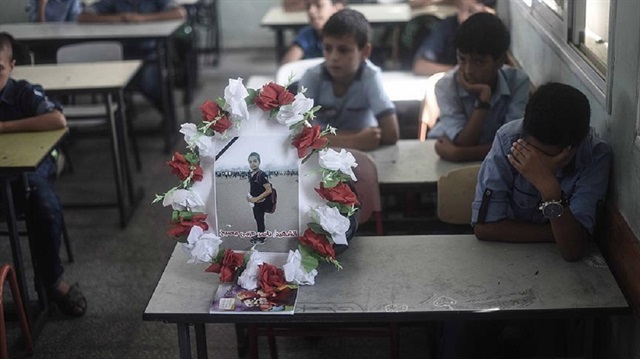
File photo
The life of Nasir Musbih -- a 12-year-old Palestinian martyred by Israeli troops Friday during the ‘Great March of Return’ demonstrations -- is like a summary of the region he lived in.
Born in Gaza in 2006, a year before Israel imposed a land, air and sea blockade on the area, his brief life ended when an Israeli soldier shot him in the head.
In 2012, when Nasir was a fresh primary student, the region echoed with shelling and gunfire. Two years later, he faced Israeli attacks on Gaza together with his family, friends and neighbors.
In a geography dominated by weapons, blood and tears, Nasir managed to achieve a great deal in his short life.
In addition to being one of the best students at Abdulkerim Kermi Primary School in Khan Younis city, he was a Quran hafiz.
He left behind a grieving family and friends.
Nasir’s weeping classmates have great difficulty with their lessons; tears and grief prevail at the school nowadays.
A classmate, Ziya Abu Hatti, burst into tears as he told Anadolu Agency about Nasir.
"He was my best friend; the best," Ziya said.
"We would always help each other in English and health lessons. We would call him 'Abdussamed', as his voice was good. He used to help people in health teams near the border protests. I would always tell him to stay away from the fences so that he wouldn't be another kid killed by the Israeli soldiers."
Kamal Najjar, 50, a science teacher at Abdulkerim Kermi Primary School, said Nasir was a successful student interested in the science lessons.
"He wanted to be a surgeon when he grew up. He couldn't fulfill his dreams," he said, noting that Nasir was one of the star students at the school.
Nasir's family can’t help crying when they look at his belongings.
"He was a lot more different than my other children," said his mother, 41-year-old Simah Musbih.
She broke into tears while recounting how Nasir had recited Quran over the school’s PA system and during prayers at the mosque.
"He always wanted to see Palestine on the other side of the border. He insisted on attending the demonstrations. He would go to the protest area each week and voluntarily help sisters in first aid teams.”
Accusing the Israeli snipers of deliberately targeting her son, she said: "My son was just a child helping the injured during first aid [activities]. He posed no threat or danger. What sort of threat could a 12-year-old child pose against soldiers fully equipped with modern weapons and armor, leading to him being shot in the head? They have to prove it."
Last Friday, Israeli troops opened fire on Palestinians taking part in the ‘Great March of Return’. Seven, including Nasir Musbih, were martyred and 90 others were wounded.
With Nasir's death, the number of Palestinian child martyrs since March 30, when the anti-occupation protests began, has reached 34.
Protesters -- who have been staging demonstrations since March 30 -- demand the “right of return” to their homes in historical Palestine from which they were driven in 1948 to make way for the new state of Israel.
They also demand an end to Israel’s 11-year blockade of the Gaza Strip, which has gutted the coastal enclave’s economy and deprived its two million inhabitants of basic commodities.
According to the Health Ministry, more than 180 Palestinians have been martyred and thousands more injured since the rallies began some six months ago.
Israel has denied reports about Norwegian mediation to reach a prisoner swap deal with Palestinian group Hamas, according to Israeli daily Yediot Aharonoth on Tuesday."The report that Norway is mediating the deal regarding the POWs and MIAs [missing in action] is incorrect," an Israeli source said.Lebanese daily al-Akhbar on Monday reported that Norway was mediating between Hamas and Israel to reach an agreement on the return of Israeli soldiers held captive in the Gaza Strip.The newspaper claimed that a Norwegian envoy had visited Gaza last month and received a “positive response” from Hamas.There was no comment from Hamas on the report.In April, the Ezzeddin al-Qassam Brigades, the military arm of Hamas, said it was holding four Israeli soldiers, without elaborating on their condition.UNRWA employees strike over downscaling plansUS enforces $38bln military aid package to help Israel fight ‘Iran-sponsored terrorists’Israel arrests 21 Palestinians in West Bank raids
Israel denies mediation on Hamas prisoner swap deal
Dozens of Palestinians staged a rally on Monday to protest plans by UN refugee agency UNRWA to scale down its services in the Palestinian territories.The protest was organized outside the office of the UN refugee agency in the occupied East Jerusalem.Leading among participants in Monday’s rally was Sheikh Ekrema Sabri, preacher of the Al-Aqsa Mosque and head of the Supreme Muslim Council in Jerusalem.The protesters handed over a message to the UNRWA operations director, in which they “highlighted the UN responsibility and historic role toward the Palestinian issue”.The message cited UN General Assembly resolution 302 that calls for the provision of services to refugees by UNRWA until reaching a just settlement to the issue of Palestinian refugees.Clashes erupt in West Bank amid general strikePalestinians, Israeli-Arabs protest ‘nation-state’ lawParticipants also appealed to international donors to increase their funding to the UN refugee agency “to guarantee UNRWA to continue to do its role”.According to the UNRWA employees’ union, funding cuts have forced the agency to close its mental health program, which had provided direct services to Palestinian refugees in Gaza and had employed about 430 people.In August, the U.S. administration said it would “no longer commit funding” to the refugee agency.The U.S. had been UNRWA's largest contributor by far, providing it with $350 million annually -- roughly a quarter of its overall budget.Established in 1949, UNRWA provides critical aid to Palestinian refugees in the blockaded Gaza Strip, the Israeli-occupied West Bank, Jordan, Lebanon and Syria.
Palestinians protest UNRWA aid cuts, downsizing plans
Clashes broke out between Palestinian protesters and Israeli forces in the West Bank on Monday amid a general strike over a law recognizing Israel as the “nation-state of the Jewish people”.Israeli forces fired rubber bullets and tear gas canisters to disperse stone-throwing Palestinians at the entrances of Ramallah and al-Bireh cities in central West Bank, according to local residents.Protesters blocked roads with barricades and set tyres ablaze amid chants against the Israeli law, which was passed by the Knesset (Israel’s parliament) in July.Similar clashes were reported in the West Bank town of Nabi Saleh and the cities of Nablus, Qalqilya and Hebron.Palestinians, Israeli-Arabs protest ‘nation-state’ lawNo information was yet available about injuries.On Monday, Palestinians staged a general strike in the West Bank and Gaza Strip in support of Israeli-Arabs protesting the nation-state law.The legislation defines Israel as a Jewish state with a “united Jerusalem” as its capital. It has also promoted Hebrew as the only official language, stripping Arabic as an official language while recognizing its “special status”.The controversial law risks further alienating the Arab minority who argue they already face discrimination from Israeli Jews and the government and already feel as though they are second-class citizens.Galeri: General Strike in West BankThe general strike coincides with the killing of 13 Israeli-Arabs by Israeli police at the start of the 2000 Palestinian intifada, triggered by a controversial visit by then opposition leader Ariel Sharon to East Jerusalem’s Al-Aqsa Mosque compound.For Muslims, Al-Aqsa represents the world's third holiest site. Jews, for their part, refer to the area as the "Temple Mount", claiming it was the site of two Jewish temples in ancient times.Jerusalem remains at the heart of the Middle East conflict, with Palestinians hoping that East Jerusalem -- occupied by Israel since 1967 -- might eventually serve as the capital of an independent Palestinian state.
Clashes erupt in West Bank amid general strike
Palestinians staged a general strike in the West Bank and Gaza Strip on Monday in support of Israeli-Arabs protesting a controversial law recognizing Israel as the “nation-state” of the Jewish people.Businesses and schools closed doors across the occupied territories and Arab towns inside Israel."I can say that there is a complete commitment to the strike,” Arab member of Knesset (Israel’s parliament) Massoud Ghanayem told Anadolu Agency.The action was staged in support of Israeli-Arabs, who called the strike in protest of the “Nation-State” law, which was passed by Knesset in July.The legislation defines Israel as a Jewish state with a “united Jerusalem” as its capital. It has also promoted Hebrew as the only official language, stripping Arabic as an official language while recognizing its “special status”.The controversial law risks further alienating the Arab minority who argue they already face discrimination from Israeli Jews and the government and already feel as though they are second-class citizens."Palestinians throughout the occupied territories are taking part in the strike,” Ghanayem said. “This unity was necessary since the nation-state law targets all issues of the Palestinian people, whether refugees, their right to self-determination and presence of Arab citizens inside Israel,” he said.Palestinians, who have Israeli citizenship make up 21 percent of the population, are known as Israeli-Arabs and have members in the Knesset.Video: Palestinians, Israeli-Arabs protest ‘nation-state’ lawPalestinian youth injured in Israeli raid in West BankDiscriminationPalestinian group Hamas said the strike aims to highlight discrimination against the Palestinians living inside Israel.“Today’s strike aims to show solidarity with our people in the occupied territories, who are facing a wave of racial discrimination,” Hamas spokesman Hazem Qassem told Anadolu Agency."[Nation-state] law is a serious legislation that paves the way for treating the Palestinians, who are the owners of this land, as strangers and deporting them,” he said.Talal Abu Zarifa, a member of the Democratic Front for the Liberation of Palestine (DFLP), said the general strike “aims to send a message to the world to put an end to this aggression”."This law, which seeks to strip all civil and social rights of all minorities in Israel, must be terminated," he said. “This legislation also undermines the right of the Palestinians to return [to their homes in historical Palestine].”Monday's strike coincides with the killing of 13 Israeli-Arabs by Israeli police at the start of the 2000 Palestinian intifada, triggered by a controversial visit by then opposition leader Ariel Sharon to East Jerusalem’s Al-Aqsa Mosque compound.For Muslims, Al-Aqsa represents the world's third holiest site. Jews, for their part, refer to the area as the "Temple Mount", claiming it was the site of two Jewish temples in ancient times.Jerusalem remains at the heart of the Middle East conflict, with Palestinians hoping that East Jerusalem -- occupied by Israel since 1967 -- might eventually serve as the capital of an independent Palestinian state.Iran refutes Israel’s secret nuclear site claims
Palestinians, Israeli-Arabs protest ‘nation-state’ law