

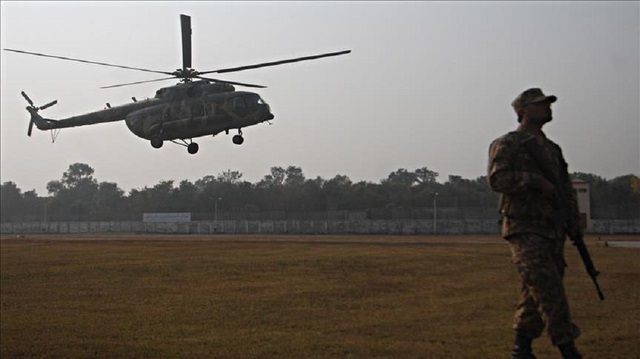
Pakistan ends military operations in Swat valley
Pakistan army on Monday said it "successfully" wrapped up its decade-long anti-Taliban offensive in the restive northwestern valley of Swat.
"Today is our victory day and we proudly announced that now there is no presence of any terrorist hideouts in Swat as Pakistan military successfully defeated them and destroyed all their hideouts in Swat and other parts of Malakand region," Mehmood Khan, chief minister of the Khyber Pakhtunkhwa province, said.
His remarks came during a ceremony to mark the end of the operations and handover of powers to civilian authorities after 11 years of military rule in the region.
Swat valley, a tourist attraction located in the northwestern province of Khyber Pakhtunkhwa, used to be known as the "Switzerland of Pakistan".
Islamabad has closed two main crossing points with Afghanistan on eve of the Afghan parliamentary polls, Pakistan’s Foreign Office said on Friday."On request by the government of Afghanistan it has been decided to keep the friendship gates on Pakistan Afghanistan border crossing points at Chaman and Torkhan closed on Oct. 19 and 20," Mohammad Faisal, spokesman for the Foreign Office, said in a statement.The decision has been taken to support Afghanistan in smooth conduct of upcoming parliamentary elections in the country, Faisal said, adding both crossing points will remain closed for all kind of traffic except emergency cases.The parliamentary election in Afghanistan is going to be held tomorrow, on Oct. 20.More than 2,500 people, including 418 women, are competing for the 249 seats in Afghanistan's Wolesi Jirga, lower house of the parliament.Election in Afghan province of Kandahar to be delayed a week
Pakistan closes border crossings ahead of Afghan polls
The top U.S. general in Afghanistan said on Friday he did not believe he was the target of an attack that killed a powerful police chief, and Afghan officials said the gunman may have deliberately avoided hitting him.The gunman assassinated the police chief of Kandahar province on Thursday along with a top Afghan intelligence agency officer, but the U.S. commander of Afghanistan's NATO-led force, General Scott Miller, who was standing nearby when the attack occurred, was not hurt."My assessment is that I was not the target. It was a very close confined space. But I don't assess that I was the target," Miller told Afghanistan's Tolo News TV in an interview.General Abdul Razeq, police commander of the southern province and one of Afghanistan's most powerful security officials, was fatally wounded by a bodyguard of the provincial governor as he came from a meeting with officials on Thursday.Election in Afghan province of Kandahar to be delayed a weekIn addition, the local head of the NDS intelligence service was killed and the provincial governor severely wounded, while the attacker himself was killed.Miller was also at the meeting and was heading to his helicopter to return to Kabul when the gunman opened fire.The Taliban claimed the attack in a statement saying both Razeq and Miller were the targets.Two Americans and a coalition contractor were wounded, however Afghan security officials, who believe Pakistan was involved in the plan, said they believed the attacker deliberately avoided killing Miller.Afghanistan in shock after death of powerful police commander"They didn't want repercussions from the U.S. and the international community. It was a pure warning for Miller that they can hit him if they want to," one of the Afghan officials, who spoke on condition of anonymity, said.Razeq himself was a fierce critic of Pakistan and its intelligence service, which Afghan officials regularly accuse of supporting Taliban operations, a charge Islamabad denies.On Friday, the chief of the Pakistan army staff issued a statement condemning the Kandahar violence and saying it supported initiatives towards peace in the region.A foreign security official said Razeq had stopped visiting the governor's house in recent months because he feared it had been infiltrated and had only gone because Miller and his delegation were there.The identity of the killer, named by Afghan officials as Gulbuddin, was known immediately, and police have made three arrests, but details of his background or why he carried out the attack remained unclear.One senior foreign security official briefed on the case said the attacker had been recruited this year as part of the governor's security detail.No one had claimed his body, but his colleagues in the security team said his family members lived in the outskirts of Kandahar. 
US general doesn't believe he was target of Kandahar attack
The valley has been a stronghold for the Tehrik Taliban Pakistan -- Pakistani Taliban -- from 2007 to 2009.
The Pakistani army deployed armed forces in Swat in 2007 to launch a large-scale operation against Taliban militants.
The last deadly attack carried out by the Taliban in Swat valley was in January 2013 when 21 worshipers were killed and 70 others injured at a religious center.
"Terrorists had destroyed our educational institutions, health facilities and killed thousands of innocent people in Swat, Dir, Bunir and other parts of the Malakand Division," Khan recalled.
"Today complete peace has returned here."
According to the provincial police chief, Salahuddin Mehsud, the provincial government has deployed over 20,000 police in the Swat valley to secure the region.
Five Kashmiri civilians and three militants were killed in southern Kashmir, police said Sunday.The militants were killed in a gunbattle with the Indian forces and a civilian was also shot dead in Kulgam area, police spokesman Manoj Pandita said.Four more civilians were killed in a blast soon after the gunbattle ended when they entered the house from where the militants had been fighting.Indian forces use explosives to blow up the houses from which the militants fight during the gunbattles.Hospital authorities confirmed the death of five people.Over 43 civilians have been reportedly wounded in the protests and clashes between people and the Indian forces that are being reported from several areas across the south.The pro-independence leadership called for a complete shutdown to be observed on Monday against the killings.Kashmir, a Muslim-majority Himalayan region, is held by India and Pakistan in parts and claimed by both in full. A small sliver of Kashmir is also held by China.Since they were partitioned in 1947, the two countries have fought three wars -- in 1948, 1965 and 1971 -- two of them over Kashmir.Also, in Siachen glacier in northern Kashmir, Indian and Pakistani troops have fought intermittently since 1984. A cease-fire came into effect in 2003.Some Kashmiri groups in Jammu and Kashmir have been fighting against Indian rule for independence, or for unification with neighboring Pakistan.According to several human rights organizations, thousands of people have reportedly been killed in the conflict in the region since 1989.
Three militants, five civilians killed in Kashmir
Yunus Emre Institute, a Turkish cultural center, on Saturday launched Turkish language program for orphans in Pakistan’s northeastern city of Lahore.Provincial Information Minister Fayyaz Ul Hassan Chohan, Turkey's Consul General Emir Ozbay, Yunus Emre Institute’s Director in Lahore Ulas Ertas and other officials were also present at the launching ceremony."This language program would help students study the very rich culture and history of Turkey,” Chohan told at the ceremony.Pakistan and Turkey enjoy historical, cultural, religious and economic relations and we want to further strengthen these ties, Chohan added.The minister assured the Turkish officials that his government would extend full support and cooperation to Turkish organizations operating in Pakistan.Ertas, for his part, said: "Turkey has launched several programs in education sector of Pakistan to support the students of our brotherly country."
Turkey starts language courses for orphans in Pakistan