

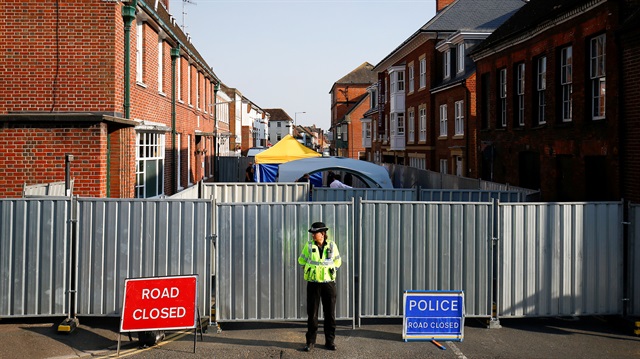
File photo
Those behind nerve agent poisonings in England have not been identified and police cannot guarantee there are no more traces of Novichok still in England, Britain's top counter-terrorism policeman said on Wednesday.
Former Russian spy Sergei Skripal and his daughter were poisoned with the Novichok nerve agent in Salisbury in March, and two Britons fell ill this month after exposure to the same nerve agent. One those, Dawn Sturgess, has died, while the other is critical but conscious.
"I would love to be able to stand here and say how we have identified and caught those responsible and how we are absolutely certain there are no traces of nerve agent left anywhere in the county," Assistant Commissioner Neil Basu said in a statement.
"The brutal reality, however, is that I cannot offer you any such assurances or guarantees at this time."
He added that it may never be possible to definitively establish a link between the death of Sturgess and the poisoning of the Skripals.
Britain's top counter-terrorism officer said on Monday that detectives were unable to say if the Novichok that two Britons were exposed to was the same that struck down a former Russian double agent and his daughter.Dawn Sturgess, 44, died after she was exposed to Novichok on June 30 in western England, just a few miles from where Russian double agent Sergei Skripal and his daughter Yulia were attacked with the same poison four months ago."This latest horrendous turn of events has only served to strengthen the resolve of our investigation team as we work to identify those responsible for this outrageous, reckless and barbaric act," Neil Basu, Britain's most senior counter-terrorism officer, told reporters."They are unable to say at this moment whether or not the nerve agent found in this incident is linked to the attack on Sergei and Yulia Skripal," Basu said. Kremlin says offered Britain Salisbury attack help, was rebuffedUK calls on Russia to give details after new Novichok poisoningUK couple near Salisbury showing similar symptoms to Skripals
UK police say unclear if latest Novichok poisoning linked to attack on Skripals
A British woman died on Sunday after she was poisoned by the same nerve agent that struck a former Russian spy in March and triggered a crisis in relations between Western capitals and Moscow.Dawn Sturgess, 44, died after she was exposed to Novichok on June 30 in western England, just a few miles from where Russian double agent Sergei Skripal and his daughter were attacked with the same poison four months ago.The death of Sturgess was being investigated as a murder, police said in a statement.Prime Minister Theresa May said she was appalled and shocked by the death.Police said they were investigating how Sturgess and a 45-year-old man, named by media as Charlie Rowley, came across an item contaminated with Novichok, which was developed by the Soviet military during the Cold War.Putin says World Cup has broken stereotypes about RussiaThe March attack on the Skripals prompted the biggest Western expulsion of Russian diplomats since the Cold War as allies sided with Britain's view that Moscow was either responsible or had lost control of the nerve agent.Moscow hit back by expelling Western diplomats.After Sturgess' death on Sunday, Britain's interior minister, Sajid Javid, said the "desperately sad news only strengthens our resolve to find out exactly what has happened."The head of UK Counter Terrorism policing, Assistant Commissioner Neil Basu, said Sturgess, a mother of three, died as the result of "an outrageous, reckless and barbaric act."Russia plans to evacuate 1,000 from de-escalation zone in Syria: reportsThe 45-year-old man remained critically ill in hospital.The poisoning in March of the Skripals with Novichok was the first known offensive use of such a chemical weapon on European soil since World War Two.Russia, which is currently hosting the soccer World Cup, has denied any involvement in the Skripal case and suggested the British security services had carried out the attack to stoke anti-Moscow hysteria.FATAL TOUCHThe two Britons were taken ill on June 30 in Amesbury, a town in southwest England, 11 km (7 miles) from Salisbury, where Skripal and his daughter Yulia were attacked.The Britons were initially thought to have taken an overdose of heroin or crack cocaine.But tests by the Porton Down military research centre showed they had been exposed to Novichok. Britain has notified the global chemical weapons watchdog, the Organisation for the Prohibition of Chemical Weapons (OPCW).Further tests of samples from Sturgess and the man showed they were exposed to the nerve agent after touching a contaminated item with their hands, police said on Sunday.Javid said earlier on Sunday that police had a working hypothesis that the two poisoning incidents were connected. He also said there were no plans at this stage for further sanctions against Russia.Sturgess died at Salisbury District Hospital, the same facility that nursed the critically ill Skripals.Yulia Skripal, Sergei's daughter, was in a coma for 20 days after she was attacked and was eventually discharged about five weeks after the poisoning. Her father was discharged on May 18.The hospital's medical director, Christine Blanshard, told the BBC that hospital staff worked tirelessly to save Sturgess. "They did everything they could," she said.Alastair Hay, a professor of environmental toxicology at Leeds University, said the hospital probably now had more experience than anywhere else in the world with Novichok cases, but there were limits to what doctors could do."Because the nerve agents compromise nerve and muscle function, their effects are widespread and where deaths occur these are usually due to either respiratory or circulatory failure, or both," he said.Britain's public health authority acknowledged on Friday the concerns of people living in the area after the two incidents involving Novichok, but said it was confident that the risk to the public remained low.The investigation into the nerve agent attacks is being led by Britain's Counter Terrorism Policing Network, and the police said around 100 detectives were working round the clock alongside colleagues from Wiltshire police.There was no evidence that the two Britons had visited any of the sites that were decontaminated following the attempted killings of Sergei and Yulia Skripal, police said on Sunday."We are not in a position to say whether the nerve agent was from the same batch that the Skripals were exposed to," they said.
UK woman dies after poisoning by Soviet-era nerve agent