

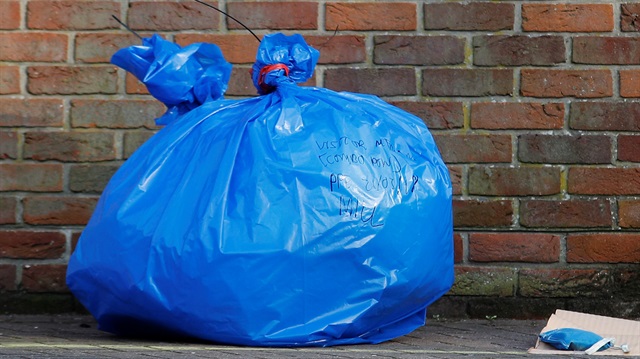
Bags containing protective clothing is seen after Inspectors from the Organisation for the Prohibition of Chemical Weapons (OPCW) left after visiting the scene of the nerve agent attack on former Russian agent Sergei Skripal, in Salisbury, Britain.
A British woman died on Sunday after she was poisoned by the same nerve agent that struck a former Russian spy in March and triggered a crisis in relations between Western capitals and Moscow.
Dawn Sturgess, 44, died after she was exposed to Novichok on June 30 in western England, just a few miles from where Russian double agent Sergei Skripal and his daughter were attacked with the same poison four months ago.
The death of Sturgess was being investigated as a murder, police said in a statement.
Prime Minister Theresa May said she was appalled and shocked by the death.
Police said they were investigating how Sturgess and a 45-year-old man, named by media as Charlie Rowley, came across an item contaminated with Novichok, which was developed by the Soviet military during the Cold War.
Russian President Vladimir Putin said on Friday that his country's hosting of the soccer World Cup had helped debunk stereotypes about it.Russia's host nation status had been met with resistance by some in the West who suggested the tournament could be unsafe and play into the hands of Putin, who stands accused by Washington of conducting "malign activities" around the world.But the month-long tournament, which ends on July 15, has so far been without major security incidents. Concerns about racism and hooligan violence that were discussed in the run-up have not been borne out and most visiting fans have spoken of a positive experience.At a meeting with FIFA president Gianni Infantino and former soccer stars at the Kremlin, Putin said the tournament and its coverage on social media had "helped break many stereotypes about Russia".World Cup: Quarterfinal matches begin Friday"People have seen that Russia is a hospitable country, a friendly one for those who come here," Putin said."I'm sure that an overwhelming majority of people who came will leave with the best feelings and memories of our country and will come again many times."Increasingly isolated on the global stage, Putin has used the tournament to send a defiant message to his opponents that Russia is succeeding despite Western efforts to hold it back.The Kremlin shrugged off on Thursday a fresh demand from Britain that it provide details about the Novichok nerve agent attack on a former double agent and his daughter in March after two British citizens were struck down this week with the same poison. Russia denies involvement in either attack."NEW IMAGE"Moscow's pedestrian streets have been flooded with fans and locals who have celebrated the world's most prestigious soccer tournament until the small hours of the morning."I was told people, police in the Red Square are smiling," Infantino told Putin, laughing."When they are asked for some information, they are very friendly. This is great. This is exactly what Russia is. This is the new image that we have about Russia."The Russian team's unexpected success at the World Cup has also added to the event's appeal in the country.After entering the tournament as the lowest-ranked side, Russia made it through to the knockout stage for the first time in post-Soviet history before upsetting Spain to make it to the quarter-finals.Russia will face Croatia in the quarter-finals in Sochi on Saturday. 
Putin says World Cup has broken stereotypes about Russia
The March attack on the Skripals prompted the biggest Western expulsion of Russian diplomats since the Cold War as allies sided with Britain's view that Moscow was either responsible or had lost control of the nerve agent.
Moscow hit back by expelling Western diplomats.
After Sturgess' death on Sunday, Britain's interior minister, Sajid Javid, said the "desperately sad news only strengthens our resolve to find out exactly what has happened."
The head of UK Counter Terrorism policing, Assistant Commissioner Neil Basu, said Sturgess, a mother of three, died as the result of "an outrageous, reckless and barbaric act."
The Russian military plans to evacuate up to 1,000 people from the south-western de-escalation zone in Syria via a humanitarian corridor near city of Daraa, Interfax news agency reported on Monday, citing Russia's Centre for Reconciliation in Syria.People will be evacuated to Syria's northern Idlib province, the centre said, Interfax reported.The number of villages and towns that have joined the truce in south-western Syria has increased to 90, Russia's RIA state news agency reported on Monday, citing the Centre for Reconciliation in Syria.180,000 children displaced in southern Syria: UNICEFSyrian opposition says pro-Assad forces to leave towns in deal brokered by Russia
Russia plans to evacuate 1,000 from de-escalation zone in Syria: reports
The 45-year-old man remained critically ill in hospital.
The poisoning in March of the Skripals with Novichok was the first known offensive use of such a chemical weapon on European soil since World War Two.
Russia, which is currently hosting the soccer World Cup, has denied any involvement in the Skripal case and suggested the British security services had carried out the attack to stoke anti-Moscow hysteria.
FATAL TOUCH
The two Britons were taken ill on June 30 in Amesbury, a town in southwest England, 11 km (7 miles) from Salisbury, where Skripal and his daughter Yulia were attacked.
The Britons were initially thought to have taken an overdose of heroin or crack cocaine.
But tests by the Porton Down military research centre showed they had been exposed to Novichok. Britain has notified the global chemical weapons watchdog, the Organisation for the Prohibition of Chemical Weapons (OPCW).
Further tests of samples from Sturgess and the man showed they were exposed to the nerve agent after touching a contaminated item with their hands, police said on Sunday.
Javid said earlier on Sunday that police had a working hypothesis that the two poisoning incidents were connected. He also said there were no plans at this stage for further sanctions against Russia.
Sturgess died at Salisbury District Hospital, the same facility that nursed the critically ill Skripals.
Yulia Skripal, Sergei's daughter, was in a coma for 20 days after she was attacked and was eventually discharged about five weeks after the poisoning. Her father was discharged on May 18.
The hospital's medical director, Christine Blanshard, told the BBC that hospital staff worked tirelessly to save Sturgess. "They did everything they could," she said.
Alastair Hay, a professor of environmental toxicology at Leeds University, said the hospital probably now had more experience than anywhere else in the world with Novichok cases, but there were limits to what doctors could do.
"Because the nerve agents compromise nerve and muscle function, their effects are widespread and where deaths occur these are usually due to either respiratory or circulatory failure, or both," he said.
Britain's public health authority acknowledged on Friday the concerns of people living in the area after the two incidents involving Novichok, but said it was confident that the risk to the public remained low.
The investigation into the nerve agent attacks is being led by Britain's Counter Terrorism Policing Network, and the police said around 100 detectives were working round the clock alongside colleagues from Wiltshire police.
There was no evidence that the two Britons had visited any of the sites that were decontaminated following the attempted killings of Sergei and Yulia Skripal, police said on Sunday.
"We are not in a position to say whether the nerve agent was from the same batch that the Skripals were exposed to," they said.