

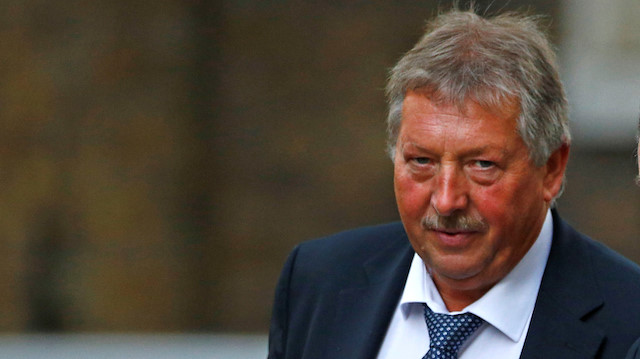
Sammy Wilson, Brexit spokesman for the Democratic Unionist Party
The Northern Irish party which props up British Prime Minister Theresa May said it will back the budget but could oppose the government in future if a Brexit deal indicates Northern Ireland is to be treated differently to the rest of the United Kingdom.
"To date we haven't seen the outcome of the Withdrawal Agreement so it would be reckless of us to oppose the budget on the basis of something we haven't seen," Sammy Wilson, Brexit spokesman for the Democratic Unionist Party, told the BBC.
"However... they shouldn't take for granted just because they get the budget passed that they can do whatever they want with Northern Ireland," he said.
British finance minister Philip Hammond said an end to his spending squeeze depended on the country getting a Brexit deal and he warned he would have to drop plans to boost public services without one.Hammond, who is due to announce an annual budget plan on Monday, said the government would be able to show voters that "their hard work has paid off" if Britain achieves a smooth exit from the European Union in five months' time.Hammond has angered many Conservative Party lawmakers by arguing Britain should remain close to the EU.Sterling stuck at seven-week lows as Brexit uncertainty mountsAsian stocks hit 20-month lows, S&P futures slide as investors flee risk"If we don't get a deal ... we would need to take a different approach to the future of Britain's economy," Hammond said in an interview with Sky News broadcast on Sunday."We would need to look at a different strategy and frankly we'd need to have a new budget that set out a different strategy for the future."Britain has cut its budget deficit sharply since the financial crisis 10 years ago but its debt levels remain high.Most economists say Britain would suffer an economic shock if it leaves the EU with no deal.Hammond said he was very confident that Britain would negotiate a Brexit deal that would minimise trade friction with the bloc but the government, and the Bank of England, would have to look at the situation and take action if there is no deal.UK budget and Bank of England take back seat to Brexit dramaEU shows no sign of heeding US threat over derivatives clearingTechnical Brexit talks are ongoing, says UK PM's spokeswoman
UK needs Brexit deal to end austerity: Hammond
Britain’s budget announcement on Monday and a “Super Thursday” at the Bank of England would normally be key moments for the world’s fifth-biggest economy, but this time they are likely to be overshadowed by the drama of Brexit.Finance minister Philip Hammond and Bank of England Governor Mark Carney have little option but to sit on the fence as they wait to see whether a no-deal exit from the European Union, which they warn would harm the economy, can be averted.Both men have other business they want to get on with.Technical Brexit talks are ongoing, says UK PM's spokeswomanHammond is under pressure from Prime Minister Theresa May to end a decade of austerity to see off a rise in popularity of the opposition Labour Party.At the BoE — where an interest rate decision and economic forecasts are due to be announced on Thursday — Carney and his fellow policymakers want to progress with their plan to raise borrowing costs gradually over the coming years.That would allow the British central bank to follow the lead of other central banks, especially in the United States and Canada, which are dismantling 10 years of massive stimulus.Sterling stuck at seven-week lows as Brexit uncertainty mountsExpectations of another rate hike by the U.S. Federal Reserve in December are likely to grow if the monthly payrolls report on Nov. 2 shows further jobs growth and rising pay.In the euro zone, data on economic growth and inflation on Tuesday and Wednesday will show whether the recovery in the single currency area has kept pace.But in Britain, with Brexit just five months away, things are much less clear cut.BREXIT FOGThere is no sign of a Brexit breakthrough with Brussels, in large part because May's Conservative Party is riven over how close Britain should remain to the European Union after it leaves the bloc."The budget is likely to be something of a holding exercise until the Brexit fog clears and the MPC is likely to remain in a state of inertia until there is a bit more clarity on the state of the Brexit negotiations," Ruth Gregory, an economist with Capital Economics, a research firm, said.When he stands up in parliament on Monday afternoon, Hammond is expected to use his high-profile budget speech to try to cool the Conservative rebels by dangling the prospect of higher spending in the future, as long as a Brexit deal is done.Britain's economy has slowed since the 2016 referendum decision to leave the EU. But it has not suffered as badly as many forecasters expected, giving Hammond some fiscal wiggle room to fund higher health spending already promised by May.Hammond might get further help if Britain's budget forecasters scale back their estimates of future deficits, as they have suggested they will.But his ability to ramp up spending in other areas depends most on avoiding a new shock to the economy.A no-deal Brexit would slash economic growth to just 0.3 percent a year in 2019 and 2020 compared with 1.9 and 1.6 percent if there is a deal, the National Institute of Economic and Social Research estimated on Friday.Britain's budget deficit would stop falling and would rise under a no-deal scenario, according to its forecasts.Looking further ahead, Hammond has suggested he will need to raise taxes to help fund higher public spending.SIGNS OF PAY "NEW DAWN"But the prospect of getting controversial measures passed in parliament, where the Conservatives have no outright majority, is probably too daunting at a time of heightened Brexit tensions.For the BoE, the Brexit stakes are high too.It has begun raising interest rates from their crisis-era levels and its chief economist has said he sees signs of a "new dawn" for British workers' pay, long the missing link in the country's recovery from the financial crisis.But most economists think it will wait until May to raise rates again, assuming Britain leaves the EU with a deal."In any other situation, we suspect the Bank of England would be looking to increase interest rates pretty soon," ING economists said in a note to clients on Friday."But inevitably, Brexit remains policymakers' number one consideration, and given that there may still be some time before we know for sure whether a deal will be in place before the UK formally leaves the EU, there is a risk growth slows as businesses and consumers grow more cautious." 
UK budget and Bank of England take back seat to Brexit drama
Technical talks on Britain's departure from the European Union are ongoing and Brexit minister Dominic Raab will head to Brussels as soon as is necessary, Prime Minister Theresa May's spokeswoman said on Friday."Technical talks have carried on between officials this week as has been the case all the way through negotiations, but I don't have a specific time or framework date as to when the minister will return, but as soon as is necessary," she told reporters. Sterling stuck at seven-week lows as Brexit uncertainty mountsUK Labour presses PM May to deliver 'end of austerity' claim
Technical Brexit talks are ongoing, says UK PM's spokeswoman