

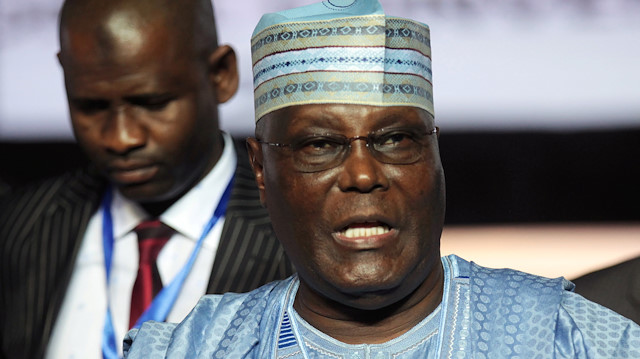
Atiku Abubakar, a former vice president, attends the national convention of Nigeria's opposition People's Democratic Party (PDP), in the southern city of Port Harcourt in the Niger Delta, Nigeria .
Nigerian opposition candidate Atiku Abubakar will seek to boost investment in the country's oil sector if he becomes president next year, according to a draft copy of his manifesto.
He plans to reconsider the introduction of bidding rounds for marginal fields and oil blocks, privatise government-owned refineries and issue new licences for greenfield investments in crude refineries, the draft said.
The country is scheduled to hold a presidential election in February.
Shutting out Muslim girls from school for wearing headscarves amounts to unacceptable religious bigotry and a violation of the Constitution, Nigeria's apex Muslim body said on Saturday, a day after nine pupils were told to leave a school in the southwest Oyo State.The nine Muslim teenagers were prevented from entering the International School Ibadan (ISI) compound on Friday because they wore headscarves, barely a week after the government in southwestern Lagos officially approved the wearing of headscarves by Muslim girls. The government decision came two years after its circular banning headscarves was struck down on appeal.In a statement on Saturday, the Nigerian Supreme Council for Islamic Affairs (NSCIA) said the action of the school, located in the premises of the country's premier University of Ibadan, amounted to official discrimination against Muslims and threatened to sue the violators.“The denial of the Muslim girls of the right to use their hijab is just a ring in a long chain of institutionalised religious discrimination against Muslims in the school, which should ordinarily be a centre of excellence where learning, probity, excellence and character are respected,” NSCIA spokesman Salihu Shehu said in a statement.“We strongly condemn the management of ISI and warn the principal that she will be held responsible for whatever her administrative incompetence and religious intolerance precipitate in this matter."Muslims in Nigeria can no longer fold their arms and watch their rights being unabashedly trampled upon by minions and tin-gods who find themselves in some positions of authority," the statement read.Headscarves have increasingly become a symbol of Muslims’ rejection of the British colonial legacies in Nigerian public life.In 2017, a Muslim female law graduate was barred from a call to bar event in the capital Abuja for wearing a headscarf, precipitating anger from the Muslim community and a debate over the country's controversial secular status.Barrister Firdaus Amasa was later called to the bar with her headscarf after the country's council on legal education backed down. In a 2016 ruling, a court said wearing headscarves qualifies as a human right under the country's Constitution.Nigeria: Over 150,000 displaced people return homeBoko Haram burnt down village in northeast Nigeria1,110 cholera deaths recorded in Nigeria this year
Muslim body slams school banning headscarves in Nigeria
A spokesman of Nigeria's Boko Haram terrorist movement has been killed in a military operation in the country's northeastern Borno state, the army said late Saturday.“Reports available reveal that one Sale Ahmad Sale a. k. a. Baban Hassan the leader of Al-Barnawi Media group, a faction of Boko Haram was killed by a joint operation conducted by the Nigerian Army and Nigerian Airforce,” according to the statement.The statement said the spokesman was in the camp of Abu Musab Al-Barnawi, factional leader of the Boko Haram officially affiliated to Daesh.“The killing of the media leader is indicative of efforts by the Nigerian Army to eliminate key members of the sect. It is worthy to note that the sect is directly affiliated to the Islamic State and has carried out several attacks against own troops and innocent civilians in the past.“Therefore, the death of the group’s media leader shows that the leadership is being targeted successfully and soon other key members would be apprehended or neutralized, thus decimating the group and its activities,” it added.Last week the Nigerian military said two top Boko Haram commanders were killed in a military offensive in Borno state.Nigeria has been battling Boko Haram insurgency since 2009 when the group turned violent following the death of its former leader Mohamed Yusuf in police custody.No fewer than 20,000 people have been killed, mostly civilians, while 2-3 million have been displaced from their homes across the Lake Chad region.Nigeria: Over 150,000 displaced people return homeBoko Haram burnt down village in northeast Nigeria1,110 cholera deaths recorded in Nigeria this year
Boko Haram spox killed in NE Nigeria: Army
A total of 157,000 displaced people in Nigeria staying in camps -- including women and children -- due to clashes between farmers and herders have returned home, a security official said on Friday.Spokesperson for the country's “Whirl Stroke” operation, Major-General Adeyemi Yekini, said the security of the Benue, Nasarawa and Taraba states were secured.Nearly 200,000 people returned home, Yetkini said, adding that a large number of armed terrorists were neutralized and scores of weapons and ammunition were seized in the operations launched in several states.Since January, hundreds of people have lost their lives and thousands other have been forced to leave their homes due to the clashes between farmers and herders.Nigeria's agrarian belt -- especially the Benue, Plateau, Taraba and Zamfara states -- has recorded huge casualties from unabated clashes between farmers and herders.Hundreds have died in the violence this year alone as herdsmen resisted a law banning open grazing in some of the states.
Nigeria: Over 150,000 displaced people return home