

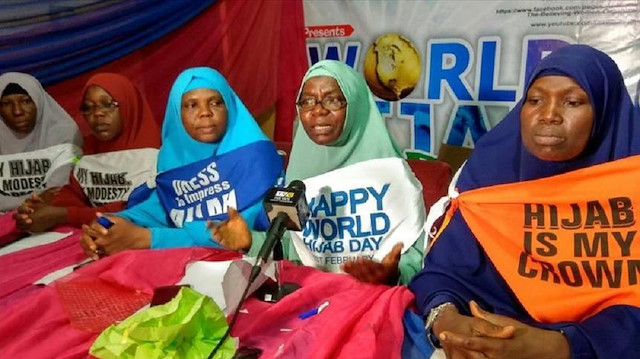
Muslim body slams school banning headscarves in Nigeria
Shutting out Muslim girls from school for wearing headscarves amounts to unacceptable religious bigotry and a violation of the Constitution, Nigeria's apex Muslim body said on Saturday, a day after nine pupils were told to leave a school in the southwest Oyo State.
The nine Muslim teenagers were prevented from entering the International School Ibadan (ISI) compound on Friday because they wore headscarves, barely a week after the government in southwestern Lagos officially approved the wearing of headscarves by Muslim girls. The government decision came two years after its circular banning headscarves was struck down on appeal.
In a statement on Saturday, the Nigerian Supreme Council for Islamic Affairs (NSCIA) said the action of the school, located in the premises of the country's premier University of Ibadan, amounted to official discrimination against Muslims and threatened to sue the violators.
“The denial of the Muslim girls of the right to use their hijab is just a ring in a long chain of institutionalised religious discrimination against Muslims in the school, which should ordinarily be a centre of excellence where learning, probity, excellence and character are respected,” NSCIA spokesman Salihu Shehu said in a statement.
“We strongly condemn the management of ISI and warn the principal that she will be held responsible for whatever her administrative incompetence and religious intolerance precipitate in this matter.
"Muslims in Nigeria can no longer fold their arms and watch their rights being unabashedly trampled upon by minions and tin-gods who find themselves in some positions of authority," the statement read.
Headscarves have increasingly become a symbol of Muslims’ rejection of the British colonial legacies in Nigerian public life.
In 2017, a Muslim female law graduate was barred from a call to bar event in the capital Abuja for wearing a headscarf, precipitating anger from the Muslim community and a debate over the country's controversial secular status.
Barrister Firdaus Amasa was later called to the bar with her headscarf after the country's council on legal education backed down. In a 2016 ruling, a court said wearing headscarves qualifies as a human right under the country's Constitution.
A total of 157,000 displaced people in Nigeria staying in camps -- including women and children -- due to clashes between farmers and herders have returned home, a security official said on Friday.Spokesperson for the country's “Whirl Stroke” operation, Major-General Adeyemi Yekini, said the security of the Benue, Nasarawa and Taraba states were secured.Nearly 200,000 people returned home, Yetkini said, adding that a large number of armed terrorists were neutralized and scores of weapons and ammunition were seized in the operations launched in several states.Since January, hundreds of people have lost their lives and thousands other have been forced to leave their homes due to the clashes between farmers and herders.Nigeria's agrarian belt -- especially the Benue, Plateau, Taraba and Zamfara states -- has recorded huge casualties from unabated clashes between farmers and herders.Hundreds have died in the violence this year alone as herdsmen resisted a law banning open grazing in some of the states.
Nigeria: Over 150,000 displaced people return home
Boko Haram militants have burnt down a village in Nigeria’s northeastern Borno state, injuring at least two civilians, the country’s army said on Thursday.“Just before Midnight on 14 November 2018, a pocket of BHTs [Boko Haram terrorists] sneaked into Mammanti village along Damboa Road in Borno State, fired some shots to scare the inhabitants and set houses ablaze,” a statement by the army said.“Troops from 251 Task Force Battalion were quickly mobilized to engage the BHTs who fled in disarray,” the statement added.Nigeria has been battling Boko Haram insurgency since 2009 when the group turned violent following the death of its former leader Mohamed Yusuf in police custody.No fewer than 20,000 people have been killed, mostly civilians, while 2-3 million have been displaced from their homes across the Lake Chad region.
Boko Haram burnt down village in northeast Nigeria
Nigeria has recorded 1,110 deaths this year from cholera outbreaks across 29 of its 36 states, the country's Center for Disease Control (NCDC) said in its weekly report issued on Wednesday.The death figure this year is many times higher than the 84 recorded within the corresponding period in 2017, the agency added.The report for week 43 showed that 48,686 suspected cholera cases were recorded, with 829 confirmed from laboratories across 29 states.It said a national emergency operations center (EOC) for cholera has been activated at the center, adding that there has now been a decline in number of new cases reported.Cholera is a potentially water-borne life-threatening disease. An estimated 1.4 billion people are at risk for cholera globally, with 2.8 million cases and 91,000 related deaths occurring annually in endemic.Developing countries are disproportionately affected because of their lack of resources, infrastructure and disaster preparedness systems. In Nigeria, cholera is an endemic and seasonal disease, occurring annually mostly during rainy seasons and more often in areas with poor sanitation.
1,110 cholera deaths recorded in Nigeria this year