

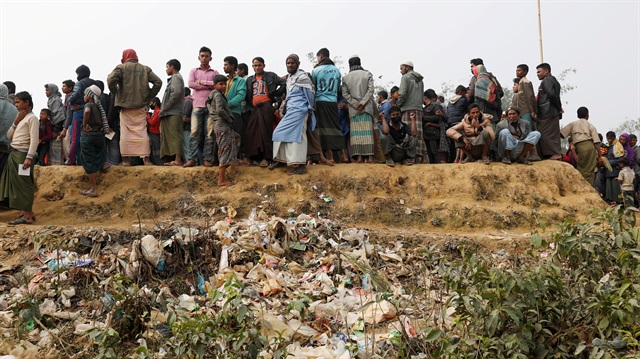
FILE PHOTO: Rohingya refugees
Myanmar authorities made “extensive and systematic preparations” for attacks on Rohingya civilians during the weeks and months before militants attacked police in August 2017, said a Bangkok-based human rights group in a report released Thursday.
The Fortify Rights report finds “reasonable grounds” that crimes against the Rohingya constitute genocide and crimes against humanity, and identifies 22 Myanmar army and police officials who it says should be criminally investigated for their roles in atrocities.
The report also calls on the UN Security Council to urgently refer the situation in Myanmar to the International Criminal Court (ICC).
“Genocide doesn’t happen spontaneously,” said Matthew Smith, chief executive officer at Fortify Rights.
“Impunity for these crimes will pave the path for more violations and attacks in the future. The world can’t sit idly by and watch another genocide unfold, but right now, that’s exactly what’s happening,” he added.
The report said at least 27 Myanmar army battalions, including up to 11,000 soldiers, along with at least three combat police battalions with an estimated 900 police personnel, were involved in the attacks in northern Rakhine state beginning on Aug. 25, 2017.
“These crimes do not occur spontaneously or as isolated events; they require resources and decisions by people in positions of power,” the report said.
The report is based on a 21-month investigation, including 254 interviews, done by Fortify Rights in Myanmar and Bangladesh.
The rights group also interviewed Rohingya eyewitnesses and survivors, Myanmar military and police personnel, Bangladeshi military and government officials, and members and former members of the Arakan Rohingya Salvation Army (ARSA), the report said.
-Violent crackdown
Since Aug. 25, 2017, some 750,000 Rohingya, mostly children and women, have fled to bordering Bangladesh after Myanmar forces began a crackdown on the minority Muslim community, according to Amnesty International.
At least 9,000 Rohingya were killed in Myanmar's Rakhine state from Aug. 25 to Sept. 24, 2017, according to Doctors Without Borders.
In a report published last December, the global humanitarian group said the deaths of 71.7 percent or 6,700 Rohingya were caused by violence. They include 730 children below the age of 5.
The Rohingya, described by the UN as the world's most persecuted people, have faced heightened fears of attack since dozens were killed in communal violence in 2012.
The UN has documented mass gang rapes, killings -- including of infants and young children -- brutal beatings, and disappearances committed by security personnel. In a report, UN investigators said such violations may have constituted crimes against humanity.
Muslim refugees reaching Bangladesh say violence, including torture, persists against them in Myanmar and the overall environment remains "menacing" for ethnic and religious minorities, U.N. human rights investigators said on Thursday.Members of the Independent International Fact-Finding Mission on Myanmar ended a five-day visit to the refugee camp of Kutupalong in Cox's Bazar where they interviewed new arrivals among the more than 700,000 Rohingya who have fled Rakhine state since an army crackdown last August.Rohingya face triple threat: UN migration agencyRohingya refugees want to return to Myanmar as citizens"They referred to the overt threats they faced of violence and persecution, being cut off from their sources of livelihood, and the overall menacing environment that finally compelled them to leave for Bangladesh," the investigators said in a statement, adding that the arrival of new refugees reflects the "the continuing gravity of the human rights violations in Myanmar."There was no immediate reaction from authorities in Myanmar, where it is a holiday. Previously, they have denied widespread abuses.Myanmar police focused interrogation on Rohingya storyThe United Nations struck an outline deal with Myanmar in May aimed at eventually allowing hundreds of thousands of Rohingya in Bangladesh to return safely and by choice. But the secret agreement, seen by Reuters, offers no explicit guarantees of citizenship or freedom of movement throughout the country."The young men I spoke with were particularly anxious, showing signs of deep trauma. Without education and livelihood I fear for their future," said investigator Radhika Coomaraswamy.The investigators will report their findings on Sept. 18 to the U.N. Human Rights Council, a 47-member state Geneva forum which launched the inquiry. 
Rohingya report more violence, persecution in Myanmar: UN investigators