

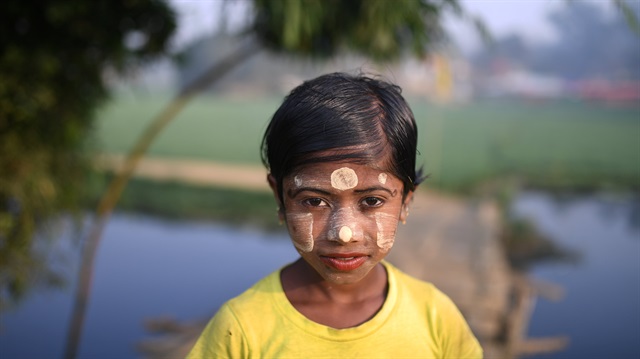
File photo: A Rohingya refugee girl named Zannat Ara, aged 10, poses for a photograph as she wears thanaka paste at Balukhali camp in Cox's Bazaar, Bangladesh
Muslim refugees reaching Bangladesh say violence, including torture, persists against them in Myanmar and the overall environment remains "menacing" for ethnic and religious minorities, U.N. human rights investigators said on Thursday.
Members of the Independent International Fact-Finding Mission on Myanmar ended a five-day visit to the refugee camp of Kutupalong in Cox's Bazar where they interviewed new arrivals among the more than 700,000 Rohingya who have fled Rakhine state since an army crackdown last August.
The International Organization for Migration (IOM) said Rohingya refugees in Bangladesh are facing a triple threat of extreme weather, funding shortfalls and uncertainty about their future.Head of the UN Migration Agency William Lacy Swing said late on Tuesday it was crucial for the world to remain focused on the crisis."Failure to do so would have tragic outcomes for the nearly a million Rohingya refugees sheltering in Bangladesh," said the director general of the UN Migration Agency in a statement.He made the remarks after reviewing progress by IOM and their partners in managing the refugee settlement in Cox’s Bazar, discussions with Bangladeshi Prime Minister Sheikh Hasina in capital Dhaka, and an earlier meeting with Myanmar’s State Counsellor Aung San Suu Kyi.Rohingya refugees want to return to Myanmar as citizens“The Rohingya in Cox’s Bazar are in danger of becoming the wretched of the earth, homeless and without a future,” he said.“The world must rally to support them.“All mothers – refugees and locals – should have access to safe, hygienic facilities to give birth and it’s profoundly worrying that funding shortages are now threatening these crucial maternity services which are making such differences to the lives of women and babies from all backgrounds.“The world must recognize the hugely generous support that the Bangladesh government and host community here in Cox’s Bazar has offered these refugees who arrived in such desperate conditions with nothing.”Video: Monsoon flood cuts off Rohingya camp in BangladeshSince Aug. 25, 2017, some 750,000 Rohingya, mostly children and women, have fled to bordering Bangladesh after Myanmar forces began a crackdown on the minority Muslim community, according to Amnesty International.At least 9,400 Rohingya were killed in Myanmar's Rakhine state from Aug. 25 to Sept. 24, 2017, according to Doctors Without Borders.Myanmar police focused interrogation on Rohingya storyTorn apart by violence, Rohingya families connect through lettersIn a report published last December, the global humanitarian group said the deaths of 71.7 percent or 6,700 Rohingya were caused by violence. They include 730 children below the age of 5.The Rohingya, described by the UN as the world's most persecuted people, have faced heightened fears of attack since dozens were killed in communal violence in 2012.The UN has documented mass gang rapes, killings -- including of infants and young children -- brutal beatings, and disappearances committed by security personnel. In a report, UN investigators said such violations may have constituted crimes against humanity.
Rohingya face triple threat: UN migration agency
Myanmar's minority Muslim Rohingya refugees told a UN envoy that they are willing to return to Myanmar if their safety and citizenship are provided, according to a UN statement Tuesday.The statement came following the UN Envoy for Myanmar Christine Schraner Burgener's first official visit to the refugee camps in Cox’s Bazar, Bangladesh from July 14 to 16, where more than 750,000 refugees live."In Cox’s Bazar, she visited the sprawling refugee camps and heard from the people accounts of unimaginable atrocities committed in Rakhine State," the statement noted.Video: Monsoon flood cuts off Rohingya camp in Bangladesh"Despite these serious violations of human rights, they expressed to the Envoy their hope to return home if security could be guaranteed and citizenship could be provided," it added.During her discussions on the visit, Burgener also underlined the importance of accountability for the crimes committed by Myanmar forces.Since Aug. 25, 2017, some 750,000 Rohingya, mostly children and women, have fled to neighboring Bangladesh after Myanmar forces began a crackdown on the minority Muslim community, according to Amnesty International. At least 9,400 Rohingya were killed in Myanmar's Rakhine State from Aug. 25 to Sept. 24, 2017, according to Doctors Without Borders. In a report published last December, the global humanitarian group said the deaths of 71.7 percent, or 6,700 Rohingya, were caused by violence. They include 730 children below the age of 5. The Rohingya, described by the UN as the world's most persecuted people, have faced heightened fears of attacks since dozens were killed in communal violence in 2012. The UN has documented mass gang rapes, killings -- including of infants and young children -- brutal beatings, and disappearances committed by security personnel. In a report, UN investigators said such violations may have constituted crimes against humanity.
Rohingya refugees want to return to Myanmar as citizens
"They referred to the overt threats they faced of violence and persecution, being cut off from their sources of livelihood, and the overall menacing environment that finally compelled them to leave for Bangladesh," the investigators said in a statement, adding that the arrival of new refugees reflects the "the continuing gravity of the human rights violations in Myanmar."
There was no immediate reaction from authorities in Myanmar, where it is a holiday. Previously, they have denied widespread abuses.
A Reuters reporter on trial in Myanmar said the police questioning after he and a colleague were arrested in December centred on their reporting of a massacre of Rohingya Muslims, not on secret state documents they are accused of obtaining.Wa Lone, 32, also said the police deprived him and Kyaw Soe Oo, 28, of sleep for more than two days, and placed black hoods over their heads while transporting them to a secret detention site where they were held incommunicado for two weeks.In hours of testimony, delivered over two days before a court in Yangon, Wa Lone also described what he called the police "trap" to arrest him. His account was the most comprehensive challenge heard so far to the prosecution's accusation that the two journalists were detained at a routine traffic stop and found to be holding secret documents from an unknown source."During the whole interrogation, they didn't ask with interest about the secret documents found on us, but they probed our reporting of Maungdaw, Rakhine," Wa Lone told the court. "I hadn't slept for many hours but they kept interrogating me. I was exhausted."At the time of their arrest, Wa Lone and Kyaw Soe Oo had been working on an investigation into the killing of 10 Rohingya Muslim men and boys in the village of Inn Din in western Myanmar's Rakhine State.The killings took place during a military crackdown that United Nations agencies say led to more than 700,000 Rohingya fleeing to neighbouring Bangladesh last year.The Reuters journalists are on trial for allegedly breaching the colonial-era Official Secrets Act which carries a maximum penalty of 14 years. Both have pleaded not guilty.The case has attracted global attention, with many governments calling for the reporters' release in what has come to be seen as a test of press freedom in Myanmar."WE'VE GOT THEM, SIR"Describing the night of their arrest on Dec. 12, Wa Lone told the judge and a courtroom packed with family members and diplomats that he and Kyaw Soe Oo were handcuffed by a group of men in civilian clothing outside a restaurant where they had just met a police officer who handed them some documents.As they were driven to a police station a man who appeared to be in charge called a police lieutenant colonel - whose name was visible on the man's phone screen - and told him, "we've got them, sir", Wa Lone said.Defence lawyers have previously said the evidence put forward by the prosecution showed the journalists were arrested in a sting operation by the police that was aimed at interfering with their reporting.Myanmar police spokesman Colonel Myo Thu Soe did not answer calls seeking comment on Tuesday. Lead prosecutor Kyaw Min Aung also declined to comment after the hearing.Myanmar government spokesman Zaw Htay has declined to comment throughout the proceedings, saying Myanmar's courts are independent and the case would be conducted according to the law. He did not answer calls seeking comment on Tuesday.Throughout his testimony Wa Lone insisted on his innocence, saying he was only carrying out his work as a journalist."I am a young person who has always tried to contribute to the development of the country," he said. "I've only ever worked for media organizations, and have never worked in other types of organizations. I am not a spy."He said police had accessed his phone and found photographs of the 10 men killed at Inn Din and his call logs to sources in the village. One of the investigators told Wa Lone they would probe the killings after they discovered the information on the phone.Six days after the journalists were arrested, the military said in a statement that security forces had found a mass grave in Inn Din and had launched an investigation. In the weeks that followed, the army made a rare admission its soldiers were involved in the murders and said it sentenced seven unnamed soldiers to 10 years in jail.The authorities have told Reuters that the sentencing was unrelated to the case against Wa Lone and Kyaw Soe Oo.REPORTING CRITICISEDWa Lone told the court that during the interrogation, an officer offered a "negotiation" over the journalists' arrest if they agreed not to publish the massacre story – an offer he said he rejected.Wa Lone also said the police criticised their reporting, questioning why they were writing about the Rohingya."They said, 'You are both Buddhists. Why are you writing about 'kalars' at a time like this? They aren't citizens'," Wa Lone said, quoting the interrogating officers. "Kalar" is a derogatory term used to describe people of South Asian origin, especially Muslims.At one point during the two weeks he was held at the detention site Wa Lone said the reporters were driven to a secluded spot while hooded, making him fear for his life.In cross-examination, prosecutor Kyaw Min Aung asked whether Reuters benefited from the reporters' work, what currency the reporter was paid in and whether the articles Wa Lone wrote were sent to Reuters headquarters in the United States.The prosecutor also asked whether Wa Lone had been aware that he was found in possession of secret documents related to the security forces. The reporter said he had not been aware of the nature of the documents handed to him minutes before he was arrested.Judge Ye Lwin adjourned the hearing until July 23, when the cross-examination will continue.
Myanmar police focused interrogation on Rohingya story
The United Nations struck an outline deal with Myanmar in May aimed at eventually allowing hundreds of thousands of Rohingya in Bangladesh to return safely and by choice. But the secret agreement, seen by Reuters, offers no explicit guarantees of citizenship or freedom of movement throughout the country.
"The young men I spoke with were particularly anxious, showing signs of deep trauma. Without education and livelihood I fear for their future," said investigator Radhika Coomaraswamy.
The investigators will report their findings on Sept. 18 to the U.N. Human Rights Council, a 47-member state Geneva forum which launched the inquiry.