

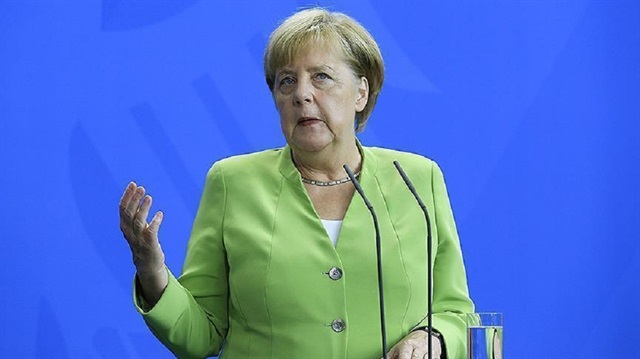
German Chancellor Angela Merkel
Senior German conservatives facing painful losses in two state elections this month have ruled out forming coalitions with the far-right Alternative for Germany (AfD) party.
"I am very clear about this: not with the AfD," parliament speaker and former finance minister Wolfgang Schaeuble told mass-selling Bild am Sonntag newspaper.
His comments support Chancellor Angela Merkel's position to ostracize the anti-Islam party, although other members of her Christian Social Union (CDU) party have expressed willingness to work with the AfD.
The AfD entered the German parliament for the first time in an election last year, buoyed by conservative voters angry with Merkel's decision in 2015 to welcome almost one million, mainly Muslim, asylum seekers.
The AfD also has lawmakers in all but two of the regional parliaments in Germany's 16 states. It is expected to enter the assembly in the southern state of Bavaria in an election next Sunday and storm into the parliament in Hesse two weeks later.
CDU officials in the eastern states of Brandenburg and Saxony, which hold elections next year, have expressed readiness to form coalitions with the AfD.
Britain signed a military cooperation agreement with Germany on Friday, emphasising London's commitment to helping shield Europe from future security threats at a time when negotiations over its exit from the EU are reaching a crunch.One of the British government's strongest cards in Brexit negotiations is the expectation that, as the EU country with the highest defence spending, it will continue to play a central role in European security after it leaves the bloc.Britain's military capabilities easily dwarf those of any other EU member state apart from France. It also has diplomatic and intelligence services that are among Europe's best resourced and most capable."We will further strengthen the European pillar in NATO, contribute to European security and improve Europe's resilience to security threats," Britain and Germany said in a document which did not mention Brexit.Germany accuses Russia of committing cyber-attacksBritish Defence Minister Gavin Williamson and his German counterpart Ursula von der Leyen signed the agreement at a British army barracks in the western German town of Sennelager."We are determined to deepen and strengthen our relationship in order to achieve our common defence and security goals," the agreement said. Naval, land and air forces would work closely together and there would be cooperation in defence procurement.Prime Minister Theresa May has vowed to maintain Britain's commitment to protecting Europe after Brexit. She has accused Russia of fomenting violence in eastern Ukraine, of repeatedly violating the national airspace of several European countries, and mounting a campaign of cyber attacks.Russia is also blamed for hacking attacks in several European countries, including the Danish defence ministry and the German parliament.The European Union and Britain are trying to finalise a deal setting out their relationship after March 29, when Britain is expected to leave the bloc. Sources told Reuters that the EU's Brexit negotiators told national diplomats in Brussels late on Thursday that a divorce deal with Britain was "very close".Merkel offers qualified support for 'Jewish state'
Germany, Britain sign defence cooperation agreement amid Brexit talks
Germany’s domestic intelligence agency on Thursday warned of a new form of far-right terrorism in the country.Stephan Kramer, head of domestic intelligence agency in Thuringia, said recent investigations have shown that far-right groups are becoming increasingly violent."There is a growing affinity with physical training, combat sports and shooting exercises. This shows that they are more inclined towards violence," he told media group Redaktionsnetzwerk Deutschland.Police arrested 7 far-right extremists this week in the eastern city of Chemnitz on suspicion of plotting terror attacks against foreigners and political opponents.They were suspected of founding a terror group named "Revolution Chemnitz", which according to the police, planned a sensational terror act on Oct. 3, Germany's national unity day.Since August, far-right groups have organized rallies in the city of Chemnitz, Saxony, and hunted down people deemed "foreign-looking" people and attacked migrant-owned shops.
German intelligence warns of far-right terror threat
Merkel said last month "I categorically rule this out," sticking to her position not to work with the party that says Islam is not compatible with the German constitution.
Merkel's conservatives, which include her CDU and their Bavarian Christian Social Union (CSU) sister party, have seen support slide since last year's election.
The conservatives formed a coalition with the centre-left Social Democrats (SPD) as their junior partners in March, after Merkel's first attempt at forming a government following the September election ended in failure.
Polls indicate the CSU will lose its absolute majority in Bavaria on Oct. 14 as voters in the state are expected to turn to the ecologist Greens and the AfD.
CSU leader and Interior Minister Horst Seehofer has also ruled out a coalition with the AfD in Bavaria.
"There will be no coalition between the Union and the AfD. No, No, No!" he told the Welt am Sonntag newspaper, referring to the CDU/CSU alliance, which is know as the Union.
Under a deal between the two parties the CSU represents the CDU in Bavaria and the CDU runs in the rest of Germany.
Germany accused Russia on Friday of carrying out cyber-attacks on Western countries and international organizations.Speaking at a news conference in Berlin, Chancellor Angela Merkel’s spokesman claimed that recent investigations showed the role of Russian military intelligence agency GRU behind these attacks.“We strongly condemn such attacks on international organizations and government institutions of our allies. And we call on Russia to meet its responsibilities and stop such acts,” Steffen Seibert said.Russia to summon Dutch ambassadorThe U.K. accused Russia on Thursday of “indiscriminate and reckless” cyber-attacks on Western countries, and the Dutch government said it had recently disrupted a cyber-attack by Russia on the Hague-based international chemical weapons watchdog OPCW.Seibert said the German government has “full confidence” in the findings of investigations carried out by British and Dutch authorities.He said such cyber-attacks pose a threat to public security and democracy.Russia dismissed the claims of the British and Dutch governments on Thursday.“The West’s spy mania is gaining momentum,” Russia's Foreign Ministry said in a statement.India, Russia sign S-400 air defense system deal
Germany accuses Russia of committing cyber-attacks
German Chancellor Angela Merkel on Thursday criticized Israel’s “Jewish National Law” and the continued construction of Israeli settlements on occupied Palestinian land.At a joint press conference in Jerusalem with Israeli Prime Minister Benjamin Netanyahu, Merkel reiterated her country’s support for the Jewish state, but stressed that minorities, too, had rights.While noting her “reservations” regarding the recently approved Jewish National Law, Merkel said she nevertheless supported Israel as a “Jewish state”, adding that -- to achieve peace -- the Palestinians would also have to accept it as such.“Germany is concerned about [Israel’s] settlement policy, which makes it difficult to implement a two-state solution,” she said.Israel can beat Russian-supplied S-300 air shield in Syria: ministerShe went on to say that she planned to encourage the Ramallah-based Palestinian Authority (PA) to return to the stalled Middle East peace process.The German chancellor also defended Israel’s right to protect its northern border from Iran’s military presence in Syria.“Iran is a threat to Israel and a threat to Lebanon,” she said. “It must have zero presence in Syria.” Netanyahu, for his part, reiterated his rejection of the 2015 nuclear agreement between Iran and the P5 1 group of nations (the five permanent UN Security Council members plus Germany).Israel to send reinforcements to Gaza buffer zone“That deal put billions of dollars into the hands of the leading sponsors of terrorism,” he asserted.On the Palestine issue, Netanyahu called on the international community to tell the PA to stop “choking” Gaza.He went on to warn that Israel would respond to any attack by Hamas, which has governed the Gaza Strip since 2007, with “overwhelming force”.US preparing Israel for war
Merkel offers qualified support for 'Jewish state'