

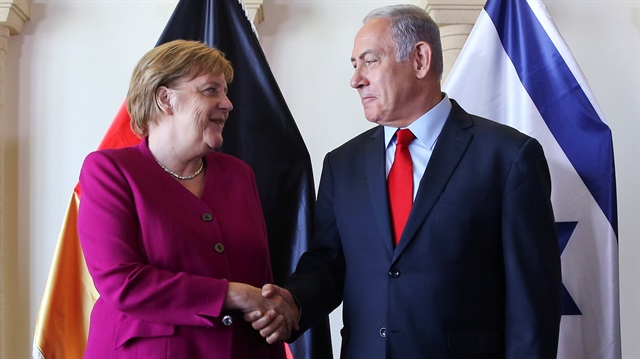
Israeli Prime Minister Benjamin Netanyahu (R) and German Chancellor Angela Merkel shake hands as they pose for photographers between meetings in Jerusalem October 4, 2018.
German Chancellor Angela Merkel on Thursday criticized Israel’s “Jewish National Law” and the continued construction of Israeli settlements on occupied Palestinian land.
At a joint press conference in Jerusalem with Israeli Prime Minister Benjamin Netanyahu, Merkel reiterated her country’s support for the Jewish state, but stressed that minorities, too, had rights.
While noting her “reservations” regarding the recently approved Jewish National Law, Merkel said she nevertheless supported Israel as a “Jewish state”, adding that -- to achieve peace -- the Palestinians would also have to accept it as such.
“Germany is concerned about [Israel’s] settlement policy, which makes it difficult to implement a two-state solution,” she said.
An Israeli official played down on Wednesday the Russian upgrading of Syria's air defences, saying the newly supplied S-300 missile system could be defeated by Israel's stealth fighters and possibly destroyed on the ground.Moscow said on Tuesday that it had delivered the S-300, a decision it took after accusing Israel of indirect responsibility for the downing of a Russian spy plane by Syrian forces as they fired on attacking Israeli jets last month.Damascus and its big-power backer describe the advanced addition to Syria's arsenal as a major deterrent. Israel and Washington have both voiced misgivings about the S-300 handover.But asked in an interview if the Syrian acquisition of the S-300 would clip the Israeli military's wings, Tzachi Hanegbi, the country's regional cooperation minister and a non-voting member of its security cabinet, said: "Unequivocally, no."Pentagon chief says Russian violation of key arms control treaty 'untenable'"The operational abilities of the air force are such that those (S-300) batteries really do not constrain the air force's abilities to act," he told Israel's Army Radio.Referring to F-35 Joint Strike Fighters that Israel began receiving from the United States over a year ago, Hanegbi said: "You know that we have stealth fighters, the best planes in the world. These batteries are not even able to detect them."Reuters reported in 2015 that Israel had trained against a Russian-supplied S-300 system in Greece.Israel says its air raids on Syria are needed to foil deployments and arms transfers by Iran or Lebanon's Hezbollah guerrillas, allies of Damascus.PKK turns Syria into drug farm under US protectionHanegbi said that Russia had previously stationed its own S-300 in Syria, so the system's capabilities had long been factored into Israeli planning. Syria's military would require "a few months" to get its S-300 operational, he said."We have clarified to the Syrians more than once that we will not step back from our commitment to prevent Iran's entrenchment in Syria," Hanegbi said, adding a veiled threat to take action against the S-300 on the ground: "We were already forced, a few months ago, to destroy Syrian missile batteries, and I hope they won't challenge us in the future."Israel said on Sept. 4 it had carried out more than 200 air strikes in Syria in the previous two years - an average rate of twice a week - with Russia largely turning a blind eye. There have been no reports of such missions since the Russian plane's downing on Sept. 17, however.Any such hiatus was a "tactical situation over a week or two" rather than a strategic reassessment by Israel, Hanegbi said.Asked if Iran and its allies had used the period to step up their activities in Syria, he said he had seen "no basis for that" in Israeli intelligence assessments. US preparing Israel for war
Israel can beat Russian-supplied S-300 air shield in Syria: minister
She went on to say that she planned to encourage the Ramallah-based Palestinian Authority (PA) to return to the stalled Middle East peace process.
The German chancellor also defended Israel’s right to protect its northern border from Iran’s military presence in Syria.
“Iran is a threat to Israel and a threat to Lebanon,” she said. “It must have zero presence in Syria.”
Netanyahu, for his part, reiterated his rejection of the 2015 nuclear agreement between Iran and the P5 1 group of nations (the five permanent UN Security Council members plus Germany).
The Israeli army on Thursday announced plans to bolster its troop presence along the Gaza-Israel buffer zone, which for the last six months has seen almost-daily rallies by Palestinians.“It was decided to reinforce our forces in the Southern Command Area [i.e., near the blockaded Gaza Strip] within coming days,” an Israeli army statement read.According to the statement, the decision was taken based on a recent situation assessment conducted by Army Chief-of-Staff Gadi Eizenkot.The statement goes on to assert that the army views Hamas -- which has governed the Gaza Strip since 2007 -- as being responsible “for everything happening in and originating from” the blockaded coastal enclave.For the last six months, thousands of Palestinians in Gaza have taken part in almost-daily demonstrations along the heavily-fortified buffer zone.Since the demonstrations began on March 30, scores of Palestinians have been martyred near the buffer zone -- and thousands more injured -- by Israeli army gunfire.Protesters demand the “right of return” to their villages in historical Palestine from which they were driven in 1948 to make way for the new state of Israel.They also demand an end to Israel’s 12-year-long blockade of Gaza, which has gutted the territory’s economy and deprived its roughly two million inhabitants of many basic commodities.Israeli army rounds up 13 Palestinians in West Bank raidsHamas Gaza leader to Israeli press: 'I don't want war'US preparing Israel for war
Israel to send reinforcements to Gaza buffer zone
“That deal put billions of dollars into the hands of the leading sponsors of terrorism,” he asserted.
On the Palestine issue, Netanyahu called on the international community to tell the PA to stop “choking” Gaza.
He went on to warn that Israel would respond to any attack by Hamas, which has governed the Gaza Strip since 2007, with “overwhelming force”.
A 2016 military aid package agreed upon between the U.S. and Israel went into force on Tuesday. The deal, signed under the Obama administration, will provide Israel with $38 billion in U.S. military financing from 2019 to 2028. It is the largest such aid package in U.S. history. The move also expands a stockpile of U.S. weapons kept in Israel.“The United States will set funding for Israel at levels of $3.3 billion in Foreign Military Financing and $500 million for cooperative programs for missile defense over each of the next 10 years,” State Department Spokeswoman Heather Nauert said in a written statement.“Israel is a valuable and capable ally to the United States that today faces dangerously escalating regional threats, first and foremost from the Iranian regime's sponsorship of terrorist groups seeking to attack not only Israel but also American interests. The United States unconditionally affirms Israel's right to self-defense.”The package “reflects the enduring and unshakable commitment of the President, this Administration, and the American people to Israel's security.”Israel slowly encroaching all of JerusalemPackage to boost Israel’s military capabilitiesThe foreign military financing will enable Israel to advance its military capabilities with possible purchases of new long-range missile defense systems, ballistic missiles and warplanes.The funding is enough for the purchase of almost 450 F-35 fighter jets, 9,000 tanks, various missiles and hundreds of thousands of arms and munitions. Washington’s move has been evaluated as a clear challenge for other regional powers such as Turkey.Eastern Mediterranean being targetedThe move has been evaluated as an effort to actualize the map in which Iraq and Syria’s underground resources provide maritime access through Israel.“The U.S. is not cutting back on anything to sow the seeds of a Great Israel state. Both financially and militarily, the U.S. is strengthening Israel. Another aim of this financial aid is to make Israel be able to control the energy reserves of the Eastern Mediterranean,” an unnamed source said.With its new financial resources, Israel will be able to fund subcontracted terrorist organizations more easily. There are also claims that the enormous funds will be provided by Saudi Arabia.The U.S. unequivocally supports Israel’s attacks that target Russia and Iran in Syria. The funding package can also be viewed as a part of Israel’s agenda against Russia and Iran, who are gaining influence in the region. Israel was responsible for the downing of a Russian intelligence plane in Syria, and following this, Russia dispatched the S-300 missile system, demonstrating that Moscow would continue its activities in the region.US enforces $38bln military aid package to help Israel fight ‘Iran-sponsored terrorists’U.S. considered increasing funding packageIn late February, U.S. senators even called for an increase in the $38 billion in military aid. Senators Lindsey Graham, a leading Republican foreign policy figure, and Chris Coons, a Democratic member of the Senate Foreign Relations Committee, said that they considered the provision of $38 billion over 10 years, “a floor.”Explicit supportAccording to data obtained from the U.S. Congress, the amount of aid sent to Israel to date is over $130 billion. In 2007, a two-year aid package agreement was signed between the two countries during George W. Bush's presidency. A total of $30 billion of this agreement covered the period between 2009 and 2018. Obama made another similar agreement with Israel in 2016, and signed a memorandum of understanding covering the years between 2019 and 2028.Israel claims to arrest Hamas cell over attack plotIsrael detains 7 Palestinians in West Bank raidsIsraeli PM to be grilled on graft allegations on Friday
US preparing Israel for war