

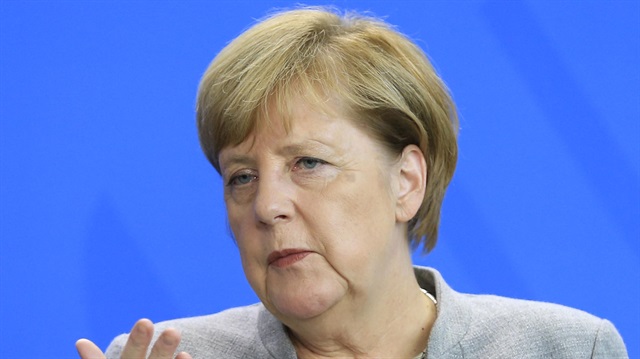
Angela Merkel
Chancellor Angela Merkel's sister party the Christian Social Union (CSU) suffered a heavy blow in regional elections in Bavaria on Sunday, according to projections by public broadcaster ARD.
The CSU, which has governed Bavaria almost continuously since 1946, managed to win only 35.6 percent, a sharp fall from the 47.7 percent the party scored in the last election in 2013.
It was the second-worst result for the Bavarian conservatives since the end of World War II, also showing that the CSU would lose its majority in the state parliament.
The Social Democratic Party (SPD) also suffered heavy losses on Sunday, drawing only 9.7 percent of the vote, less than half of its showing of 20.6 percent five years ago.
The environmentalist, pro-immigration Green Party scored a record 18.3 percent, up from 9.8 percent in the last election, making it the second-largest group in the state parliament.
The moderate right Free Voters of Bavaria came in third with 11.6 percent.
Projections showed the Islamophobic, far-right Alternative for Germany (AfD) with 10.9 percent of the vote, thereby entering the Bavarian parliament for the first time.
Protestors from across Germany marched through Berlin on Saturday against xenophobia and the far right in one of the country's biggest rallies of recent years.Organisers put the turnout at more than 150,000 people for the demonstration, which followed anti-immigration protests in several eastern cities over the summer and a rise in support for the far-right Alternative for Germany (AfD) party before a state election on Sunday.A police spokesman declined to estimate the size of the crowd at the protest, which was organised by rights groups including Amnesty International.Marchers carried placards reading "Build bridges not walls", "United against racism" and "We are indivisible - for an open and free society". Some danced to pop music on a warm autumn day.The arrival of more than a million migrants, many from war zones in the Middle East, has boosted support for the AfD. It is expected to fare well in the election in Bavaria, long a stronghold of the conservative Christian Social Union, a member of the Chancellor Angela Merkel's federal coalition government.German lawmakers slam AfD party for anti-Islamic motionIn August, far-right groups in the eastern city of Chemnitz clashed with police and chased people they believed to be foreign after the fatal stabbing of a German man blamed on two migrants.Similar protests took place in Dresden, Koethen and other eastern cities.Nevertheless, the number of violent attacks on refugees and asylum shelters in Germany has fallen sharply in the first half of this year.Two companies have also warned their German employees about the dangers of populism before the regional election in Bavaria.Survey reveals EU 'irrelevant' to majority of citizens
'United against racism', Germans stage mass protest against far right
Coalition options
Interior Minister Horst Seehofer, also the CSU leader, voiced regret over the disappointing results, but also stressed that his party now has a clear task to form a stable government.
“This is not a good result, there's nothing to quibble about,” he told reporters in Munich.
“On the other hand, today, Bavarian voters gave us a clear task to form a new government for the free state of Bavaria. And we will undertake this responsibility,” he stressed.
Early seat projections suggested that the CSU will hold 80 seats in the Bavarian state parliament, and the Green Party 39.
Germany on Friday urged Saudi Arabia to “fully cooperate” in Turkey’s investigation into the disappearance of prominent Saudi journalist Jamal Khashoggi.“The German government is seriously concerned over Khashoggi’s disappearance without a trace, and sweeping suspicions [on the disappearance] are horrifying,” Chancellor Angela Merkel’s spokesman Steffen Seibert told a news conference in Berlin.Khashoggi has been missing since Oct. 2, when he visited the Saudi Consulate in Istanbul, and several media reports claimed that he was killed at the consulate.Seibert said the a prompt and extensive investigation should clarify the journalist's disappearance.German Foreign Ministry’s deputy spokesman Rainer Breul said Germany’s expectations from Saudi Arabia on the matter were also conveyed during Foreign Minister Heiko Maas’s recent meeting with the Saudi ambassador.“Freedom of press, protecting the safety and security of critical journalists is a concern for us. We are now expecting a prompt and reliable investigation,” he said.Saudi delegation arrives in Ankara for Khashoggi probeTurkey has recordings proving Khashoggi was killed inside Saudi consulate: Washington PostTrump: Khashoggi disappearance no reason to stop Saudi investmentsMedia companies, journalists drop out of Saudi event after Khashoggi disappearanceEurope wants full probe over missing Saudi journalist
Germany urges Riyadh to cooperate on missing journalist
The Free Voters of Bavaria was set to take 25 seats, the AfD 24, the SPD 21, and the liberal Free Democratic Party (FDP) 11.
Public broadcaster ARD’s projections showed that the CSU would have two major coalition government options, either the Green Party or the Free Voters of Bavaria, to secure its coalition a majority in parliament.
Sunday night Seehofer was silent on possible coalition options, but said the party’s executive committee would meet in the coming days to discuss the election results, and government options.
Chancellor Angela Merkel's Bavarian allies are heading for their worst state election result in over 60 years in a regional vote on Sunday that is likely to increase tensions within Germany's fragile coalition government.According to the latest polls, the Christian Social Union (CSU) will win around 34 percent, losing the absolute majority with which the center-right party has controlled its southeastern heartland for most of the post-war period.Voting stations open at 8 a.m. (0600 GMT) and broadcasters are expected to publish exit polls shortly after 6 pm (1600 GMT).One of the biggest winners are likely to be the ecologist, pro-immigration Greens who are projected to more than double their vote share to up to 19 percent and overtake the centre-left Social Democrats (SPD) as the second-strongest party.The regional protest party Free Voters and the anti-immigration Alternative for Germany (AfD) party are both forecast to win roughly 10 percent of the votes.This could complicate CSU State Premier Markus Soeder's efforts to form a stable coalition government in Bavaria.The splintered electoral result could force Soeder, who has ruled out a coalition with the AfD, into an awkward alliance with the left-of-centre Greens.Horst Seehofer, CSU party leader and interior minister in Merkel's federal government, could face calls to give up at least one of his posts following the Bavarian election as his hard-line rhetoric against asylum seekers is likely to scare away voters."We've lost trust because of the CSU," Volker Bouffier, deputy party leader of Merkel's Christian Democratic Union (CDU), told Welt am Sonntag newspaper. He accused Seehofer of damaging the image of the CDU/CSU conservative alliance.Bouffier is premier in the state of Hesse where another regional election will be held later this month.Seehofer has been among Merkel's fiercest critics following her decision in 2015 to welcome more than 1 million migrants. He has gradually shifted the CSU, the sister party to the CDU, to the right to counter the rise of the AfD party.Divisions between the conservative allies have widened further since March, when an inconclusive national election forced them into a coalition with the left-leaning SPD.Merkel's fourth and probably final government has already come close to collapsing twice, in arguments over immigration and a scandal over Germany's former domestic spymaster. The parties are also at odds over how to phase out polluting diesel cars and whether to grant tax cuts for the rich.'United against racism', Germans stage mass protest against far rightFETÖ terror group afloat in Ethiopia with German supportGermany urges Riyadh to cooperate on missing journalistGermany to extradite suspect in killing of Bulgarian journalist soon
Merkel's Bavarian allies brace for election bruising