

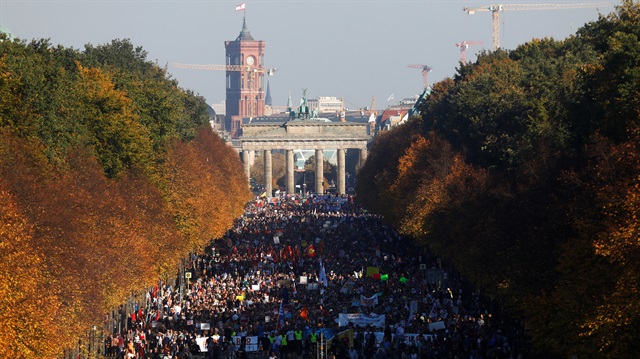
Protesters march during the "#unteilbar", demonstration which aims to 'rise up against discrimination,poverty, racism, sexism, and nationalism' in berlin
Protestors from across Germany marched through Berlin on Saturday against xenophobia and the far right in one of the country's biggest rallies of recent years.
Organisers put the turnout at more than 150,000 people for the demonstration, which followed anti-immigration protests in several eastern cities over the summer and a rise in support for the far-right Alternative for Germany (AfD) party before a state election on Sunday.
A police spokesman declined to estimate the size of the crowd at the protest, which was organised by rights groups including Amnesty International.
Marchers carried placards reading "Build bridges not walls", "United against racism" and "We are indivisible - for an open and free society". Some danced to pop music on a warm autumn day.
The arrival of more than a million migrants, many from war zones in the Middle East, has boosted support for the AfD. It is expected to fare well in the election in Bavaria, long a stronghold of the conservative Christian Social Union, a member of the Chancellor Angela Merkel's federal coalition government.
Lawmakers from different parties heavily criticized the far-right Alternative for Germany (AfD) party on Thursday over its controversial motion demanding a ban on the Quran.Chancellor Angela Merkel’s Christian Democratic Union (CDU) accused the AfD of distorted generalizations about Islam and stereotyping Muslims as violent.“Your allegations are malicious, discriminating and also destructive. What you are trying to achieve is not social peace but discrediting Islam and its believers,” CDU lawmaker Christoph de Vries said during a debate at the parliament.Merkel’s coalition partner Social Democratic Party (SPD) also rejected the motion, saying that it was another attempt by the AfD to stigmatise Muslims.Germany extradites Iranian diplomat to Belgium“You are inciting hatred against Islam in a calculated political manoeuvre,” said SPD lawmaker Lars Castellucci.“The big majority of Muslims in this country stand for democracy, they are loyal to our country,” he stressed.The opposition Left Party lawmaker Christine Buchholz said AfD’s leader Alexander Gauland was increasingly resembling Adolf Hitler.“AfD is trying to denigrate Islam with the same methods used by anti-Semites against Jews,” she said. Buchholz accused the AfD conducting an anti-Muslim campaign by using passages from Quran, which were always taken out of context.“The Left Party supports religious freedom of all people in this country,” she stressed.The far-right AfD’s controversial motion, which was submitted to the Committee on Legal Affairs on Thursday for further debate, demands the government to take necessary measures to ban disseminating messages of the Quran.The AfD scored record gains in federal elections last year and entered the parliament for the first time.Adopting an explicitly anti-Islamic rhetoric, the AfD argued that Germany was under the threat of “Islamization”, especially after nearly one million refugees -- mostly from Syria and Iraq -- arrived in the country since 2015.
German lawmakers slam AfD party for anti-Islamic motion
In August, far-right groups in the eastern city of Chemnitz clashed with police and chased people they believed to be foreign after the fatal stabbing of a German man blamed on two migrants.
Similar protests took place in Dresden, Koethen and other eastern cities.
Nevertheless, the number of violent attacks on refugees and asylum shelters in Germany has fallen sharply in the first half of this year.
Two companies have also warned their German employees about the dangers of populism before the regional election in Bavaria.
A survey by Brussels-based think-tank Friends of Europe revealed on Friday that majority of European citizens believe the 28-member bloc “will remain irrelevant" for them without reforms.According to the survey, which was conducted as part of its #EuropeMatters project, 64 percent of Europeans are not convinced their life would be worse without the EU, while 49 percent of the citizens think the EU is irrelevant."More than one third of Europeans want more transparency when it comes to how the EU is spending money," the survey noted.Underscoring that the Europeans "want to have a bigger say", the survey revealed that Europeans are divided on the primary role of the bloc as “40 percent of citizens in Visegrad and Southern European countries think the EU's main focus should be to improve economic growth.""32 percent of Nordics, 36 percent of the French and 37 percent of the Germans want the EU to promote values and democracy across Europe," it added.EU committee proposes ‘humanitarian visas’ for migrants
Survey reveals EU 'irrelevant' to majority of citizens