

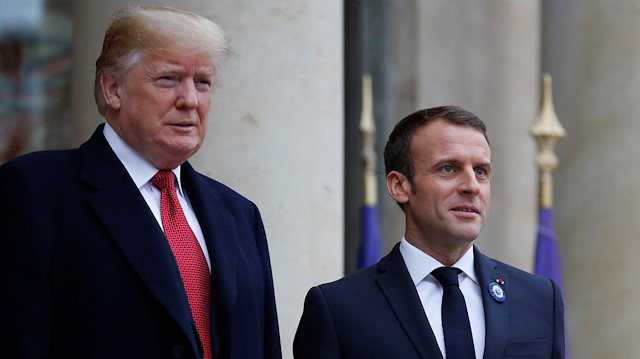
U.S. President Donald Trump meets with French President Emmanuel Macron
France's Emmanuel Macron and U.S. President Donald Trump agreed on Saturday on the need for Europe to bear more of the burden for defence, papering over an earlier Trump tweet that described Macron's call for a European army as "very insulting".
Meeting for talks at the Elysee ahead of commemorations to mark the 100th anniversary of the end of World War One, Macron welcomed Trump with a firm handshake, but there appeared to be less immediate warmth between them than in the past.
Seated on gilded chairs, Macron placed his hand on Trump's knee and referred to him as "my friend", while Trump too sought to find common ground on an issue that has caused friction.
"We want a strong Europe, it's very important to us, and whichever way we can do it the best and more efficient would be something we both want," said Trump. "We want to help Europe but it has to be fair. Right now the burden sharing has been largely on the United States."
The United States wants a "strong Europe" and is willing to help its ally, but Europe must be fair when it comes to sharing the defence burden, U.S. President Donald Trump said on Saturday."We want a strong Europe, it's very important to us and whichever way we can do it the best and more efficient would be something we both want," Trump said in remarks after being greeted by President Emmanuel Macron in Paris.Asked what he meant when he tweeted that he felt insulted by Macron's comments that Europe should reduce its dependence on the United States for security, Trump said: "We want to help Europe but it has to be fair. Right now the burden sharing has been largely on the United States."
Trump says wants 'strong Europe', but more defense cost-sharing
Macron echoed those sentiments, saying he wanted Europe to bear a greater share of the defence costs within NATO, a point he has made repeatedly since taking office, alongside calls for Europe to develop its own military capability.
"That's why I do believe my proposals for European defence are totally consistent with that," Macron said in English.
Fresh off U.S. congressional elections that saw his Republican Party's power eroded, Trump is in Paris to bolster the U.S.-European alliance during the Armistice commemorations.
But in a tweet prior to landing in Paris on Friday, Trump took a dim view of comments Macron made in a Europe 1 radio interview this week.
Discussing the threat from cyber-hacking and outside meddling in the electoral process, Macron said Europe needed to protect itself against China, Russia "and even the United States".
U.S. President Donald Trump and French President Emmanuel Macron headed towards a potential clash in talks on Saturday after Trump took offense at what he called a "very insulting" comment from Macron about the need to create a European army.Fresh off U.S. congressional elections that saw his Republican Party's power erode, Trump is in Paris this weekend to bolster the U.S.-European alliance at commemorations to mark the 100th anniversary of the end of World War One.But in a tweet prior to landing in Paris, Trump took a dim view of comments Macron made in a Europe 1 radio interview this week.Discussing the threat from cyber-hacking and meddling from outside in the electoral process, Macron said Europe needed to protect itself against China, Russia and even the United States.Later in the interview he spoke about the need for a European army, saying:“Faced by Russia, which is on our borders and which has shown that it can be threatening... we need to have a Europe that can better defend itself by itself, without depending solely on the United States," he said.Trump, who has pushed NATO allies to pay more for their common defense and not rely so heavily on the United States, complained."Very insulting, but perhaps Europe should first pay its fair share of NATO, which the U.S. subsidizes greatly," Trump said on Twitter.The president, joined by his wife Melania and high-ranking U.S. officials, arrived late on Friday aboard Air Force One for a visit that he called "very special" and one that he "looked forward to."On Saturday morning, the U.S. president arrived at the Elysee Palace under rainy skies for talks with Macron. Macron welcomed him at the front steps, but their hand shake and greeting appeared less warm than it has been in the past.Trump says wants 'strong Europe', but more defenwe cost-sharingSolemn Commemoration Trump's official mission on the trip is to participate in ceremonies marking the 100th anniversary of the end of World War One. He is scheduled to make pilgrimages to two American cemeteries, Belleau Wood east of Paris on Saturday and Suresnes on the western outskirts of the capital on Sunday, where he will make formal remarks.His trip comes just days after congressional elections delivered results that will complicate his next two years. While Republicans slightly expanded their majority in the U.S. Senate, they lost control of the U.S. House of Representatives to Democrats who may use their newfound power to launch investigations into Trump and stymie his agenda.Trump's talks with Macron at the Elysee are likely to cover European concerns about Trump's plans to withdraw the United States from the 1980s Intermediate-Range Nuclear Forces Agreement and U.S. renewal of sanctions against Iran.Macron told Europe 1 radio that the "main victim" of the U.S. withdrawal from the INF accord was Europe and its security.The French president, who tried but failed earlier this year to talk Trump out of withdrawing from the 2015 Iran nuclear deal, has also voiced worries about the impact of sanctions on European companies doing business with Iran.Trump may also chat briefly with Russian President Vladimir Putin on Sunday when both are among some 70 world leaders gathered at the Arc de Triomphe to mark the end of the Great War 100 years ago. Trump and Putin are expected to have formal talks later this month when both attend a G-20 summit in Buenos Aires.Trump, who has pursued "America First" policies since taking over the presidency in January 2017, declared himself a "nationalist" during the run-up to the congressional elections, a term likely to raise concerns in Europe."I’m not a globalist, but I want to take care of the globe, but first I have to take care of our country," he told Fox News Channel's "The Ingraham Angle" last week. "I want to help people around the world, but we have to take care of our country, or we won’t have a country." Turkish President Erdoğan due in France for WWI tributeUK PM May dives into flurry of diplomacy in bid to clinch Brexit dealMacron says still pushing for Germans to back digital tax
Trump, Macron at odds on European defense ahead of WW1 commemoration
Later in the interview he spoke about the need for a European army, saying:
"Faced by Russia, which is on our borders and which has shown that it can be threatening... we need to have a Europe that can better defend itself by itself, without depending solely on the United States."
Trump, who has pushed NATO allies to pay more for their common defense and not rely so heavily on the United States, complained.
"Very insulting, but perhaps Europe should first pay its fair share of NATO, which the U.S. subsidizes greatly," Trump said on Twitter.
Trump and Macron are set to hold around an hour of bilateral talks before they are joined by their wives, Melania and Brigitte, for lunch at the Elysee Palace. It is the second time the four have dined together in Paris.
U.S. President Donald Trump on Friday slammed his French counterpart's call for a unified European military to protect against international threats."President Macron of France has just suggested that Europe build its own military in order to protect itself from the U.S., China and Russia," he said on Twitter. "Very insulting, but perhaps Europe should first pay its fair share of NATO, which the U.S. subsidizes greatly!"Macron made the announcement Tuesday during an interview with Europe 1 radio."We will not protect the Europeans unless we decide to have a real European army," Macron said, emphasizing Europe needs an army to reduce dependence on the U.S.Macron said Europe needs to protect itself especially from China, Russia and the U.S.“When I see President Trump announcing that he’s quitting a major disarmament treaty which was formed after the 1980s Euro-missile crisis that hit Europe, who is the main victim? Europe and its security,” Macron said.He was referring to Trump's decision last month to withdraw the U.S. from the 1987 Intermediate-range Nuclear Forces treaty, which banned ground-launched nuclear missiles with a range of 500–5,500 kilometers (310-3,420 miles).The agreement was signed between Russia and the U.S., and was largely designed to stave off the prospects of nuclear war in Europe.
Trump rips Macron call for unified European military
SOLEMN COMMEMORATION
During the weekend, Trump is scheduled to make pilgrimages to two American cemeteries, Belleau Wood east of Paris on Saturday and Suresnes on the western outskirts of the capital on Sunday, where he will make formal remarks.
His trip comes just days after congressional elections delivered results that will complicate his next two years. While Republicans slightly expanded their majority in the U.S. Senate, they lost control of the U.S. House of Representatives to Democrats who may use their newfound power to launch investigations into Trump and stymie his agenda.
As well as defence, Macron said he and Trump would discuss trade, Iran and the conflicts in Syria and Yemen. Talks may also cover European concerns about Trump's plans to withdraw the United States from the 1980s Intermediate-Range Nuclear Forces Agreement and U.S. renewal of sanctions against Iran.
Macron told Europe 1 radio that the "main victim" of the U.S. withdrawal from the INF accord was Europe and its security.
The French president, who tried but failed earlier this year to talk Trump out of withdrawing from the 2015 Iran nuclear deal, has also voiced worries about the impact of sanctions on European companies doing business with Iran.
Trump may also chat briefly with Russian President Vladimir Putin on Sunday when both are among some 70 world leaders gathered at the Arc de Triomphe to mark the end of the Great War 100 years ago. Trump and Putin are expected to have formal talks later this month when both attend a G-20 summit in Buenos Aires.
Trump, who has pursued "America First" policies since taking over the presidency in January 2017, declared himself a "nationalist" during the run-up to the congressional elections, a term likely to raise concerns in Europe.
"I'm not a globalist, but I want to take care of the globe, but first I have to take care of our country," he told Fox News Channel's "The Ingraham Angle" last week. "I want to help people around the world, but we have to take care of our country, or we won't have a country."