

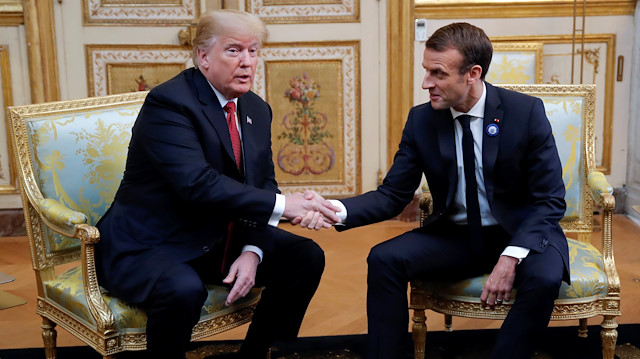
US President Donald Trump & French President Emmanuel Macron
U.S. President Donald Trump and French President Emmanuel Macron headed towards a potential clash in talks on Saturday after Trump took offense at what he called a "very insulting" comment from Macron about the need to create a European army.
Fresh off U.S. congressional elections that saw his Republican Party's power erode, Trump is in Paris this weekend to bolster the U.S.-European alliance at commemorations to mark the 100th anniversary of the end of World War One.
But in a tweet prior to landing in Paris, Trump took a dim view of comments Macron made in a Europe 1 radio interview this week.
Discussing the threat from cyber-hacking and meddling from outside in the electoral process, Macron said Europe needed to protect itself against China, Russia and even the United States.
Later in the interview he spoke about the need for a European army, saying:
“Faced by Russia, which is on our borders and which has shown that it can be threatening... we need to have a Europe that can better defend itself by itself, without depending solely on the United States," he said.
Trump, who has pushed NATO allies to pay more for their common defense and not rely so heavily on the United States, complained.
"Very insulting, but perhaps Europe should first pay its fair share of NATO, which the U.S. subsidizes greatly," Trump said on Twitter.
The president, joined by his wife Melania and high-ranking U.S. officials, arrived late on Friday aboard Air Force One for a visit that he called "very special" and one that he "looked forward to."
On Saturday morning, the U.S. president arrived at the Elysee Palace under rainy skies for talks with Macron. Macron welcomed him at the front steps, but their hand shake and greeting appeared less warm than it has been in the past.
The United States wants a "strong Europe" and is willing to help its ally, but Europe must be fair when it comes to sharing the defence burden, U.S. President Donald Trump said on Saturday."We want a strong Europe, it's very important to us and whichever way we can do it the best and more efficient would be something we both want," Trump said in remarks after being greeted by President Emmanuel Macron in Paris.Asked what he meant when he tweeted that he felt insulted by Macron's comments that Europe should reduce its dependence on the United States for security, Trump said: "We want to help Europe but it has to be fair. Right now the burden sharing has been largely on the United States."
Trump says wants 'strong Europe', but more defense cost-sharing
Solemn Commemoration
Trump's official mission on the trip is to participate in ceremonies marking the 100th anniversary of the end of World War One. He is scheduled to make pilgrimages to two American cemeteries, Belleau Wood east of Paris on Saturday and Suresnes on the western outskirts of the capital on Sunday, where he will make formal remarks.
His trip comes just days after congressional elections delivered results that will complicate his next two years. While Republicans slightly expanded their majority in the U.S. Senate, they lost control of the U.S. House of Representatives to Democrats who may use their newfound power to launch investigations into Trump and stymie his agenda.
Trump's talks with Macron at the Elysee are likely to cover European concerns about Trump's plans to withdraw the United States from the 1980s Intermediate-Range Nuclear Forces Agreement and U.S. renewal of sanctions against Iran.
Macron told Europe 1 radio that the "main victim" of the U.S. withdrawal from the INF accord was Europe and its security.
The French president, who tried but failed earlier this year to talk Trump out of withdrawing from the 2015 Iran nuclear deal, has also voiced worries about the impact of sanctions on European companies doing business with Iran.
Trump may also chat briefly with Russian President Vladimir Putin on Sunday when both are among some 70 world leaders gathered at the Arc de Triomphe to mark the end of the Great War 100 years ago. Trump and Putin are expected to have formal talks later this month when both attend a G-20 summit in Buenos Aires.
Trump, who has pursued "America First" policies since taking over the presidency in January 2017, declared himself a "nationalist" during the run-up to the congressional elections, a term likely to raise concerns in Europe.
"I’m not a globalist, but I want to take care of the globe, but first I have to take care of our country," he told Fox News Channel's "The Ingraham Angle" last week. "I want to help people around the world, but we have to take care of our country, or we won’t have a country."
On an official visit to France, Turkey’s president this weekend will attend events marking the 100th anniversary of the end of World War I.Recep Tayyip Erdoğan will pay an official visit to France on Nov. 10-11, the presidential press office said on Friday.Erdoğan’s visit comes at the invitation of French President Emmanuel Macron, said the statement.During his visit, Erdoğan will attend Armistice Day commemorations.Erdoğan marks 80th anniversary of Atatürk's demiseThe ceremonies -- to be hosted by Macron in Paris -- will also see the attendance of nearly 100 world leaders, including U.S. President Donald Trump and Russian President Vladimir Putin.Nov. 11 Armistice Day marks the 1918 end of World War between the Allies and their opponent, Germany, on land, sea, and air.Erdoğan is also expected to hold bilateral meetings, particularly with his counterparts Trump and Putin.France and Comoros agree to end migration row
Turkish President Erdoğan due in France for WWI tribute
British Prime Minister Theresa May steps up attempts to court European support for a draft Brexit deal on Thursday as negotiations on securing a smooth divorce from the world's biggest trading bloc enter their final stages.Less than five months before Britain is due to leave the EU on March 29, a deal is 95 percent done. But officials have repeatedly cautioned they are still haggling over the fate of the land border between British-ruled Northern Ireland and EU member Ireland.The EU wants to see a breakthrough within a week if leaders are to endorse any Brexit deal in November, official and diplomatic sources told Reuters. An EU summit tentatively scheduled for Nov. 17-18 is no longer on the cards.After May discussed Brexit with German Chancellor Angela Merkel and European Council President Donald Tusk earlier this week, British ministers were shown the text of a deal which is 95 percent agreed.EU asks level playing field of Britain in case of all-UK Irish backstopMay will meet other EU leaders on Thursday in France and Belgium at commemorations to mark the 100th anniversary of the end of World War One. She is scheduled to have lunch with French President Emmanuel Macron and dinner with other leaders of the NATO military alliance in Brussels.The deal - or the lack of one - will shape Britain’s prosperity for generations to come and have long-term consequences for the European Union's global clout.Both sides need an agreement to keep trade flowing between the world’s biggest trading bloc and the fifth largest global economy. The other 27 members of the EU combined have about five times the economic might of Britain.November Brexit summit requires deal breakthrough in days: EU sourcesDEAL OR NO DEAL?Ever since the shock 2016 Brexit referendum sent sterling to its biggest one-day fall in decades, the pound has been see-sawing on differing perceptions of whether a deal will be done.May told her cabinet on Tuesday that more time was needed to clear the final hurdle standing between her and a deal: the plan to ensure no hard border emerges on the island of Ireland.Some of her senior ministers, such as Brexiteer Michael Gove, want to see the verdict of British government lawyers on how a post-Brexit plan for Northern Ireland's border might work. A Northern Irish political party, the DUP, which props up her minority government, wants the advice to be published in full.Leaked British memo gives a taste of PM May's possible Brexit finaleThere is only a slim chance that an agreement between British and EU negotiators can be reached in time to hold a summit of leaders in November to sign off the agreement, according to one British official.May wants a deal - both on a withdrawal agreement and a framework for future ties - before year-end as she must get the deal approved by the British parliament. The EU holds a regular summit on Dec. 13-14."We are not there yet. The clock is ticking. The choices need to be made now on the UK side," EU negotiator Michel Barnier told reporters on Wednesday. "There are still important issues outstanding."If May fails to clinch a Brexit deal with the EU, or parliament votes down her deal, then Britain would face leaving without a divorce deal, and thus without a transition period.Many business chiefs and investors fear such a "no-deal" Brexit would weaken the West, panic financial markets and block the arteries of trade. 
UK PM May dives into flurry of diplomacy in bid to clinch Brexit deal
French President Emmanuel Macron said he still hopes to persuade Germany to back a European Union-wide digital turnover tax, despite Berlin's preference for a global minimum corporate tax to stop firms shopping around for tax havens."I hope that we can agree on the digital tax with the Germans by December," Macron told Germany's Zeit news weekly on the sidelines of a speaking engagement on Wednesday. "I'm not going to give up."An EU plan to tax big internet firms like Google and Facebook on their turnover is on the verge of collapsing after several members rejected it and announced national initiatives instead.Germany not hopeful of US policy change after midterms
Macron says still pushing for Germans to back digital tax