

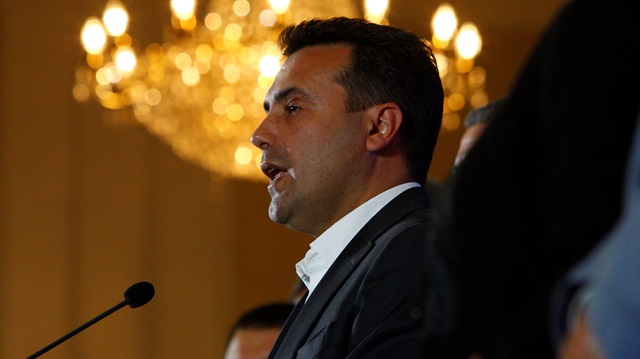
Macedonia's PM Zoran Zaev
Macedonia's hopes of joining the European Union and NATO were in limbo on Monday, a day after voters backed a plan to change the country's name by a large margin but failed to hit the 50 percent turnout required for the referendum result to be valid.
Prime Minister Zoran Zaev said he would press on regardless with a vote in parliament to endorse the change of name to the 'Republic of North Macedonia' but the defence minister said an early election might now prove necessary, potentially derailing the whole plan due to a tight timeframe.
Some 91 percent of voters backed the name change, demanded by neighbouring Greece as a precondition for it lifting its veto on Macedonia joining the EU and NATO. But turnout was just 36.9 percent, final figures showed, far below the required threshold.
The EU, echoing the pro-Western Zaev, hailed the referendum result as a ringing endorsement of Macedonia's plans to join the bloc and NATO. But Russia, which opposes NATO eastern expansion, said tersely it expected the law in Macedonia to be respected.
Zaev lacks the two thirds majority in parliament to push through the name change, and the main nationalist opposition VMRO-DPMNE has vowed to block the legislation. Many of its supporters did not vote in order to invalidate the result.
"In the coming week we will assess if we can secure the necessary majority for the constitutional changes, and if not we will call an early election," Defence Minister Radmila Sekerinska told Reuters.
"The downside is that the election would postpone adoption of the constitutional changes for 45 to 60 days," she said.
Macedonia is preparing to hold a historic referendum Sunday on the country’s "second independence.”It follows the signing of the Prespa Agreement in June by the Macedonian and Greek governments which requires Macedonia to change its name to the Republic of North Macedonia and Greece to drop its objection to Macedonia joining the North Atlantic Treaty Organization (NATO) and becoming a member of the European Union.Greece, both a NATO and EU member, has long opposed Macedonia’s official name, as it has a province named Macedonia in the country’s north.Due to Athens’ objection, the dispute has been one of the main obstacles to Macedonia’s ambitions to join NATO and the EU.Negotiations between Macedonia and Greece had recently picked up pace as the new government in Skopje sought progress in its bid to join the two organizations.The wording of the question being put to voters is telling: "Are you in favor of NATO and EU membership, and accepting the name agreement between the Republic of Macedonia and Greece?"The referendum on Sunday will be the third in the country’s history.The first referendum was held on Sept. 8, 1991, which gave independence to Macedonia from the Socialist Federal Republic of Yugoslavia. The question "Are you for a sovereign and independent state of Macedonia with a right to enter any alliance with sovereign states of Yugoslavia?" was approved by 96.4 percent of votes.The second referendum, held on Nov. 7, 2004, asked voters whether they approved of overturning municipal redistricting plans that had given greater autonomy to ethnic Albanians. The referendum, where only 26.58 percent of the public went to the polling stations, was considered invalid due to insufficient participation.Referendum campaignsThe campaigns before the historic referendum started on Sept. 10.Many political parties are participating in the Macedonian Alliance for European Integration led by the Social Democratic Union of Macedonia (SDSM) with a call to vote "yes" in order to get positive results from the referendum by benefitting from Macedonia's NATO and EU membership.Describing a successful referendum as a forward step towards the country's Euro-Atlantic integration, the alliance says it will have a positive impact on prosperity, a better future, security, investments and quality of life for citizens of Macedonia. Macedonian Prime Minister Zoran Zaev, in his speech during the referendum campaign, described the referendum as a vote for the country’s second independence, pointing out that research shows that the majority of citizens support NATO and EU membership. Another important part of the government's coalition, the Albanian party the Democratic Union for Integration (BDI), also supports the "yes" campaign. According to the BDI, the agreement between Macedonia and Greece is a prerequisite for Macedonia's strong progress, stable peaceful environment, economic development and strengthening of the identities of all ethnic communities in the country.Nationalists against name change On the other hand, the opposition Macedonian National Revolutionary Organization (VMRO-DPMNE), which advocates that the deal that resolved the name issue is harmful, is calling for citizens to make their own decisions and cast their votes accordingly in the referendum.Hristijan Mickovski, head of the VMRO-DPMNE, claimed that the question of the referendum did not involve changing the name of the state and thus it has many meanings and is manipulative.Apart from the parties calling on citizens to vote in the referendum, there are also non-governmental organizations that think the referendum should be boycotted. An association of NGOs which has come together under the motto "Macedonia is boycotting" argues that the referendum should be boycotted because NATO is not an institution in which Macedonia should be a member and the agreement reached with Greece is against national interests.Agreement 'harmful' On the other hand, Macedonian President Gjorge Ivanov, who suggested that the agreement is detrimental to Macedonia's national interests, had previously announced that he would not sign it after the agreement was adopted in parliament. In a letter to parliament, Ivanov stressed that the country's constitutional name is "Republic of Macedonia" and did not accept the idea of changing Macedonia's national identity.1.8 million registered votersAccording to the Macedonian State Election Commission, a little over 1.8 million voters have the right to vote in the referendum. In order for the referendum to be considered valid, more than half of this number, or some 903,000, should vote.On the other hand, even though the result of the Sept. 30 referendum will not be binding, the government said the will of citizens in this referendum will be considered as binding.Following the referendum, at least two-thirds or 81 of the 120 members of parliament in Macedonia should support it to ratify the constitutional amendments in the agreement between the two countries.After the completion of these processes in Macedonia, the agreement must be approved by the Greek parliament.Macedonia has not been able to become a member of the EU or NATO since its independence in 1991 due to the name problem that has been continuing with its southern neighbor Greece.Macedonia's international recognition was finalized in April 1993 when the country was unanimously adopted as a UN member at the United Nations General Assembly but was admitted as the Former Yugoslav Republic of Macedonia (FYROM) by an appeal from Greece.Despite the dispute between Athens and Skopje, many countries, including Turkey, recognize the country as Macedonia.Eyeing EU, NATO, Macedonians set for referendum on changing state's name
Macedonia prepares to hold historical referendum
"Political Crisis"
Political analysts said the outcome greatly complicated the tiny ex-Yugoslav republic's push to join Western structures.
"Instead of having a clearer picture the outcome of the referendum will only deepen the political crisis,' said Petar Arsovski a political analyst. "We are likely heading towards early elections and Macedonia does not have time for that."
Greece and the EU tried to put a brave face on the setback.
"We hope that Mr. Zaev's initiative for a constitutional reform will be successful," Greek government spokesman Dimitris Tzanakopoulos said on Monday.
"The Greek government will continue with sobriety and prudence ... to support the need for an implementation of the deal. This opportunity must not be wasted," he said.
Greece has insisted on the change because it views the name 'Macedonia' as implying a territorial claim on a northern Greek region of that name. Greece's parliament must also approve the June name deal and, like Zaev, leftist Greek Prime Minister Alexis Tsipras also faces opposition from his nationalist foes.
An early election could be called in Macedonia for the end of November at the earliest, pushing the constitutional changes into the spring.
"The biggest risk is that this drags on and the EU’s electoral calendar overtakes things," an EU official said, referring to next May's elections to the European Parliament.
EU foreign policy chief Federica Mogherini and EU Enlargement Commissioner Johannes Hahn said in a joint statement: "The (Macedonia) parliament will now be called upon to proceed with the next steps for implementation of the name agreement by deciding on adoption" of the legal changes.
A NATO diplomat was more circumspect, saying the alliance did not want to be drawn into Macedonian domestic politics.
"But we have made it very clear that should the country turn its back on this opportunity, we don’t expect it to arise again for a very long time," he said.
In Moscow, which regards NATO enlargement as a threat to its own security, Kremlin spokesman Dmitry Peskov said: "We are observing closely and of course think that all the processes should remain within the framework of the law.
Macedonian voters will vote on Sunday in a landmark deal with Greece to resolve a name dispute and bring the country deeper into the international fold.The question put to voters in the referendum says: "Are you in favor of NATO and EU membership, and accepting the name agreement between the Republic of Macedonia and Greece?" The vote follows the Macedonian and Greek governments reaching a deal in June requiring Macedonia to change its name to the Republic of North Macedonia and also Greece to drop its opposition to Macedonia's accession to both NATO and the European Union. Greece, a member of both for decades, has long opposed Macedonia's official name, as it has a province called Macedonia in the north of the country. Due to Athens' objections, the dispute was one of the main obstacles to Macedonia's ambitions to join NATO and the EU. Negotiations between Macedonia and Greece have recently picked up pace as a new government in Skopje sought progress in its bid to join the two organizations. Although the result of the Sept. 30 referendum will not be binding, the government said it will abide by the will of the citizens in this vote.-2 countries' parliaments must okayThis will be the third-ever referendum for Macedonia, one of the smallest countries in Europe, with a population of a little over 2 million. Just over 1.8 million voters have the right to vote on the measure, and more than half must vote for the referendum to be valid. Following the referendum, at least two-thirds or 81 of Macedonia’s 120 parliamentary deputies must support it to ratify the constitutional changes. After the completion of these processes in Macedonia, the agreement must also be approved by Greece’s parliament. The name issue has kept Macedonia from joining the EU and NATO since its independence in 1991. Macedonia's international recognition was finalized in April 1993, when the country was unanimously adopted as a member of the UN General Assembly, but was admitted as the Former Yugoslav Republic of Macedonia (FYROM) due to pressure by Greece. Despite the dispute between Athens and Skopje, many countries, including Turkey, recognize the country as Macedonia.
Macedonia voting on landmark name deal with Greece