

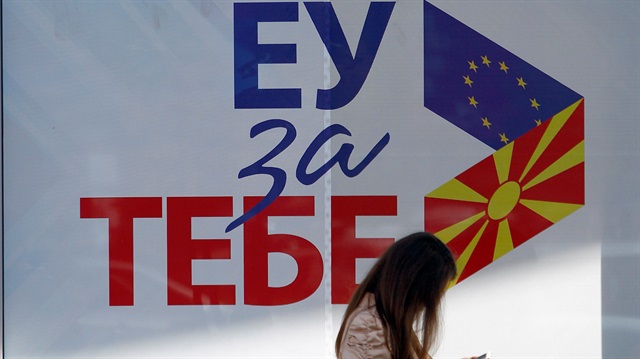
A woman passes next to posters reading "EU for you" for the referendum in Macedonia on changing the country's name that would open the way for it to join NATO and the European Union, in Skopje, Macedonia September 28, 2018.
Macedonia is preparing to hold a historic referendum Sunday on the country’s "second independence.”
It follows the signing of the Prespa Agreement in June by the Macedonian and Greek governments which requires Macedonia to change its name to the Republic of North Macedonia and Greece to drop its objection to Macedonia joining the North Atlantic Treaty Organization (NATO) and becoming a member of the European Union.
Greece, both a NATO and EU member, has long opposed Macedonia’s official name, as it has a province named Macedonia in the country’s north.
Due to Athens’ objection, the dispute has been one of the main obstacles to Macedonia’s ambitions to join NATO and the EU.
Negotiations between Macedonia and Greece had recently picked up pace as the new government in Skopje sought progress in its bid to join the two organizations.
The wording of the question being put to voters is telling: "Are you in favor of NATO and EU membership, and accepting the name agreement between the Republic of Macedonia and Greece?"
The referendum on Sunday will be the third in the country’s history.
The first referendum was held on Sept. 8, 1991, which gave independence to Macedonia from the Socialist Federal Republic of Yugoslavia. The question "Are you for a sovereign and independent state of Macedonia with a right to enter any alliance with sovereign states of Yugoslavia?" was approved by 96.4 percent of votes.
The second referendum, held on Nov. 7, 2004, asked voters whether they approved of overturning municipal redistricting plans that had given greater autonomy to ethnic Albanians. The referendum, where only 26.58 percent of the public went to the polling stations, was considered invalid due to insufficient participation.
Referendum campaigns
The campaigns before the historic referendum started on Sept. 10.
Many political parties are participating in the Macedonian Alliance for European Integration led by the Social Democratic Union of Macedonia (SDSM) with a call to vote "yes" in order to get positive results from the referendum by benefitting from Macedonia's NATO and EU membership.
Describing a successful referendum as a forward step towards the country's Euro-Atlantic integration, the alliance says it will have a positive impact on prosperity, a better future, security, investments and quality of life for citizens of Macedonia.
Macedonian Prime Minister Zoran Zaev, in his speech during the referendum campaign, described the referendum as a vote for the country’s second independence, pointing out that research shows that the majority of citizens support NATO and EU membership.
Another important part of the government's coalition, the Albanian party the Democratic Union for Integration (BDI), also supports the "yes" campaign.
According to the BDI, the agreement between Macedonia and Greece is a prerequisite for Macedonia's strong progress, stable peaceful environment, economic development and strengthening of the identities of all ethnic communities in the country.
Nationalists against name change
On the other hand, the opposition Macedonian National Revolutionary Organization (VMRO-DPMNE), which advocates that the deal that resolved the name issue is harmful, is calling for citizens to make their own decisions and cast their votes accordingly in the referendum.
Hristijan Mickovski, head of the VMRO-DPMNE, claimed that the question of the referendum did not involve changing the name of the state and thus it has many meanings and is manipulative.
Apart from the parties calling on citizens to vote in the referendum, there are also non-governmental organizations that think the referendum should be boycotted.
An association of NGOs which has come together under the motto "Macedonia is boycotting" argues that the referendum should be boycotted because NATO is not an institution in which Macedonia should be a member and the agreement reached with Greece is against national interests.
Agreement 'harmful'
On the other hand, Macedonian President Gjorge Ivanov, who suggested that the agreement is detrimental to Macedonia's national interests, had previously announced that he would not sign it after the agreement was adopted in parliament.
In a letter to parliament, Ivanov stressed that the country's constitutional name is "Republic of Macedonia" and did not accept the idea of changing Macedonia's national identity.
1.8 million registered voters
According to the Macedonian State Election Commission, a little over 1.8 million voters have the right to vote in the referendum. In order for the referendum to be considered valid, more than half of this number, or some 903,000, should vote.
On the other hand, even though the result of the Sept. 30 referendum will not be binding, the government said the will of citizens in this referendum will be considered as binding.
Following the referendum, at least two-thirds or 81 of the 120 members of parliament in Macedonia should support it to ratify the constitutional amendments in the agreement between the two countries.
After the completion of these processes in Macedonia, the agreement must be approved by the Greek parliament.
Macedonia has not been able to become a member of the EU or NATO since its independence in 1991 due to the name problem that has been continuing with its southern neighbor Greece.
Macedonia's international recognition was finalized in April 1993 when the country was unanimously adopted as a UN member at the United Nations General Assembly but was admitted as the Former Yugoslav Republic of Macedonia (FYROM) by an appeal from Greece.
Despite the dispute between Athens and Skopje, many countries, including Turkey, recognize the country as Macedonia.
Fed up with Macedonia's economic woes, Solomon Bicakcic will vote "yes" in a referendum on Sunday on whether to change the country's name to qualify for European Union membership and - many hope - usher in prosperity."Something has to change, we cannot continue like this," Bicakcic, a 52-year-old pensioner, told Reuters.Macedonia's bids for EU and NATO membership were blocked by Greece until June when it struck a deal with Athens on the name of the ex-Yugoslav republic to end a 27-year-long dispute.Greece maintained that Macedonia's name implied territorial claims to its northern province of the same name.Skopje must now formally adopt the name of Republic of North Macedonia, replacing Former Yugoslav Republic of Macedonia, to emerge from decades of stagnation and instability.To secure popular support for the required constitutional amendments, Prime Minister Zoran Zaev's government called a referendum with one question - are you for or against EU and NATO membership through implementation of the name deal."NATO membership would bring stability and security, which is very important for investment," Zaev told Reuters after a referendum "yes" rally in the southern town of Demir Kapija.He said he expected parliament to adopt the constitutional changes, enabling the small landlocked Balkan republic to join NATO next spring, once Greece's parliament ratifies the pact.A recent poll by Macedonia's Telma TV found 57 percent of respondents planning to vote on Sunday. Of those, 70 percent said they would vote yes.But whether turnout does exceed the minimum 50 percent for the referendum to be valid is uncertain given a boycott campaign backed by nationalists opposed to the name change, including a group linked to Russia's ruling party."Russia is openly saying it is against Macedonian membership in NATO and the EU, and we understand the position of Russia, but all our friends should know there is no alternative for us," Zaev, a Social Democrat, said.Macedonia's economy stalled last year on the back of a two-year financial crisis with unemployment exceeding 20 percent, one of the highest rates in the Balkans, and an average monthly net salary of 350 euros ($411), the lowest in the region."This isn’t living, this is surviving," Bicakcic said.Western diplomats regard integration of the Western Balkan countries into NATO and the EU as the best way to stabilise and develop a region still suffering instability lingering from the 1990s wars triggered by Yugoslavia's break-up.Boycott CampaignAlthough a vast majority of Macedonians support NATO and EU membership, many may be reluctant to vote on Sunday because of objections - common among nationalists and conservatives - to changing the country's name.The boycott campaign has made effective use of social media - Facebook and Twitter - and spread "fake news", critics say.The Transatlantic Commission on Election Integrity said on Wednesday it had uncovered evidence that automated Twitter accounts had swung "behind an effort to suppress voter turnout"."New accounts (created less than 60 days ago) make up 10 percent of the conversation – a figure higher than in the recent Mexican and almost three times higher than in the Italian elections," it said in an emailed statement to Reuters.One of the main pro-boycott opposition parties is United Macedonia, which has ties with the United Russia party of Russian President Vladimir Putin."It is interesting how much all fake news pages reflect stances similar to Russia Today and other Russian (media) outlets," said Florian Bieber of Austria's Graz University.U.S. Defence Secretary James Mattis has accused Russia of meddling in the referendum by trying to suppress turnout.Last week Russian Foreign Minister Sergei Lavrov denied that Moscow had done anything "which could be interpreted as favouring a particular vote ... We do not say anything."Macedonia's main opposition, nationalist VMRO-DPMNE party strongly opposed the name change deal. It has not taken a position on the referendum, instead urging faithful to vote or boycott it according to their conscience.Even if a referendum "yes" emerges, that may not settle the matter - ratification by Greece is no sure thing given divisions in the ruling-left right coalition. A right-wing party in the bloc vows to vote "no" when the matter comes before parliament early next year, defying Prime Minister Alexis Tsipras. ($1 = 0.8515 euros) 
Eyeing EU, NATO, Macedonians set for referendum on changing state's name