

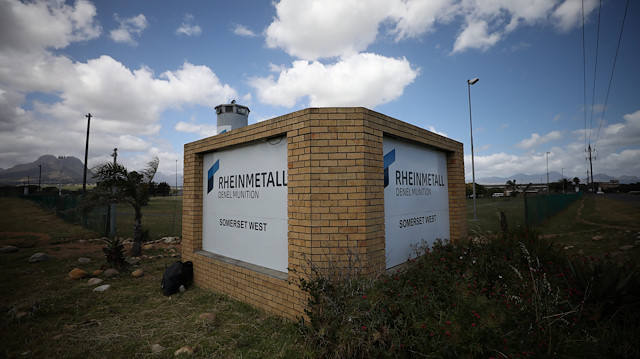
A corporate logo is seen outside the Rheinmetall Denel munitons plant near Cape Town, South Africa.
Loss-making South African arms maker Denel has a problem as it fights to survive. Its potential saviour is Saudi Arabia, now drawing fierce criticism following the killing of journalist Jamal Khashoggi.
But after being mismanaged for years and tainted by a far-reaching influence-peddling scandal, state-owned Denel now needs the kind of help that the deep-pocketed Saudis can provide.
Reuters analysed five years of South African arms export data, spoke to former and current Denel employees and obtained internal Denel presentations on plans to rescue the company.
What emerged is that Saudi Arabia and its allies account for almost half of South Africa's recent arms exports and a significant portion of future orders.
So rejecting Riyadh's $1 billion offer could severely hamper efforts to save Denel, which relies on foreign sales for more than 60 percent of its revenue.
Saudi Arabia is seeking a broad partnership with Denel that would include acquisition of the company's minority stake in a joint venture with Germany's Rheinmetall.
Global health authorities need to counter a worrying lull in the fight against malaria by focusing their efforts on the near-dozen mostly African countries where it claims most lives, the World Health Organization said.After several years of steady declines, annual cases of the mosquito-borne disease are levelling off, the U.N. health agency's 2018 malaria report showed on Monday.To get back on track, the current broad approach to combating it must be fine-tuned, said WHO malaria chief Pedro Alonso. "The problem is that we have stalled progress," he told Reuters in a telephone interview.Scientists are working on potential malaria vaccines and on new ways to control mosquito populations, but with the WHO report showing around half of Africans at risk still not sleeping under insecticide-treated nets in 2017, the world cannot simply afford to wait for those to materalise."So we need to do better at having a greater impact with the tools and resources we have," Alonso said.The report showed around 435,000 deaths and 219 million malaria cases in 2017, both little changed from 2016. Global case numbers fell steadily from 239 million in 2010 to 214 million in 2015, and deaths from 607,000 to around 500,000 from 2010 to 2013.The WHO's new "precision public health" approach is to focus in on the areas where malaria is hitting hardest, Alonso said.In 2017, the report found, around 70 percent of all cases and deaths were concentrated in 10 African countries - including Cameroon, Nigeria and Democratic Republic of Congo - plus India.The plan involves making better use of detailed data to target areas where bednets or more widespread use of indoor spraying would have a greater impact. Protection for pregnant women and children from malaria also remained too low, the report found."We recognise we have to do something different – now," WHO's Director-General Tedros Adhanom Ghebreyesus said.The report found some pockets of progress: India recorded a 24 percent reduction in malaria cases in 2017 and Rwanda 436,000 fewer. Ethiopia and Pakistan also both reported marked decreases.'I earn around a million euros', German conservative Merz tells BildMerkel protege eyes female quota for lawmakers, takes aim at dual citizenship
Faltering malaria fight should refocus on high-risk countries, says WHO
The Saudis - on a drive to build a domestic arms industry as traditional suppliers worry about its human rights record - are keen to close the deal by the end of next month. A source with knowledge of its offer said the kingdom could take its business elsewhere if that does not happen.
Some Denel employees are also keen on a tie-up, seeing it as the only way to rescue the firm, which is struggling to pay salaries. But some South African officials are concerned about doing business with Saudi Arabia.
"Denel depends on the deal. The entire industry depends on the deal," said Helmoed Heitman, a defence analyst. "I think it's 50/50. The pragmatists want to go in, but the Khashoggi thing is bad PR."
With President Cyril Ramaphosa and the ruling African National Congress facing an election next year, the deal promises to become a political issue.
South Africa's main opposition party, the Democratic Alliance, says the Saudi offer should be rejected.
"Putting our state defence firm at the disposal of a murderous despot would make the whole nation complicit in the human rights atrocities of the regime of Saudi Crown Prince Mohammed bin Salman," said DA lawmaker Stevens Mokgalapa.
"That there are negotiations to consider this at all is an indictment of the approach of the Ramaphosa government to international human rights violations."
Saudi Arabia denies that the crown prince ordered Khashoggi's killing.
Cambodian Prime Minister Hun Sen said on Monday there would never be a foreign military base in his country, following a news report that China was lobbying for a naval base in southwest Koh Kong province.The Asia Times, citing unidentified diplomatic sources and analysts, reported on Thursday that Beijing had been lobbying Cambodia since 2017 for the naval base, which could host frigates, destroyers and other vessels of the People's Liberation Army Navy."Does Cambodia need to violate its Constitution to allow a foreign military base on Cambodian territory?" Information Minister Khieu Kanharith quoted Hun Sen as saying on Facebook during a Cabinet meeting on Monday."With whom does Cambodia need foreign troops to fight with?," Hun Sen said, according to Khieu Kanharith. "And I do not need foreigners to fight in Cambodian territory like in the past, nor does Cambodia allow her to be a place for ideology or weapon experiment," he said.The possible naval base is thought to be part of a project by China's Tianjin Union Development Group (UDG), which began work in 2008 on 45,000 hectares of land in a national park for 99 years.There has been little information about the $3.8 billion project or its progress.UDG was also to spend $45 million on the port, which The Asia Times report described as a naval base.Cambodia-based Sawac Consultants for Development, commissioned by Cambodia's environment ministry, said the port would be able to handle up to four 20,000-tonne container ships.The port was guarded by Cambodian military and appeared unfinished when Reuters visited in June.China, Hun Sen's strongest regional ally, has poured billions of dollars in development assistance and loans into Cambodia through bilateral frameworks and China's Belt and Road initiative.The initiative, unveiled by Chinese President Xi Jinping in 2013, aims to bolster a sprawling network of land and sea links with Southeast Asia, Central Asia, the Middle East, Europe and Africa.It has attracted a flood of Chinese commercial ventures in Cambodia, including casinos and special economic zones. 
Cambodian PM says won't allow any foreign military base in his country
Apartheid Industry
Denel owes its existence to South Africa's own dark past.
Its direct forebear, Armscor, was forced to produce nearly all of its own defence and security hardware in response to sanctions on the apartheid government.
It's that expertise that is now so attractive to Saudi Arabia as it seeks to build its own industry, Andreas Schwer, head of the Saudi state defence company, SAMI, told Reuters.
"South Africa is very integrated in their capabilities because they had to become quite independent," he said last month. "We believe South Africa can offer us more than just products. They can help us on this journey."
Denel - formed in 1992 - only started to turn a regular profit from 2011 after being restructured several times. But its financial position remained weak as it used profits from some divisions to subsidise others.
In 2016 senior management became embroiled in a corruption scandal involving friends of former president Jacob Zuma, the Gupta brothers. In response, banks pulled lending. The company recorded a 1.7 billion rand ($122 million) loss - its first in eight years - in the financial year that ended in March.
Denel's new management is working on a turnaround plan to secure new funding and exit some loss-making business units, like satellite development and its Pretoria Metal Pressings foundry, a presentation seen by Reuters showed.
It also wants to cut its salary bill by 20 percent and achieve cost savings of between 157 million and 608 million rand in each of the next five years, the presentation showed.
But it missed out on additional state funds in last month's budget, and labour unions reject wage cuts. A cash crunch has become so dire that the company cannot provide toilet paper to some employees, and production lines sometimes stand idle as payments to suppliers fall behind.
Members of the National Union of Metalworkers of South Africa, which represents a quarter of Denel's 4,000-strong workforce, marched to the public enterprises ministry this month to demand a 7 billion rand ($500 million) bailout.
Insiders say even that would be little more than a stopgap.
"The machine has stopped," a former Denel executive told Reuters. "I can't see how Denel can pull itself up by its bootstraps without an equity partner."
The World Bank will work with Tanzania to redesign a $300 million education project, a senior official said on Sunday, days after the lender said it cancelled plans for the project due to the country's controversial policies on pregnant school girls.The World Bank told Reuters on Wednesday that it had not presented the education programme to its board for financing approval last month in part due to Tanzanian President John Magufuli's stance on pregnant girls in schools.Tanzania has banned pregnant girls from attending state primary and secondary schools since 1961. Magufuli affirmed his commitment to this policy last year, saying school girls who become pregnant must be expelled and not allowed to return.However, World Bank Vice President for Africa Hafez Ghanem told reporters on Sunday the lender had agreed with authorities to find ways for pregnant girls who are forced to leave school to still access education.Ghanem said, following a meeting between the World Bank, Magufuli and other officials in Tanzania, the local government had committed to finding ways for the girls to return to school."That is what has changed," he said, when asked why the World Bank had reversed its decision to withdraw the project from board consideration.However, he said the project would still be subject to board approval before the funds could be disbursed.Leonard Akwilapo, Tanzania's Permanent Secretary at the Ministry of Education, told Reuters on Sunday that he could not comment on the World Bank's latest comments until he received an official statement.However, he said Tanzania's policy was to ensure all school dropouts, including pregnant school girls, continued their education through different options such as the adult education system.On Friday, the Tanzanian government said the World Bank had agreed to provide the $300 million loan to implement the project. The project includes the construction of class rooms, hostels, laboratories, staff houses and teaching facilities.Tanzanian female teenagers are on average three times more likely than their peers globally to get pregnant, according to government data, a statistic researchers attribute largely to low access to contraception. In a September speech, Magufuli told Tanzanian women to not use birth control because the country needs more people and described women who limited the number of children they have as "lazy".The World Bank's decision to re-engage the government on the education project comes amid increasing criticism from foreign donors over the Magufuli government's restrictions on the media and political parties and threats against LGBTI people.Denmark on Wednesday was the first foreign donor to freeze funding to Tanzania over concerns about policies that threaten gay people and women.The European Union also last week launched a comprehensive review of its policies toward the East African nation over concerns about rights abuses.Magufuli -- a populist leader nicknamed "the bulldozer" -- has railed against foreign investors and promised to end corruption.Ghanem also said the government told him they are open to discussing how a new statistics law will be implemented. The lender last month criticised the legislation, which will punish anyone who questions official statistics, saying the law will undermine the production of useful, high-quality data."We agreed that we will work together to avoid having in place a system that stops us and others from having access to credible, neutral and transparent data," he said. "If we don’t get reliable and credible statistics, we will be unable to do our job ... we made this clear to the government." African Union reforms on agenda of leaders' meetingAfrica's first 'Silicon Valley' to be built in Rwanda'Al-Shabaab continues to pose threat to Somalia'Invasive trees targeted by new South Africa anti-drought fundSouth African parliament team calls for law change over land reform
World Bank re-engages Tanzania on scrapped education plan
'Our Common Religion'
Ramaphosa appeared open to bringing in a partner to bolster Denel when he acknowledged the Saudi bid earlier this month.
Foreign Minister Lindiwe Sisulu said any deliberations over a potential deal would be based on South Africa's values.
"Our common religion is human rights. We have suffered too long to ever veer away from that religious belief," she told journalists last month.
But Khashoggi's death has created a dilemma.
Asked about the killing, Ramaphosa told reporters: "We are hoping that they will deal with the matter speedily so that the truth will come out."
The United States has announced sanctions against those believed to have been directly involved. Germany is halting arms exports to Saudi Arabia until it explains the killing.
It's the kind of backlash that Riyadh - under fire since 2015 over its war against in Yemen - has long feared and it explains why the government is building its own arms industry. It's also why it has turned to South Africa.
"South Africa's export policy was always stable and robust ... and we need very reliable partners on the political side, on the export policy side. Partners who do not change their minds," SAMI CEO Schwer said before Khashoggi's murder.
In 2013, South African sales to coalition allies Saudi Arabia and the United Arab Emirates made up around 9 percent of total arms exports, a Reuters analysis of data shows.
Since the Yemen war began, South Africa has sold the two countries military hardware - armoured vehicles, sniper rifles, bombs, mortars and surveillance equipment - worth 4.6 billion rand, or 44 percent of total arms exports.
But what might have appeared a natural arrangement to save Denel now appears fraught.
Despite apparent government enthusiasm to do business with Saudi Arabia and Denel's pressing need for financial rescue, not everyone is open to the kingdom's overtures.
Responding to Reuters publication of details of the Saudi bid, Denel chairperson Monhla Hlahla rejected out of hand a sell-off of Denel's stake in Rheinmetall Denel Munition.
"The board of Denel is selling neither Denel, or RDM. I want to be clear about that," she told a local television network.
News of the Saudi overtures has also provoked an outcry on South African social media, but a senior ANC source said the government would not be rushed into a decision.
"It's a strategic asset, so I would be wary about dealing with any foreign country, be that the Saudis or anyone else," the source said.
But despite Ramaphosa's assertion that Saudi Arabia was only one of several suitors, no others have come forward publicly.
"A billion dollars over two or three years would turn around Denel," said Heitman, the defence analyst. "The longer we wait, the less Denel is worth. People will leave and that's where the value lies."
The language used by international media outlets on Palestine should be reworked and revamped to better help the Palestinian cause, said experts at a conference on Palestine on Saturday.The consensus came in a panel called “Developing the Global Media Discourse on Palestine” during the two-day Palestine Addressing the World Conference held in the Turkish city of Istanbul. Professor Azzam al-Tamimi, a Palestinian writer and researcher, said: “The genuine truth should be highlighted while addressing the Palestinian cause by attributing the reasons for the conflict to its origins, which is the Zionist movement and its atrocities committed on Palestinian Land.” He added that pro-Palestine discourse “should not highlight the importance of creating a mere Palestinian political entity or even a Palestinian state but the origin of the problem resulting in the ethnic Zionist regime.” He said this rhetoric should be used to found “an international movement against the Zionist movement the same as the movement against the Apartheid regime originated in South Africa.” For his part, Metin Mutanoglu, deputy director general of the Turkish Anadolu Agency, said that the Palestinian cause has a large presence in Turkish media outlets and newspapers. “As Turkish people, we felt that the Israeli shells were hitting our homes when they were fired against the Palestinian people in Gaza,” he said. He added: “Everything that happens in Palestine has immediate effects here in Turkey, since people see the Palestinian cause as their own.”'Successful people with rich culture'But as for the international community’s reaction to Palestinian suffering, he said: “The Palestinian people have been suffering for more than six decades, but the international community doesn’t care, as they prefer to look after their own interests at the expense of giving a helping hand to the Palestinian people.” To improve the international rhetoric on the Palestinian cause, he urged: “We should not only write stories on the Palestinians as oppressed and victimized people, but we have to reflect the Palestinian cause with a people who have a rich culture and rooted history,”Farid Abu Dheir, professor of media at the West Bank’s Al-Najah University, argued that the biggest problem Palestinians face is that “our enemy is investing in media projects with a view to creating an international media network that backs their narrative.”“We have been suffering from their hegemony over the media for decades, but nowadays we are living in the age of social media, and still we have yet to defeat the Israeli narrative,” he lamented.He agreed with Mutanoglu that covering the Palestinian cause “should not only focus on the Palestinians as an oppressed people but also as a successful and hopeful people.”Indonesian journalist Nour Hassan, deputy chief editor of the Republika daily, said every Israeli attack on Palestine makes headlines in the Indonesian media. “Due to the pro-Palestine news stories Indonesian media outlets have, we see thousands of people taking part in pro-Palestine protests and demonstrations in Jakarta,” he added.He said hundreds of languages are spoken in Indonesia, with people having at least 130 million accounts on Facebook which “should make us put more priority on digital media and the news circulated on social media platforms.” A major conference opened in Istanbul on Saturday with a view to raising global awareness of the Palestinian cause. Organized by the Beirut-based Palestine International Forum for Media and Communication, the conference brings together hundreds of journalists, academics, and writers from some 60 countries around the world.
International community doesn't care about Palestinian cause, say experts
African leaders met on Saturday to decide on institutional reforms for the African Union Commission, calling these reforms imperative for Africa to be able to speak with one voice on the international stage. Institutional flexibility and independence, financial independence, and restructuring the functions of the African Union Commission as well as a division of labor among African Union and Regional Economic Communities (RECs) are among the key reforms being discussed in Addis Ababa, Ethiopia’s capital.Speaking at the summit's opening, AU Commission Chairperson Moussa Faki Mahamat said that over the next two days, the leaders will consider numerous options and decide the future direction of reforms. The aim of these reforms is to achieve greater flexibility to respond to the continent’s demands, Faki said, adding that advances have already been made in terms of increasing financial contributions from member states in the form of membership contributions as well as setting aside 0.2 percent import levies to the Union. Rwandan President Paul Kagami – the mastermind of the reform document – said in his opening speech: “We are very much on course and the end is in sight.” Close to $55 million has been collected so far in the form of the import levies from member states since 2016, according to Pierre Moukoko, head of the commission's Reform Implementation Unit. According to projections, to minimize financial dependence on donors, the commission hopes to collect an additional $40 million by 2020. In his maiden speech to an African Union Summit since coming to power this April, the reformist Ethiopian Prime Minister Abiy Ahmed told the leaders: “Reforms also require accountability.” In a competitive and interdependent world mired with conflict, Abiy said Africans cannot stand alone, and the reforms would bring the continent towards achieving the principles and spirit of pan-Africanism. Over the course of two days, the leaders are expected to come up with tangible decisions and directions to implement the reform agenda, including instituting a sanction regime against member states that fail to make annual financial contributions. Gender and youth participation in the affairs of the union is another of the reform components.Africa's first 'Silicon Valley' to be built in Rwanda'Al-Shabaab continues to pose threat to Somalia'Invasive trees targeted by new South Africa anti-drought fundSouth African parliament team calls for law change over land reform
African Union reforms on agenda of leaders' meeting