

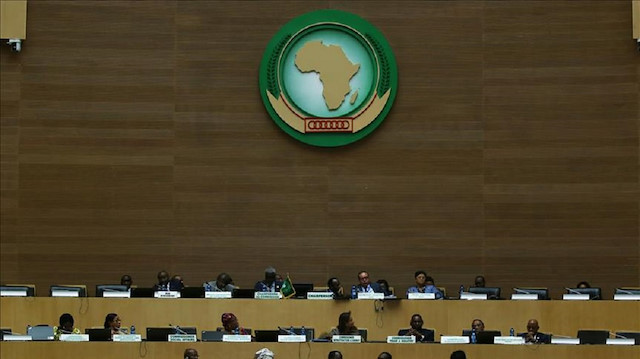
African leaders met on Saturday to decide on institutional reforms for the African Union Commission, calling these reforms imperative for Africa to be able to speak with one voice on the international stage.
African leaders met on Saturday to decide on institutional reforms for the African Union Commission, calling these reforms imperative for Africa to be able to speak with one voice on the international stage.
Institutional flexibility and independence, financial independence, and restructuring the functions of the African Union Commission as well as a division of labor among African Union and Regional Economic Communities (RECs) are among the key reforms being discussed in Addis Ababa, Ethiopia’s capital.
Speaking at the summit's opening, AU Commission Chairperson Moussa Faki Mahamat said that over the next two days, the leaders will consider numerous options and decide the future direction of reforms.
The aim of these reforms is to achieve greater flexibility to respond to the continent’s demands, Faki said, adding that advances have already been made in terms of increasing financial contributions from member states in the form of membership contributions as well as setting aside 0.2 percent import levies to the Union.
Rwandan President Paul Kagami – the mastermind of the reform document – said in his opening speech: “We are very much on course and the end is in sight.”
Close to $55 million has been collected so far in the form of the import levies from member states since 2016, according to Pierre Moukoko, head of the commission's Reform Implementation Unit.
According to projections, to minimize financial dependence on donors, the commission hopes to collect an additional $40 million by 2020.
In his maiden speech to an African Union Summit since coming to power this April, the reformist Ethiopian Prime Minister Abiy Ahmed told the leaders: “Reforms also require accountability.”
In a competitive and interdependent world mired with conflict, Abiy said Africans cannot stand alone, and the reforms would bring the continent towards achieving the principles and spirit of pan-Africanism.
Over the course of two days, the leaders are expected to come up with tangible decisions and directions to implement the reform agenda, including instituting a sanction regime against member states that fail to make annual financial contributions.
Gender and youth participation in the affairs of the union is another of the reform components.
A multi-billion dollar project for the production and development of technology inspired by the U.S.'s Silicon Valley will be built in Rwanda's capital, Kigali.The project will be co-financed by the Rwandan government and Africa50, an infrastructure investment platform founded by the African Development Bank (AfDB) and African states.It will be constructed under the name Kigali Innovation City (KIC), which will presumably create over 50,000 job opportunities annually.The $2 billion project is to be built on an area of 70 hectares, and will consist of world-class universities, technology companies, biotech firms, and commercial centers.Rwandan Prime Minister Edouard Ngirente said at the Africa Investment Forum: “This is an innovative effort, the first of its kind on the continent. It will have Pan-African development impact both in terms of economy and human capital.”“Kigali Innovation City forms part of the Government of Rwanda’s Vision 2020 development program and National Strategy for Transformation 2017-2024.It is one of the projects that aims at establishing Rwanda as a globally competitive knowledge-based economy,” Ngirente added.Rwanda is not the first African country attempting to build a Silicon Valley in the continent. Kenya in 2008 and Ghana in 2013 planned such projects but failed to materialize them.The East African nation recently launched Africa’s first electronic cross-border trade platform with the help of Alibaba Group’s Electronic World Trade Platform (eWTP) to engage small businesses across the continent.
Africa's first 'Silicon Valley' to be built in Rwanda
The special envoy of the Inter-governmental Authority on Development (IGAD), an 8-nation Horn of Africa bloc, has warned that Al-Shabaab continues to pose a threat to peace in Somalia.“This is the first time in 30 years that Somalia has been registering progress in institutional building,” Mohamed Ali Guyo told an IGAD foreign ministers meeting on Friday.However, he said, lack of security and peace was a growing challenge.“Al Shabaab continues to be threat to Somalia and the region.”Last week, triple explosions by Al-Shabaab rocked Somalian capital Mogadishu killing more than 50 civilians and wounding others.He called for enhanced efforts by the international community to fight Al-Shabaab, which continues to launch deadly attacks across Somalia -- a country gearing up for elections in 2020-2021.The ministers also heard progress report on South Sudan in their deliberations that came ahead of an expected IGAD meeting of leaders on Sunday.
'Al-Shabaab continues to pose threat to Somalia'
Big business is backing a South African fund to eradicate invasive trees around Cape Town and yield billions of litres of water as the city emerges from its worst drought in a century, officials said on Friday.Alien species, such as eucalyptus trees which are largely native to Australia, are thirstier than indigenous vegetation and draw more groundwater through their roots. Preliminary studies estimate 1.8 billion litres of water is lost each year due to alien plants on one aquifer north of Cape Town."In order to secure our long-term water supplies, we need to pursue a range of cost effective strategies. One of those is to clear vegetation in our catchments that reduce the runoff into our dams," Ian Neilson, Cape Town's deputy mayor, said in a statement.An initial 53 million rand ($3.7 million) has been committed to the new Greater Cape Town Water Fund, which has been pioneered by global conservation organisation Nature Conservancy.The group said plans by the city for desalination, recycling waste water and tapping groundwater supplies would cost on average 10 times more to supply each litre of water than clearing invasive eucalyptus, pine and acacia trees.The Nature Conservancy added that 372 million rand could fund a 30-year programme to clear invasive trees and prevent them from returning to seven sub-catchments supplying around three-quarters of Cape Town's water needs."In its first six years, a programme of clearing invasive plants could yield 56 billion litres of new supplies," it said in a statement. ($1 = 14.2250 rand)
Invasive trees targeted by new South Africa anti-drought fund
A South African parliamentary team has recommended a constitutional amendment to make it possible for the state to expropriate land without compensation in the public interest.The Constitutional Review Committee said amending section 25 would make it explicitly clear that such expropriation could be carried out to accelerate land reform."South Africans have spoken, loud and clear, and we listened to their cry," Lewis Nzimande, co-chairman of the review team, said in a statement on Thursday."This has truly been a massive project. We have seen people queuing for long periods, just to make sure they have a say on the matter."The review team's recommendation will now go to the national assembly. It is not clear when a vote will take place.More than two decades after apartheid’s demise, most private land remains in the hands of the country's white minority, making it a vivid symbol of wider disparities.Parliament set the ball rolling in February to hasten the transfer to black ownership by backing a motion calling for the constitution to allow land expropriation without compensation, and set up the review team to canvass public opinion.The committee carried out public hearings, received written submissions and heard presentations in parliament on the proposed review of the constitution.President Cyril Ramaphosa’s ruling African National Congress has made the acceleration of land redistribution a key issue ahead of 2019 elections, unnerving investors despite pledges to do so in a way that does not threaten food security or growth.AgriSA, an association of agricultural associations, criticised the committee's recommendation, saying the amendment of section 25 would be diametrically opposed to the protection of property rights and would gravely harm the economy.Dan Kriek, Agri SA president, said his organisation would challenge the recommendation, which it termed "reckless and populist", through its legal team."The proposed amendment is politically motivated and will cause large-scale damage to the South African economy," he said.Speaking in Strasbourg on Wednesday, Ramaphosa told the European Parliament that South Africa would enact land reforms in line with its constitution and with respect for the human rights of all its people. 
South African parliament team calls for law change over land reform