

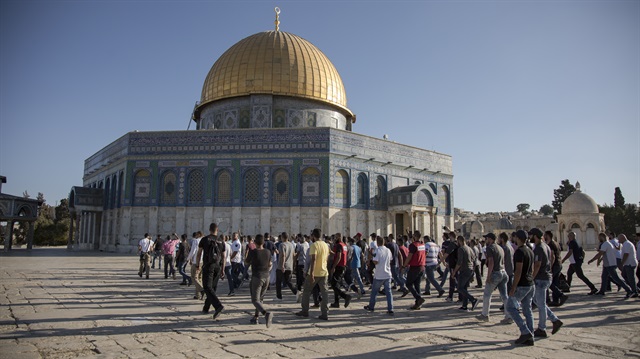
Al-Aqsa Mosque
Israeli police on Sunday detained five Palestinians near East Jerusalem’s flashpoint Al-Aqsa Mosque compound, according to a local resident.
“The five were detained as they attempted to stop two Israeli settlers from vandalizing Bab al-Rahma cemetery, a major Islamic graveyard in the area,” Khaled Abu Tayha told Anadolu Agency.
There was no Israeli or Palestinian comment on the report.
Notably, the Bab Al-Rahma is an ancient Muslim cemetery that has been an endowment property for more than 1,400 years.
The Israeli Antiquities Authority has been preventing locals of Silwan neighborhood in East Jerusalem from burying their dead in recent years in an effort to convert parts of the cemetery into biblical gardens.
Talks have been reportedly underway for a five-year gradual truce between Palestinian resistance group Hamas and Israel, a Lebanese newspaper reported Saturday.Al Akhbar daily, citing sources close to Hamas, said the talks were being conducted through a third party.According to the newspaper, the first phase of the proposed truce will be applied in one week by halting the launch of incendiary balloons from the Gaza Strip into Israel, in return for Israel reopening the Kerem Shalom crossing, Gaza’s sole commercial access point.Top Hamas leader returns to GazaThe balloons are being fired by Palestinian activists as part of ongoing anti-occupation rallies being held along Gaza border.The second phase of the plan, according to the sources, includes the total lifting of the 11-year Israeli blockade on Gaza and improving living standards.The third phase of the plan includes implementing UN pledges on carrying out a host of humanitarian projects as building a seaport in Egypt’s canal city of Ismailiyah, a power station in Sinai and the rebuilding of the Gaza Strip, the sources said.US seeks ‘clarification’ of controversial Israel lawAccording to the Lebanese newspaper, Hamas has initially agreed to an Egyptian and international roadmap for de-escalation in Gaza. However, a final decision will be taken by the resistance group after a meeting of Hamas political bureau.A prisoners swap between Israel and Hamas is also expected to be discussed in light of the truce talks, the sources said.On Thursday, Hamas deputy leader Saleh al-Arouri returned to Gaza after eight years of exile.Israeli PM cancels trip abroad amid talk of Gaza truceArouri’s return to Gaza has been interpreted in Israeli and Palestinian media as "relevant to negotiations through third parties for a long-term agreement between Hamas and Israel".Since 2007, the Gaza Strip has groaned under a crippling Israeli blockade that continues to deprive its inhabitants of many essential commodities, including food, fuel, medicine and building materials.
Talks underway for Hamas-Israel truce
Following the recent escalation between Turkey and the U.S., the influence of evangelical groups have on U.S. foreign policy during Donald Trump's term have been brought to the fore, yet again.Tensions between Ankara and Washington were triggered by arrest of American evangelist pastor Andrew Craig Brunson. Evangelists, who are considered among the significant political figures in the U.S., have become the most debated group after the U.S. decided to relocate its embassy in Tel Aviv to Jerusalem and a Turkey-U.S. crisis that occurred following the trial of Andrew Brunson, who faces terrorism charges in Turkey.While President Trump was voted in office by a deeply religious Christian group, the influence Vice President Mike Pence, who is an evangelist, has in the White House and, the approaching midterm elections are the leading subjects pondered by evangelists and their influence in the U.S.- What is Evangelism?Evangelism, which means "teaching and spreading the Bible" in Christianity, is regarded as one of the most common sects among Christians in the U.S. While the evangelists compose 25 percent of population, they are also known as Christian Zionists.White evangelists traditionally support the Republican Party for being “more religious". The greatest support they have provided in recent elections was to Trump.Evangelical support during the 2004 presidential elections was 78 percent in favor of George Bush while 74 percent voted for John McCain in 2008. Mitt Romney was received 78 percent in the 2012 elections. On the other hand, Donald Trump had received 81 percent from evangelicals in the 2016 elections.In the U.S. where Republican candidates are viewed as more religious in comparison with Democrats, it was quite remarkable that evangelicals provided the greatest support to Donald Trump, who was speculated not to know "a single verse of the Bible".- Ethical debate over evangelical support for TrumpThat the unconventional Republican candidate Donald Trump was backed by Christians -- "who live by directly following the Bible" -- despite the claims accusing him of immorality, lying and bribing led to the ethical discussion among evangelical.Priest Jim Wallis, an evangelical leader in the U.S, in one of his critical commentaries said: "Supporting Trump is a moral struggle for Christians. I didn't back him up so that he would commit immorality."On the other hand, some evangelical priests claim that "the president was forgiven." Jerry Falwell in a statement to CNN called on Christians to "forgive the president", saying that the claims against him were based on events of years ago.Priest Tony Perkins, speaking to Politico magazine, said: "The President should be given a second chance because he led the agenda of Evangelists."- Approach on Israel and JerusalemOn the other side, it is evaluated that evangelicals played a huge role in the U.S. recognition of Jerusalem as the capital of Israel.Yariv Levin, the Israeli Minister of Tourism, in a statement in April said tourism in Israel broke records. He said Israel was visited by 3.6 million people in 2017. According to the information by the U.S. press, nearly 800,000 Americans visited Israel in 2017 and most of the visitors were evangelicals.- Theological basis of evangelicalsEvangelicals believe that Israel, in 1948, was established "in accordance with the teachings of Bible" and "Jesus Christ would again come back to life in these lands" then "the end of the world" would appear this way.Based on these theological reasons, evangelicals are regarded as the most significant political elements of the "sharp" policy the Trump administration has followed on Jerusalem and Israel topics.Evangelist Priest Robert Jeffress, who performed prayers during the ceremony after the U.S. moved its embassy to Jerusalem, told CNN that "throughout the history, Jerusalem has been a target for Jews and Christians."Donald Trump promised during his election campaign that the U.S. would recognize Jerusalem "as the capital of Israel" once he was elected. After the support Trump obtained from evangelicals, he fulfilled his promise.Speaking to Vox news portal, Elizabeth Oldmixon, a professor at North Texas University, said "Trump's decision to relocate the U.S. embassy was not political, but related to Evangelists' religious reasons.""In the belief of the Christian Zionists [Evangelicals], it is believed that God gave the sacred lands to Jews, forever," she said. - Influence of Mike PenceThat evangelicals have such direct influence over the Trump administration is also directly related to Vice President Mike Pence.Having identified himself as an "Evangelist Catholic" during his time as Governor of Indiana, Pence recently called himself as a "Christian, Conservative and Republican", appealing to wider portion of the population.The American public defines Pence as a man who is "religious", "conservative", "hateful towards homosexuals". He is regarded as one of the "most opposing figures against abortion in the U.S." and a person "who doesn't enjoy being alone with women apart from his wife".Undoubtedly, Pence's position in the office as vice president pleased the religious communities in the U.S., particularly evangelists. In fact, Richard Land, one of Trump's advisors, who also serves as the principal of the Southern Evangelist Priest School, addressed Pence as "24-carat gold who contains what they [evangelists] want to see in a politician."Therefore, having influence over the White House and Trump through Pence, evangelicals are "pressuring" to have a result on the Brunson issue.- Upcoming midterm Congress electionsHowever, the evangelical nature of Pence is not the sole reason for the "crooked" scene that appeared following the Brunson issue. With midterm elections in November approaching, the Brunson topic serves as a significant "domestic policy dynamic".Given that Trump has passed 1.5 years in the office, the Republicans have to be successful in November elections so that Trump could continue his policies smoothly and gain an advantage in the 2020 presidential elections.In this crucial period, Trump and Pence do not want to seem unsuccessful in the eyes of religious voters who turned the Brunson issue into "a matter of pride", and pay the price in the congress elections.In addition, U.S. media outlets' coverage of the story suggests another perspective on the issue. It is claimed that "Trump and Pence will save Brunson, who has become a symbol for evangelists, from prison and create a perception of success before the voters and gain points by bringing him to the U.S."*Ali Murat Alhas and S. Ahmet Aytac contributed to this story from Ankara
Who are the evangelicals?
Teenage Palestinian resistance icon Ahed al-Tamimi, who on Sunday was released after an eight-month stint in Israeli custody, now hopes to return to her normal life. The 17-year-old has some very bad memories of the Israeli forces who killed, arrested and injured several of her family members in recent years.In an exclusive interview with Anadolu Agency, Ahed said: “I will continue resisting the Israeli occupation and am ready to face them again if they enter our home.”She added: “It is the destiny of the Palestinian people to resist the occupation.”291 Palestinian children being held in Israeli prisonsAs for her ambitions in the upcoming period, she said she hopes to study international law with a view to “defending Palestinian children and the cause of our people”.While in Israeli custody, Ahed managed to obtain a high school diploma.Ahed was detained by Israeli forces last December after she was filmed slapping an Israeli soldier during a raid on her home.In March, an Israeli court slapped her with an eight-month prison term for “attacking” Israeli security personnel.Galeri: Water shortage in GazaBorn on Jan. 31, 2001 in the village of Nabi Saleh near the West Bank city of Ramallah, al-Tamimi hails from a family known for defying Israel’s decades-long occupation. Several of her family members, including her parents and brothers, have been repeatedly arrested by the Israeli authorities.Palestinian prisoner enters 67th day on hunger strikeIn 2012, her uncle, Rushdie al-Tamimi, was shot dead by Israeli troops in Nabi Saleh. In 1993, her aunt, Bassima al-Tamimi, was beaten to death by an Israeli policeman while attending her son’s trial.Since her early childhood, Ahed attended weekly anti-occupation rallies in her village.During these rallies, her parents recalled, she would yell and shout insults at Israeli troops.Her mother, Nariman, who was also recently detained for eight months, told Anadolu Agency: “I had a difficult time while in detention. I was subjected to harsh interrogations and held in solitary confinement for 15 days, while receiving news of the arrest of my son, Waed, and the martyrdom of my cousin, Ezzedine.”Israeli PM warns Iran against blocking Bab al-Mandab“If we stay in our homes, we may die by fire, like the Dawabshah family,” Nariman added. “If my child goes to the mosque, he could be burnt alive like Mohamed Abu Khudair.”“We have no choice but to resist the occupation,” she said. “My daughter Ahed has become a model for all the sons of Nabi Saleh.”“I am the sister of a martyr and two of my uncles were martyred by the Israeli occupation,” she went on. “My eldest brother was injured by Israeli forces in Lebanon and my father spent many years in Israeli prisons.”She urged the international media to report on the many other detainees currently languishing in Israeli prisons, especially children.“The Israeli authorities have threatened my home with demolition, while homes for Jewish settlers -- who came to our country only a few years ago -- are being built all around us,” Nariman lamented.“From a very young age, my daughter has faced the Israeli occupation,” the mother recalled. “She took part in the marches and stood up to the Israeli army to defend her family and people.”'Double standards of the Israeli judicial system'Sitting next to his wife, Bassem al-Tamimi, Ahed’s father, told Anadolu Agency: “I hope my daughter has a peaceful future and beautiful life far from the harassment of the Israeli occupation.”“The occupation comes to our homes to assault us. We don’t go to them. That’s why resistance is an obligation,” he added.Between 1988 and 2013, Bassem was jailed by the Israeli authorities nine separate times, during which he was subjected to various kinds of torture.“Our family has suffered deeply as a result of the occupation,” he said. “My sister was martyred in 1993 and my cousin and son -- along with several close friends -- were all shot dead by Israeli troops.”Addressing the occupation, Bassem asserted: “You must get out of our lives. And the international community must not remain silent. It is time to end the Israeli occupation of Palestine.”
Palestine’s Al-Tamimi family: A history of defiance