

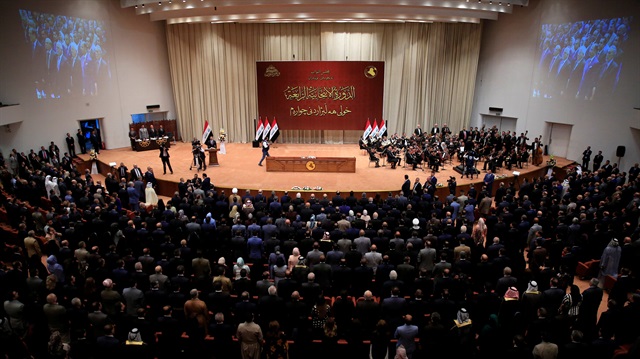
Iraqi lawmakers are seen during the first session of the new Iraqi parliament in Baghdad, Iraq September 3
Iraq’s newly-elected parliament on Tuesday postponed the election of a new assembly speaker to mid-September after a number of lawmakers decided to boycott the vote.
Attended by only 85 of 329 MPs, Tuesday’s session had been convened to choose a new speaker -- along with two deputies -- after the initial vote was postponed a day earlier.
A Monday session -- parliament’s first of the season -- saw fierce disagreements between rival coalitions (Al-Bina and Reform Construction), both of which claimed to have attained a majority bloc in the assembly.
Under Iraq’s constitution, the majority bloc in parliament has the right to draw up the country’s next government.
Among the most prominent nominees for the post of speaker is Osama al-Nujaifi, a prominent Sunni politician.
According to results of Iraq’s May 12 parliamentary poll, Muqtada al-Sadr's Sairoon Coalition won 54 seats, followed by a Hashd al-Shaabi-led coalition (47 seats) and Prime Minister Haider al-Abadi's Victory Bloc (42 seats).
Within 30 days of holding its first session, parliament will elect -- by a two-thirds majority -- the country’s next president.
The president will then task the majority bloc in parliament with drawing up a new government, which must be referred back to the assembly for approval.
The newly-seated Iraqi Parliament convened on Monday for the first time since the May 12 parliamentary elections.Iraqi President Fuad Masum is scheduled to address lawmakers during the session, which will also see speeches by Prime Minister Haidar al-Abadi and former speaker of parliament Salim al-Jabouri.The session will also include the swearing-in of deputies and election of a new assembly speaker and his two deputies.At least 165 MPs are required to form a coalition in the 329-seat parliament to be able to form the country's next government.Early Monday, Vice-President Nouri al-Maliki, leader of State of Law coalition, claimed the formation of a major coalition in parliament named (construction) with 145 MPs.Late Sunday, 16 Iraqi political groups said they formed the largest parliamentary group with 177 lawmakers.Among the group are Shia cleric Muqteda al-Sadr’s Sairoon, al-Abadi’s al-Nasr coalition, al-Hikma, al-Wataniya, al-Qarar, as well as Iraqi Turkmen Front (ITF) and Kirkuk Arab MPs, according to a statement issued by the pertinent parties after a meeting in Baghdad.The new bloc includes religious and ethnic groups, such as Shia and Sunni Arabs and Turkmen, as well as Ezidi and Christian minorities.On Aug. 27, the Iraqi president issued a decree to convene the first session of the newly-elected parliament.The formation of a new government in Iraq has been delayed since May, when the results of the parliamentary elections were fiercely disputed, leading to a manual recount of votes.
New Iraqi parliament convenes for 1st time since polls
Israel's defence minister signalled on Monday it could attack suspected Iranian military assets in Iraq, as it has done by carrying out scores of air strikes in civil war-torn Syria."We are certainly monitoring everything that is happening in Syria, and regarding Iranian threats we are not limiting ourselves just to Syrian territory. This also needs to be clear," Avigdor Lieberman told a conference in Jerusalem.Asked if this included Iraq, where sources told Reuters that Iran has given ballistic missiles to Shi’ite proxies, Lieberman responded: "I am saying that we will contend with any Iranian threat, and it doesn't matter from where it comes ... Israel's freedom is total. We retain this freedom of action." 
Israel signals it could target Iranian military assets in Iraq
Iraqi Vice President Nouri al-Maliki announced on Sunday that he does not plan to run for the post of prime minister.Al-Maliki, who leads the State of Law coalition, was elected a prime minister in 2006 and served for another term between 2010 and 2014.“When I announced years ago that I will not run for prime minister I was serious based on a vision that I am still committed to… and now I confirm my decision for the same reasons and vision,” al-Maliki said in a statement.Iraq says its territory won’t be used to attack othersThe former premier said he would support the upcoming prime minister to carry out reforms and accomplish his national tasks.The remarks came a day before the new parliament convenes for its first session.Last month, Iraq's electoral commission announced that a manual recount of the May 12 parliamentary elections were more or less the same as the initial electronic vote count.Iraqi protesters rally for jobs in BasraThe vote results were approved by the Iraqi Federal Court.According to the results, Shia cleric Muqtada al-Sadr's Sairoon Coalition won 54 parliamentary seats, followed by a Hashd al-Shaabi-led coalition (47 seats) and Prime Minister Haider al-Abadi's Victory Bloc (42 seats).Within 30 days of the first parliament session, the assembly will elect -- by a two-thirds majority -- the country’s next president.The president will then task the largest bloc in parliament with drawing up a government, which must be referred back to parliament for approval.Iraq’s Sadr rejects returning to 'quota' system
Former PM al-Maliki says won’t run for Iraq premiership
The Iraqi government on Sunday reiterated rejection of using Iraqi territory to launch attacks against any other countries.“All Iraqi state institutions are obligated and committed to Article 7 of the Constitution, which bans the use of Iraqi territory as a base or passage for any operations that target the security of any other country,” foreign ministry spokesman Ahmed Hahjoub said in a statement.Media reports earlier said that Iran had provided Iran-affiliated Shia militia in Iraq with ballistic missiles.According to the reports, Iraqi Shia groups would target other countries in case of any attacks on Iran, without naming any specific state.The reports came amid rising tensions between Iran and the U.S. since Washington withdrew from a 2015 nuclear deal in May.Washington also re-imposed sanctions on Iran, which primarily target the country’s banking sector.“Iraq is not obliged to respond to press reports that do not have a solid evidence for their claims and allegations,” Mahjoub said.Iran and the U.S. are major allies to the Iraqi government.
Iraq says its territory won’t be used to attack others
Angry protesters blocked a main highway in Iraq’s southern Basra province on Sunday as part of pressure on the government to create jobs and resolve civic problems, according to a local police officer.“Dozens of protesters gathered at the main entrance of Nahr Bin Omar oilfield,” Police Lieutenant Jamil al-Khafaji told Anadolu Agency.No clashes were reported between demonstrators and security forces.For his part, Tareq al-Ali, one of the protesters, said demonstrators came to submit their demands to the administration of the oilfield as they seek employment.Meanwhile, scores of demonstrators blocked the main road in Garmat Ali in northern Basra, with police attempting to disperse them and reopen the road, a police source told Anadolu Agency.Roughly 80 percent of Iraq’s overall crude oil exports originate from oilfields in Basra province.For years, Basra residents have complained that foreign nationals, rather than locals, were being employed by the domestic energy sector.They also complain of frequent power outages amid summer temperatures that often reach as high as 50 degrees Celsius.Since July 9, the province, as well as other southern and central Shia-majority provinces, have witnessed ongoing popular protests which have spread to capital Baghdad.Demonstrators demand improved public services like water and electricity, more job opportunities and an end to perceived government corruption.
Iraqi protesters rally for jobs in Basra