

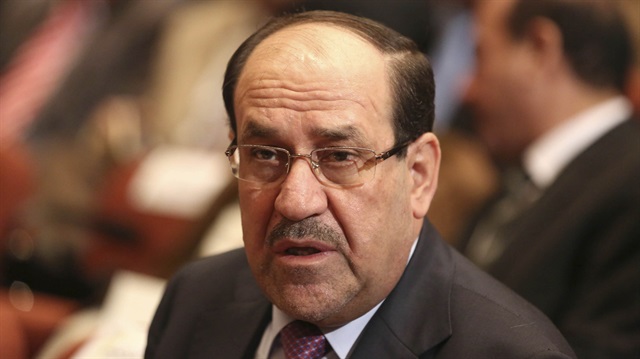
Iraq's Vice President Nouri al-Maliki
Iraqi Vice President Nouri al-Maliki announced on Sunday that he does not plan to run for the post of prime minister.
Al-Maliki, who leads the State of Law coalition, was elected a prime minister in 2006 and served for another term between 2010 and 2014.
“When I announced years ago that I will not run for prime minister I was serious based on a vision that I am still committed to… and now I confirm my decision for the same reasons and vision,” al-Maliki said in a statement.
The Iraqi government on Sunday reiterated rejection of using Iraqi territory to launch attacks against any other countries.“All Iraqi state institutions are obligated and committed to Article 7 of the Constitution, which bans the use of Iraqi territory as a base or passage for any operations that target the security of any other country,” foreign ministry spokesman Ahmed Hahjoub said in a statement.Media reports earlier said that Iran had provided Iran-affiliated Shia militia in Iraq with ballistic missiles.According to the reports, Iraqi Shia groups would target other countries in case of any attacks on Iran, without naming any specific state.The reports came amid rising tensions between Iran and the U.S. since Washington withdrew from a 2015 nuclear deal in May.Washington also re-imposed sanctions on Iran, which primarily target the country’s banking sector.“Iraq is not obliged to respond to press reports that do not have a solid evidence for their claims and allegations,” Mahjoub said.Iran and the U.S. are major allies to the Iraqi government.
Iraq says its territory won’t be used to attack others
The former premier said he would support the upcoming prime minister to carry out reforms and accomplish his national tasks.
The remarks came a day before the new parliament convenes for its first session.
Last month, Iraq's electoral commission announced that a manual recount of the May 12 parliamentary elections were more or less the same as the initial electronic vote count.
Angry protesters blocked a main highway in Iraq’s southern Basra province on Sunday as part of pressure on the government to create jobs and resolve civic problems, according to a local police officer.“Dozens of protesters gathered at the main entrance of Nahr Bin Omar oilfield,” Police Lieutenant Jamil al-Khafaji told Anadolu Agency.No clashes were reported between demonstrators and security forces.For his part, Tareq al-Ali, one of the protesters, said demonstrators came to submit their demands to the administration of the oilfield as they seek employment.Meanwhile, scores of demonstrators blocked the main road in Garmat Ali in northern Basra, with police attempting to disperse them and reopen the road, a police source told Anadolu Agency.Roughly 80 percent of Iraq’s overall crude oil exports originate from oilfields in Basra province.For years, Basra residents have complained that foreign nationals, rather than locals, were being employed by the domestic energy sector.They also complain of frequent power outages amid summer temperatures that often reach as high as 50 degrees Celsius.Since July 9, the province, as well as other southern and central Shia-majority provinces, have witnessed ongoing popular protests which have spread to capital Baghdad.Demonstrators demand improved public services like water and electricity, more job opportunities and an end to perceived government corruption.
Iraqi protesters rally for jobs in Basra
The vote results were approved by the Iraqi Federal Court.
According to the results, Shia cleric Muqtada al-Sadr's Sairoon Coalition won 54 parliamentary seats, followed by a Hashd al-Shaabi-led coalition (47 seats) and Prime Minister Haider al-Abadi's Victory Bloc (42 seats).
Within 30 days of the first parliament session, the assembly will elect -- by a two-thirds majority -- the country’s next president.
The president will then task the largest bloc in parliament with drawing up a government, which must be referred back to parliament for approval.
Prominent Iraqi Shia cleric and politician Muqtada al-Sadr on Saturday announced his refusal to establish the government in Iraq based on “quota” system.In a post on its official Twitter account, al-Sadr said: "We will not go back to the beginning. We will never return to the sects, corruption, quota system and ethnicity."We will definitely not join them if they return to old system and we will oppose them in parliament," he added.Many Iraqi political forces, including Al-Wataniya, blame the country’s political “quota” system -- which is ostensibly aimed at ensuring fair representation -- for the violence and corruption with which Iraq has been plagued since the U.S.-led invasion in 2003.The quota system was initially set up by Paul Bremer, who was appointed head of the Coalition Provisional Authority (Iraq’s post-invasion U.S.-led interim government) in 2004.Under Bremer’s quota system, the post of president is reserved for a Kurd; that of prime minister for a Shia Muslim; and that of Parliament Speaker for a Sunni Muslim.Once Iraq’s Federal Court approves the results of a recently-conducted manual recount of May 12 parliamentary poll results, incoming MPs will hold a first session to elect a new assembly speaker.Within 30 days of that first session, the assembly will elect -- by a two-thirds majority -- the country’s next president.
Iraq’s Sadr rejects returning to 'quota' system