

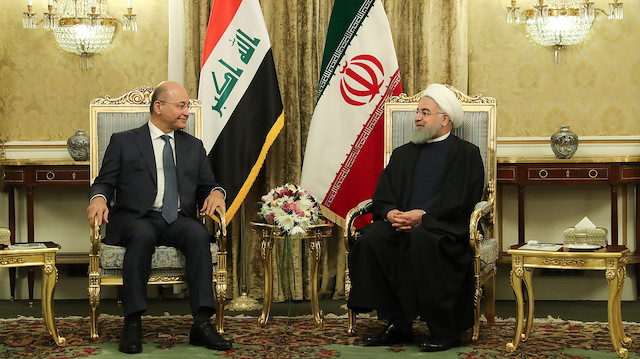
Iran's President Hassan Rouhani meets with Iraq's President Barham Salih in Tehran, Iran.
Iraq and Iran are seeking to bolster the volume of their trade exchange, Iraqi President Barham Salih said Saturday.
“We have close relations with Iran and we are keen on developing them,” Salih told a press conference following his talks with Iranian President Hassan Rouhani in the capital Tehran.
“It’s time to establish a regional system that serves peoples of the region,” he said.
“We want Iraq to be an area for conciliation between the region’s countries, not an area for conflict,” he said, in reference to the current tension between the U.S. and Iran.
Salih’s visit to Iran is the first by the Iraqi president since he assumed office last month.
Rouhani, for his part, said his talks with the Iraqi leader tackled energy cooperation between the two countries.
“We also discussed the extension of a rail line between the Iranian city of Shalamjah and Basra in southern Iraq,” he said.
“We seek to increase the volume of the trade exchange with Iraq to $20 billion annually,” Rouhani said.
The remarks by the Iraqi and Iranian leaders come against recent sanctions imposed by the U.S. against Iran.
The U.S. has issued Iraq a 45-day waiver from U.S. sanctions on Iran for natural gas and electricity imports, the U.S. Embassy in Baghdad announced last week.
Iraq, which is struggling with electricity outages and insufficient power generation, is reliant on its neighbor for natural gas imports for its power stations.
The second wave of renewed U.S. sanctions on OPEC's third largest exporter officially started Nov. 5, targeting Iran's energy, shipbuilding, shipping and financial sectors.
The Donald Trump administration also granted China, Greece, India, Turkey, Italy, Japan, South Korea and Taiwan a 180-day waiver for Iranian oil imports.
Iraq has restarted exports of Kirkuk oil, halted a year ago due to a standoff between the central government and Kurdistan's semi-autonomous region, industry sources said on Friday after a new government in Baghdad agreed a tentative deal with Erbil.The development is a win for the U.S. government, which has been urging both sides to settle the dispute and resume flows to help address a shortage of Iranian crude in the region after Washington imposed new sanctions on Tehran.Flows resumed on Friday at a modest level of around 50,000-60,000 barrels per day (bpd) versus a peak of 300,000 seen occasionally last year and it was not clear when and by how much they would rise, sources said.The Iraqi Oil Ministry did not immediately respond to a request for comment.YPG is 'Syrian offshoot' of PKK terror group: US envoyThe deal signals new Iraqi Prime Minister Adel Abdul-Mahdi and Oil Minister Thamir Ghadhban are ready to work with Erbil despite previous tensions and a failed independence referendum in September 2017.The halting of exports from Kirkuk in October 2017 stopped nearly 300,000 bpd flowing out of Iraq towards Turkey and international markets - causing a net revenue loss of some $8 billion over the past year.Most of Iraq's exports come from southern fields, but Kirkuk is one of the biggest and oldest oilfields in the Middle East, estimated to contain 9 billion barrels of recoverable oil.Exports have been on hold because Iraqi government forces took control of Kirkuk from Kurdish authorities. The Kurds had controlled Kirkuk and its oilfields after Daesh militants drove the Iraqi army out in 2014, and Kurdish forces in turn ejected the militants.Iraqi president arrives in Jordan for official visitThe pipeline Baghdad once used for export via Turkey was wrecked by Daesh - leaving only one working pipeline, built and controlled by the Kurds.Talks about a flow resumption were also complicated by the fact that the pipeline is controlled by Russian oil major Rosneft, which collects transit fees for exports.Kurdistan is producing and exporting some 400,000 bpd via the pipeline. Kirkuk's flow resumption will boost the volume to 450,000-500,000 bpd, short of the 700,000 bpd Kurdistan was exporting in some periods of last year.Iraqi authorities say they still need to feed local refineries where Kirkuk's output has been diverted over the past year. The refineries are still set to receive some 185,000 bpd under the latest arrangements, according to sources.Baghdad and Erbil have yet to find a compromise over maximum flow levels as well as budget transfers from the central government to Erbil - something the two sides have struggled to agree on for many years. US comes to Talabani’s rescue as Barzani attempts coup after KRG referendum
Iraq restarts some Kirkuk oil flows after year-long halt
The PYD/YPG is the Syrian branch of the PKK terror group, the American Special Representative for Syria James Jeffrey said Thursday.He spoke at a panel at the Defense One Summit, which brings top military, foreign policy and intelligence leaders to Washington to discuss American security throughout the world.Jeffrey said U.S. operations in Syria could not be done without the "active participation, coordination, and cooperation of Turkey."The U.S. is not able to function in the northeastern region of Syria while fighting Daesh forces at the same time, and to do both a local partner is needed, according to Jeffrey."That local partner since 2014 has been the PYD, which is the Syrian offshoot of PKK, but we have not designated it as a terrorist organization which we did with the PKK,” said Jeffrey, referring to the political wing of the YPG.Video: 'YPG is Syrian offshoot of PKK terror group'In its more than 30-year terror campaign against Turkey, the PKK -- listed as a terrorist organization by Turkey, the U.S. and the EU -- has been responsible for the deaths of 40,000 people.Turkey has repeatedly told Washington that the PYD/YPG is not any different from the PKK and partnering with one terrorist organization to defeat another would not yield any result.He said that the U.S. is still in the northeast region of Syria to defeat Daesh terrorists, remove Iranians out of the area and ensure the political process in the country.Turkey agrees with all three points but the U.S. added "some conditions" and did not do a proper job of explaining them to Ankara, he said without mentioning what those conditions were.Jeffrey said without Turkey’s help, the U.S. mission in Syria would be over.Turkey neutralizes four PKK terrorists in northern IraqN. Syrian tribes hail Turkey’s anti-YPG/PKK effortsPKK bans hijab in occupied areas of NW Syria
YPG is 'Syrian offshoot' of PKK terror group: US envoy
Iraqi President Barham Salih arrived in Jordan on Thursday for his first official visit to the Hashemite Kingdom since taking office last month.In a statement, Jordan’s Royal Court said that King Abdullah II had received the visiting Iraqi president, but refrained from providing any additional details.Salih’s reception in the Jordanian capital was reportedly attended by a host of top Jordanian government officials.The Iraqi president is being accompanied on his visit by a high-level delegation including several Iraqi government ministers.
Iraqi president arrives in Jordan for official visit
Turkish counterterrorism operation neutralized four PKK terrorists in northern Iraq, the Defense Ministry said on Wednesday.Turkish authorities often use the word "neutralize" in their statements to imply the terrorists in question either surrendered or were killed or captured.In a statement, the ministry said the Turkish Armed Forces carried out an air operation in northern Iraq’s Metina region.Turkish jets also targeted shelters, weapon positions and arms depots.The terrorists were preparing for attacks on Turkish military bases, it added.In its more than 30-year terror campaign against Turkey, the PKK -- listed as a terrorist organization by Turkey, the U.S. and the EU -- has been responsible for the deaths of some 40,000 people, including women and children.More than 1,200 people, including security force personnel and civilians, have lost their lives since the PKK resumed its decades-old acts of terror in July 2015.
Turkey neutralizes four PKK terrorists in northern Iraq